HFT Infrastructure
High-Frequency Trading Infrastructure: How Much Does It Cost to Compete with Banks and Hedge Funds
A complete guide to HFT infrastructure costs and technical requirements: colocation, FPGA, network cards, market data feeds, microwave links. Comparison table for different trader types.
There is a question that everyone seriously involved in algorithmic trading asks once they reach a certain level: “I wrote a strategy. It works in backtesting. What now?”
And this is where real trading begins. Not the kind from books about candlestick patterns, and not the kind advertised in trading courses. The kind where the difference between profit and loss is measured in microseconds, and the entry ticket costs hundreds of thousands of dollars.
I won’t promise that after reading this you’ll start making money. Quite the opposite — you’ll understand why most people will never profit from HFT. And why that’s perfectly normal.
Latency Is Not an Abstraction. It’s Money
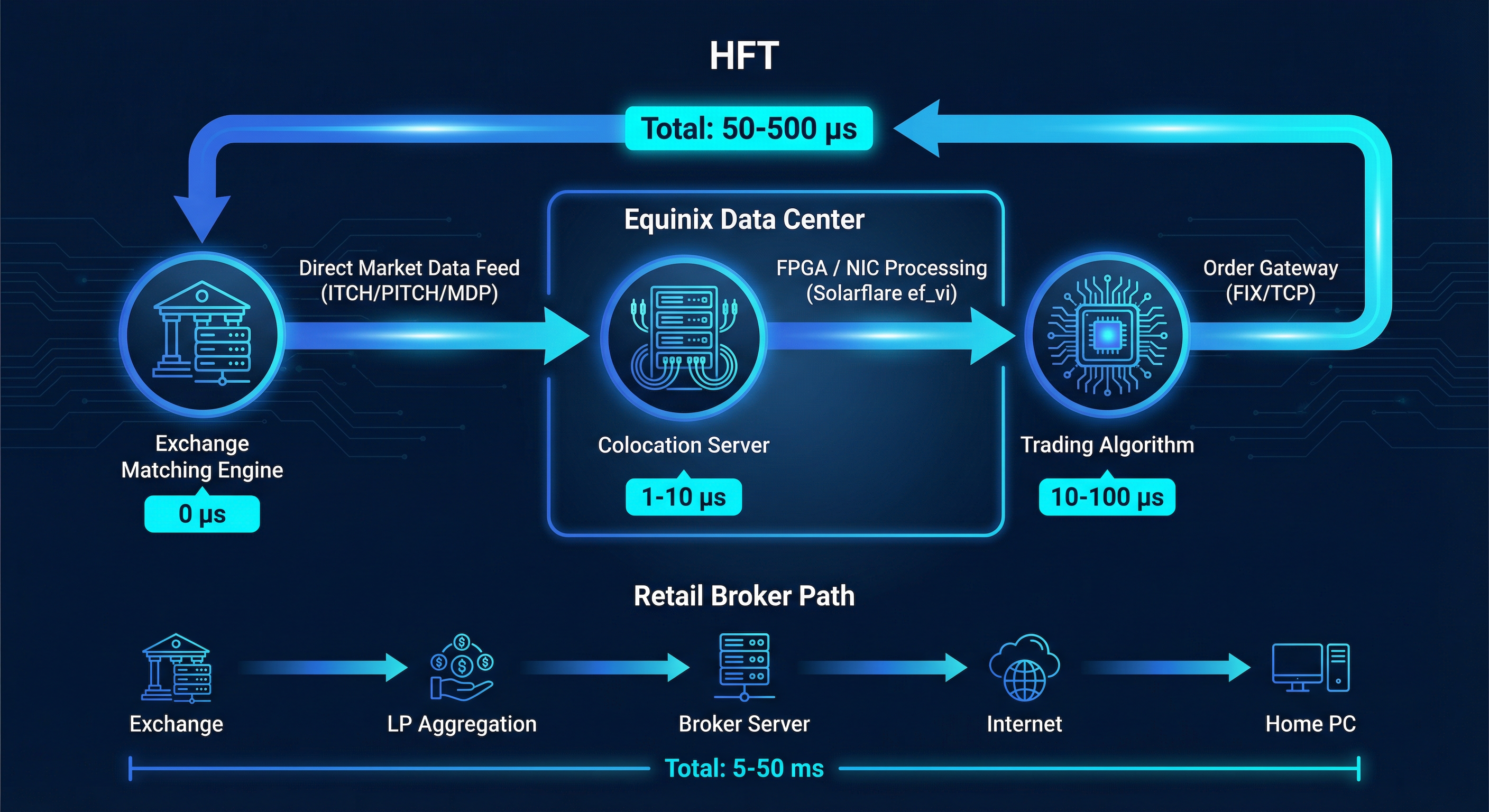
When a trader talks about strategy, they usually mean logic. When a professional talks about strategy, they mean the entire chain: from the moment a quote leaves the exchange’s matching engine to the moment your order arrives back.
That chain is your real strategy. The logic is just one element of it.
If your edge exists for only a few milliseconds, you need to detect the signal, build the order, and send it to the exchange within that window. Miss by 200 microseconds — and the edge is gone. Someone else already took that liquidity.
Latency requirements are always dictated by data and strategy type. If your edge lives 50 milliseconds — that’s one story. If it’s 500 microseconds — it’s a completely different one. And the infrastructure cost difference between them is an order of magnitude.
Colocation: You Must Be Physically Next to the Exchange
The first rule of low latency — no remote access. No virtual servers. No cloud.
Your server must be located in the same data center as the exchange’s matching engine. For US markets, this typically means Equinix NY5 (Nasdaq), NY4/NY5 (NYSE), CME in Aurora. For European markets — Equinix LD4 (London), Interxion (Eurex). Each venue means a separate rack, separate equipment, separate costs.
Rack space rental, electricity, cooling, hands-on support — that’s approximately $1,500–$3,000 per month per venue. Your server needs a cross-connect to a broker or directly to the exchange. That’s a physical cable from your rack to the exchange port. Another $500–$1,000 per month for each connection. And you need several: for market data, for order submission, for a backup channel.
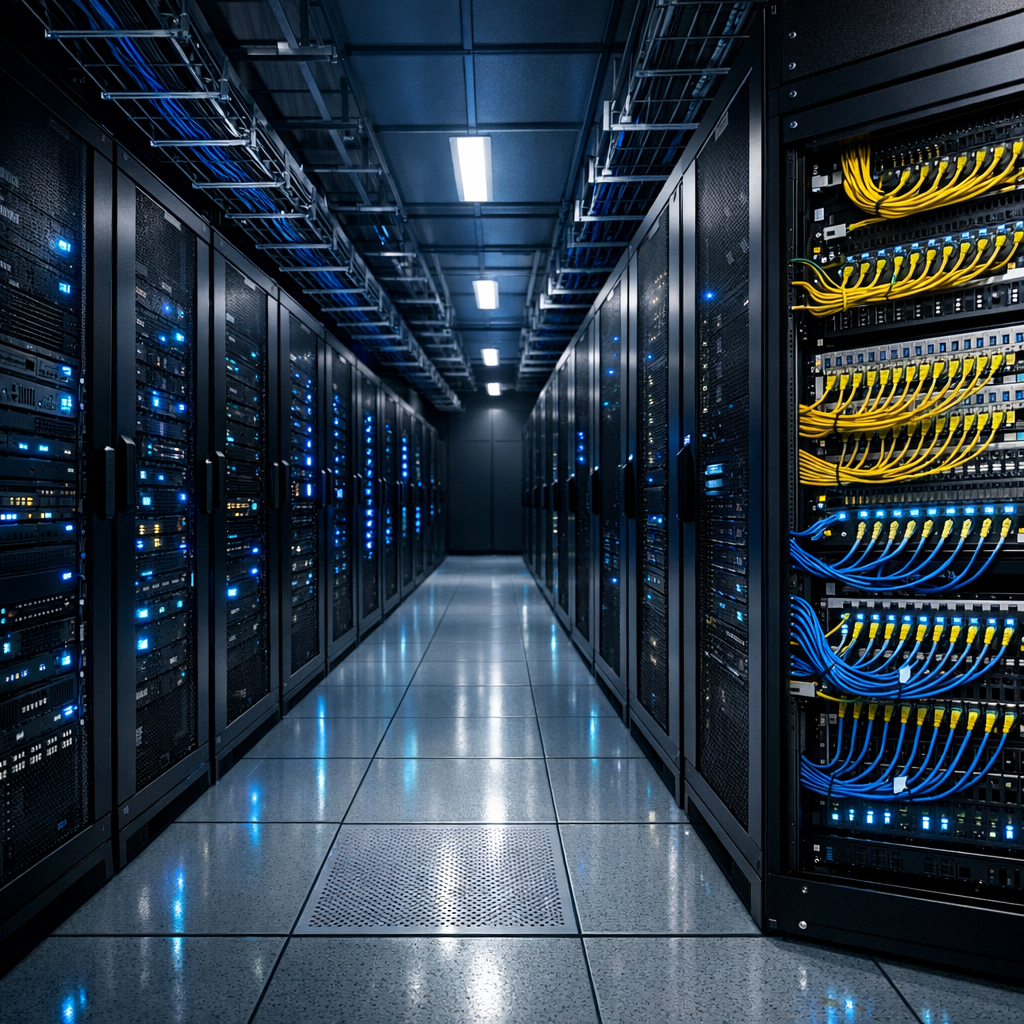
Server rack in an Equinix data center
Server Hardware: Single-Thread Performance Matters More Than Core Count
In HFT, the “more cores = faster” logic doesn’t work. The critical path for processing market data and making decisions is a single thread. One. And it must be as fast as possible.
Enterprise-grade servers — Dell PowerEdge R750, custom Supermicro builds with high-clock-speed Intel Xeon or AMD EPYC processors. Not for parallelism, but for raw single-threaded performance. Some practitioners use Ryzen 9 on bare metal with real-time Linux kernels, but that’s closer to the 1–5 millisecond category, not sub-microsecond trading.
The cost of one properly built server with low-latency components is $50,000–$100,000. Most serious firms maintain at least two (for failover). That’s $100,000–$200,000 for hardware alone.
Network Cards: Forget Standard Ethernet
A standard network card adds tens of microseconds of latency per packet. For HFT, that’s an eternity.
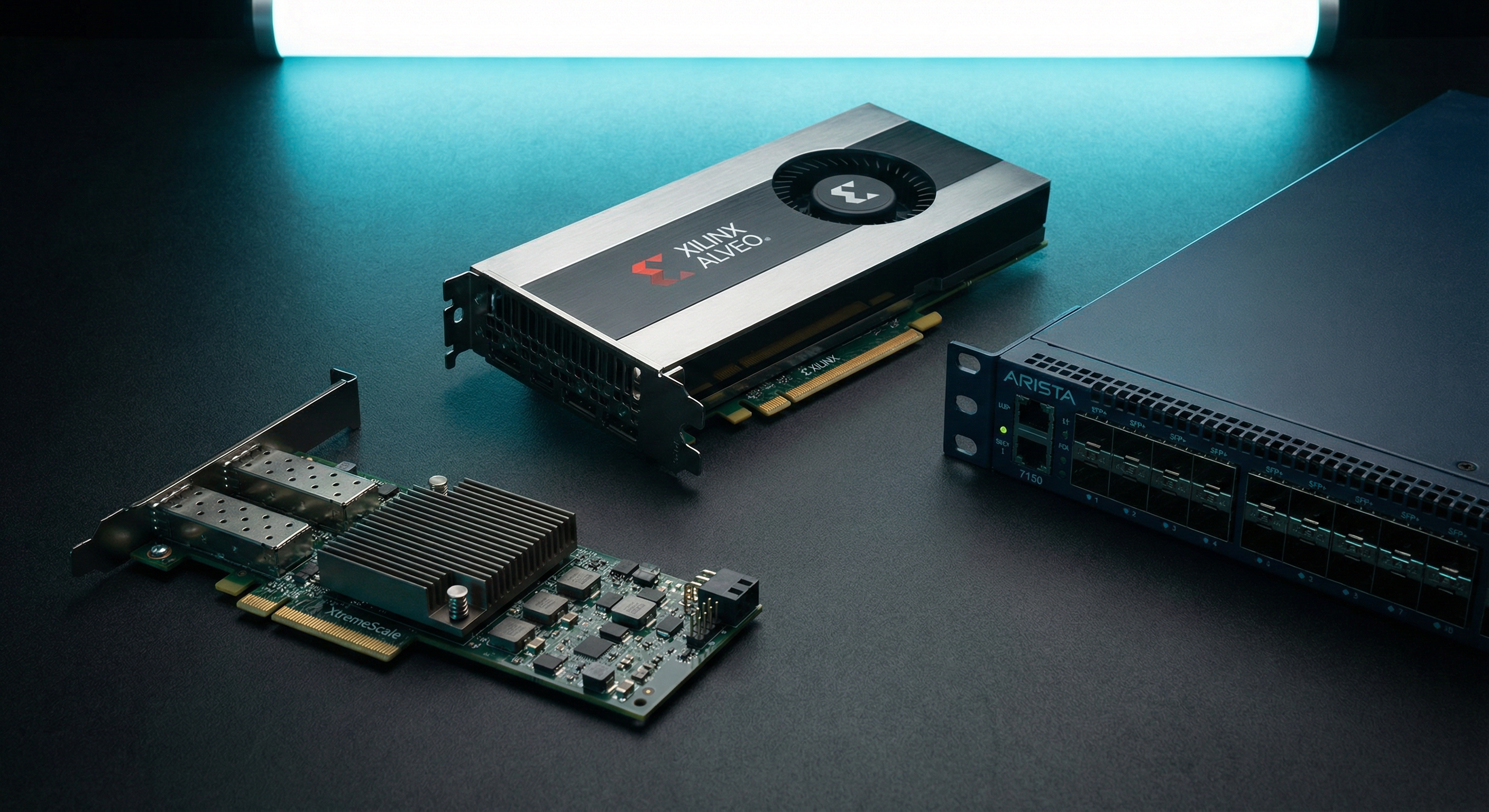
The industry standard is Solarflare (now Xilinx/AMD) network cards with ef_vi or OpenOnload support. This is kernel bypass technology: packets go directly from the NIC to user space, bypassing the entire Linux network stack. The difference — from tens of microseconds down to single digits.
An alternative is Mellanox ConnectX-5/6 (now NVIDIA) with DPDK (Data Plane Development Kit) support. A different approach to the same problem: remove the operating system from the critical path.
Switches between components — Arista 7150 or 7130 series. Sub-microsecond switching. One of these costs several thousand dollars, but without it, all other optimizations become pointless.
Market Data: Direct Feeds from the Exchange
REST API? WebSocket? That’s for retail trading with latency in the tens and hundreds of milliseconds.
Professional HFT firms receive market data through direct multicast UDP feeds from the exchange. Binary protocols: ITCH (Nasdaq), PITCH (BATS/Cboe), Pillar (NYSE), MDP 3.0 (CME). These protocols are optimized for minimal packet size and maximum parsing speed.
A direct feed subscription costs from several thousand to tens of thousands of dollars per month, depending on the exchange and data type. A full L3 feed with all orders is the most expensive and most informative.
There’s a practice of arbitraging between duplicate feeds from the same exchange. Exchanges typically broadcast two identical data streams (A and B feed) over different network paths. A smart system takes whichever packet arrives first from either channel. This can save single-digit microseconds, but at this level, every microsecond counts.
FPGA: When Software Is No Longer Fast Enough
Field-Programmable Gate Arrays (FPGAs) are the next level. Cards like ExaNIC (now Cisco) or Xilinx Alveo allow you to implement critical logic directly in hardware: decoding market data, building the order book, checking entry conditions, and constructing orders — all inside the chip, without involving the CPU.
An FPGA can start encoding the outgoing message before the incoming market data packet has been fully decoded. This is called cut-through processing, and it provides an advantage unattainable by any software solution.
The cost of developing FPGA logic starts at $125,000. Including hardware, testing, and debugging, a realistic NRE (non-recurring engineering) estimate is around $200,000. And that’s for just one strategy at one venue.
Do you need an FPGA? It depends on your strategy. If you trade based on specific messages in the data feed and try to react before competitors — yes, without an FPGA you will lose. If your edge is measured in milliseconds rather than microseconds, you can get by with well-optimized software and kernel bypass.
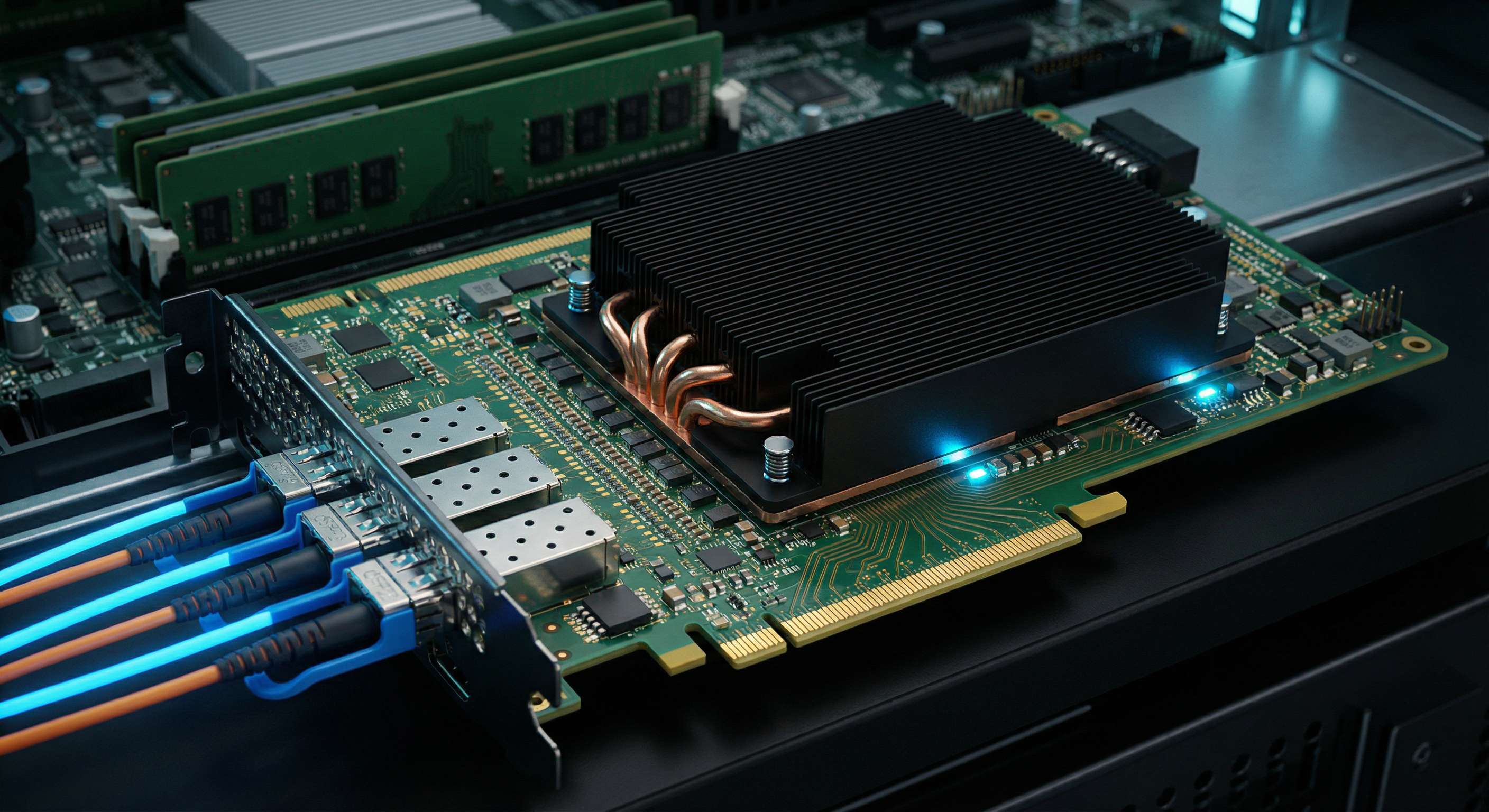
FPGA card with copper heatpipes and fiber optic connections
Microwave and Laser Communication Links
Between exchange data centers — for example, between Chicago (CME) and New Jersey (Nasdaq/NYSE) — fiber optic transmits data in approximately 6.5 milliseconds. Microwave does it in 4 milliseconds. The 2.5-millisecond difference is an eternity for cross-exchange arbitrage.
Leasing a microwave channel from a provider like McKay Brothers costs about $450,000 per year for a single route. One. If you need routes through Chicago, European exchanges, and back — multiply accordingly.
However, if your strategy doesn’t require cross-exchange arbitrage, microwave links aren’t necessary. And then the overall budget drops dramatically.
Operating System: Strip Away Everything Unnecessary
Standard Linux runs hundreds of processes, interrupts, and context switches. Each one is a potential jitter source of tens of microseconds. Preparing an operating system for HFT is a discipline in itself:
- CPU core isolation (isolcpus) for critical threads
- Thread-to-core pinning (CPU pinning)
- Disabling power saving in BIOS
- Interrupt protection (IRQ affinity)
- Busy-polling instead of blocking waits
- Minimal kernel with unnecessary modules removed
Python for the critical path is categorically unsuitable. C and C++ are the standard. Some components are written in Rust. Everything must be profiled and measured. Bottlenecks will keep surprising you — that’s normal.
OS security updates are applied cautiously: the Spectre/Meltdown patch, for example, added noticeable latency on many systems. You have to choose between security and speed.
How Much Does It Cost: Real Numbers
Let’s put together a budget for a small HFT operation on two US venues.
Initial capital expenditure: servers, network cards, switches, FPGA cards, development — from $200,000 to $400,000. Operating expenses: colocation, cross-connects, data feeds, DMA broker (roughly $2,000 per month plus $500 for cross-connect), maintenance — approximately $50,000–$72,000 per month. That’s $600,000–$850,000 per year, not counting capital expenditure and trading capital.
With redundancy (two servers per venue, duplicate channels), capital costs double. A million dollars of starting budget — and you barely have enough for one year of operation without redundancy.
If you add direct exchange membership, clearing relationships, and proprietary feeds (instead of DMA broker), costs multiply: $200,000 NRE and $20,000 per month for each venue, plus several million in clearing broker collateral. But latency drops below 100 microseconds.
Do You Actually Need All of This
Here’s an honest question worth asking yourself: what latency does your strategy actually need?
If your edge lives milliseconds — colocation with a bare metal server, a Solarflare/Mellanox card, kernel bypass, and good C++ code will cost you $3,000–$5,000 per month. That puts you ahead of 99% of retail market participants.
If you need sub-500 microseconds — prepare $200,000–$400,000 upfront and $36,000–$72,000 per month.
If sub-100 microseconds — you’re building a Formula 1 car. And just like in F1, the pit crew costs more than the car itself.
If sub-100 microseconds — you’re building a Formula 1 car. And just like in F1, the pit crew costs more than the car itself.
The bank stack on this page is a different business from retail HFT with a $50–$150 test deposit.
What Trading Courses Won’t Tell You
Infrastructure is just the entry ticket. It doesn’t generate profit by itself. Ultra-low-latency trading systems for market making have existed for years, and infrastructure is a solved problem. The real challenge is strategy and adaptation to changing market regimes. Volatility, liquidity, regulatory constraints — everything changes, and your logic must evolve with the market.
Even if you win the speed race only 3% of the time, it can produce excellent results — because you don’t carry the overhead of hundreds of employees like a large trading firm. That’s the advantage of a small team: low fixed costs allow you to operate with minimal margin.
But most people lose money not because of latency. It’s because of a lack of discipline, poor understanding of risk management, and the belief that technology alone guarantees results. It doesn’t. Technology is a tool. Nothing more.
The market promises nothing. It simply exists. And those who understand its infrastructure, psychology, and the cost of participation have slightly better odds of staying in the game long enough for it to start producing results.
Comparison Table: Low-Latency Trading Types and Infrastructure Costs
| Ultra-Low Latency (nanoseconds — single-digit μs) |
Low Latency (tens — hundreds of μs) |
Fast Retail (1–5 ms) |
Advanced Retail (5–20 ms) |
|
|---|---|---|---|---|
| Who | Market makers, cross-exchange arbitrage, speculative racing | Statistical arbitrage, aggressive market making, latency arbitrage | Solo algo traders, small prop firms | Algo traders on VPS, signal-based strategies |
| Typical Edge | Reacting to specific feed messages before everyone else | Faster than 95% of participants, L2/L3 data processing | Faster than 99% of retail, broker-to-broker arbitrage | Faster than manual traders |
| Latency (round-trip) | < 10 microseconds | 50–500 microseconds | 1–5 milliseconds | 5–20 milliseconds |
| Server | Custom Supermicro / FPGA hosting platform | Dell PowerEdge R750, Supermicro, Xeon | Bare metal Ryzen 9 / Xeon in colocation | VPS or dedicated server from broker |
| Network Card | FPGA NIC (ExaNIC, Xilinx Alveo) | Solarflare XtremeScale (ef_vi) / Mellanox ConnectX-6 | Solarflare / Mellanox, kernel bypass | Standard 1–10 Gbit |
| Switch | Arista 7130 (FPGA), Layer 1+ | Arista 7150, sub-microsecond | Not required | Not required |
| Market Data | Direct exchange feed (ITCH/PITCH/Pillar) + A/B feed arbitrage | Direct feed via DMA broker | DMA broker, direct feed | Broker API (FIX, WebSocket) |
| FPGA | Required | Optional | Not needed | Not needed |
| Microwave Links | Yes (~$450,000/year per route) | Rarely | No | No |
| OS & Software | Custom Linux kernel, FPGA firmware, C/C++ | RT Linux kernel, isolcpus, C/C++ | Linux, C/C++ or Rust | Linux/Windows, Python acceptable |
| Team Size | 5–50 people | 2–10 people | 1–3 people | 1 person |
Deployment Costs (CAPEX)
| Cost Item | Ultra-Low (nanoseconds) |
Low Latency (microseconds) |
Fast Retail (1–5 ms) |
Advanced Retail (5–20 ms) |
|---|---|---|---|---|
| Servers & Hardware | $300,000 – $800,000 | $100,000 – $200,000 | $10,000 – $30,000 | $0 – $2,000 |
| FPGA (development + cards) | $200,000 – $500,000 | $0 – $200,000 | $0 | $0 |
| NICs + Switches | $50,000 – $150,000 | $15,000 – $40,000 | $2,000 – $5,000 | $0 |
| Microwave Links | $450,000 – $1,500,000/year | $0 | $0 | $0 |
| Total Initial (CAPEX) | $1,000,000 – $3,000,000 | $200,000 – $400,000 | $15,000 – $35,000 | $0 – $2,000 |
Monthly Operating Expenses (OPEX)
| Cost Item / Month | Ultra-Low | Low Latency | Fast Retail | Advanced Retail |
|---|---|---|---|---|
| Colocation + Power | $5,000 – $15,000 | $2,000 – $5,000 | $500 – $1,500 | $0 – $50 |
| Cross-Connects | $3,000 – $10,000 | $1,000 – $3,000 | $500 – $1,000 | $0 |
| Market Data Feeds | $10,000 – $50,000 | $3,000 – $10,000 | $500 – $2,000 | $0 – $100 |
| DMA Broker / Membership | $5,000 – $20,000 | $2,000 – $5,000 | $500 – $2,000 | $0 – $200 |
| Maintenance & Monitoring | $3,000 – $10,000 | $1,000 – $3,000 | $200 – $500 | $0 |
| Team Salaries | $100,000 – $500,000 | $20,000 – $80,000 | $0 (solo) | $0 (solo) |
| Total per Month (OPEX) | $130,000 – $600,000 | $30,000 – $100,000 | $2,000 – $7,000 | $50 – $350 |
| Total per Year (OPEX) | $1,500,000 – $7,000,000 | $360,000 – $1,200,000 | $24,000 – $84,000 | $600 – $4,200 |
Total: Full First-Year Budget
| Ultra-Low (nanoseconds) |
Low Latency (microseconds) |
Fast Retail (1–5 ms) |
Advanced Retail (5–20 ms) |
|
|---|---|---|---|---|
| Trading Capital (min.) | $2,000,000 – $10,000,000 | $500,000 – $2,000,000 | $50,000 – $200,000 | $5,000 – $50,000 |
| Clearing / Exchange Collateral | $2,000,000 – $10,000,000 | $0 – $1,000,000 | $0 | $0 |
| CAPEX + Year OPEX + Capital | $5,000,000 – $20,000,000 | $1,000,000 – $3,500,000 | $90,000 – $320,000 | $5,600 – $56,000 |
| Realistic Estimate to Launch | ~$10,000,000 | ~$1,500,000 | ~$150,000 | ~$20,000 |
Key takeaway: The difference between categories is not linear — it’s exponential. Moving from 5 milliseconds to 500 microseconds multiplies the cost by 10x. Moving from 500 microseconds to 5 microseconds — another 10x. Each order of magnitude in latency equals an order of magnitude in budget.
Before investing in infrastructure, answer one question: how long does your trading edge last? If the edge exists for 50 milliseconds — don’t spend a million on sub-microsecond infrastructure. If the edge lives 5 microseconds — a $20,000 VPS won’t help. Infrastructure must match the strategy, not the other way around.
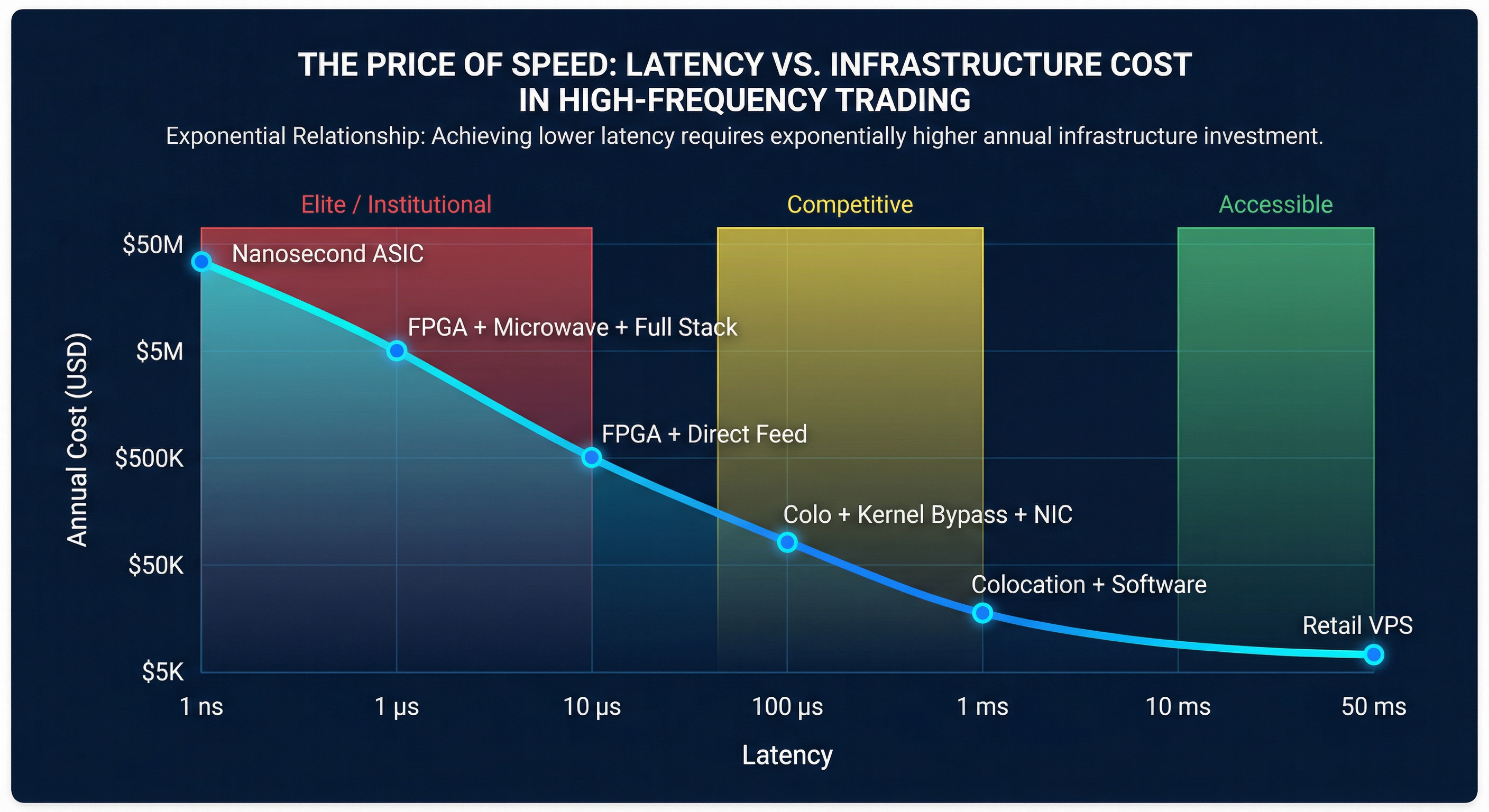
Exponential relationship: lower latency requires exponentially higher infrastructure investment
FAQ: Common Questions About HFT Infrastructure
Westernpips Private HFT Trading Tools
Since 2007, Westernpips has been a global leader in arbitrage technology for low-latency traders.
Our mission is to continuously innovate, refine, and deliver advanced solutions in algorithmic trading — helping not only our own teams but also our customers, partners, and investors achieve consistent profitability.
We specialize in high-frequency algorithmic trading and arbitrage across multiple markets, including Forex, CFDs, futures, and cryptocurrencies. With a reputation built on innovation and results,
Westernpips continues to push boundaries, empowering traders with the speed, precision, and efficiency required to thrive in today’s markets.


Contact Us
If you are a trader or investor and you are interested in HFT trading technology, please Contact Us for advice.
westernpips_hft_trading[email protected]