


 FIX API Trading
 Infrastructure for HFT and Algorithmic Trading
FIX (Financial Information eXchange) is a widely adopted messaging standard for electronic trading. It enables trading systems, brokers, exchanges and liquidity providers to exchange orders, executions and market data through documented, machine-readable messages. This guide explains where a FIX engine fits in a modern trading infrastructure and how Westernpips supports multi-venue algorithmic trading workflows.
Reviewed and updated by Westernpips Group on October 6, 2026.
A Brief History of the FIX Protocol
The FIX Protocol was introduced in the early 1990s by Fidelity Investments and Salomon Brothers to automate the slow, manual order flow that dominated equity trading.
Its goal was simple: create a common, transparent, and real-time format for electronic trade messages. From those beginnings, FIX evolved into the world standard for institutional trading, widely used by banks, exchanges, brokers and trading firms across asset classes.
What a FIX Engine Does
At its heart, FIX defines how two financial institutions exchange trading information — from quotes and orders to confirmations and allocations. It standardizes communication so that systems built by different firms can exchange standardized messages. Each integration still requires configuration, counterparty-specific mapping and testing.
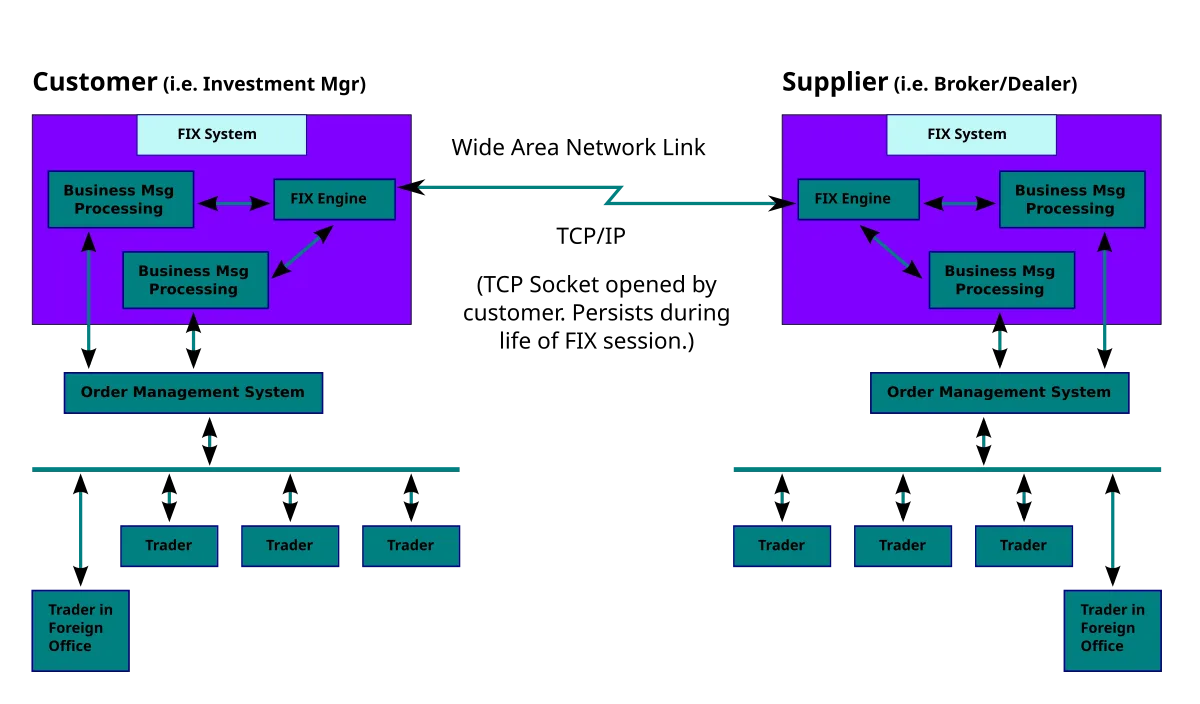
In practice, a FIX connection is a persistent messaging session, commonly over TCP between a trading system (the initiator) and a broker or liquidity provider (the acceptor).
FIX messages use standardized tag-value fields. Actual throughput and latency depend on the FIX engine, network, hardware, message validation and counterparty infrastructure.
The diagram shows a typical FIX messaging flow between a buy-side customer and a sell-side supplier.
View a list of Software for FIX API Trading.
Why Trading Firms Use FIX
- Speed and Latency Control – FIX supports continuous message exchange; actual end-to-end latency must be measured on the intended connection.
- Transparency – Every order, amendment, or execution acknowledgment is timestamped and traceable.
- Direct market connectivity – Where the broker or venue permits it, FIX can connect an order-management system to an execution gateway without a retail terminal.
- Scalability – Instrument coverage, account handling and message limits depend on the counterparty and implementation.
- Cross-Asset Coverage – FIX handles equities, FX, derivatives, crypto, and even OTC products under one standard.
- Interoperability – Standard message structures support integration across counterparties, but versions, fields and rules of engagement can differ.
These qualities make FIX the backbone of algorithmic, quantitative, and high-frequency trading worldwide.
FIX API in Algorithmic and HFT Workflows
High-frequency trading strategies rely on timely data processing and execution; their models and trading objectives differ. For these systems, FIX can provide a standardized route between the trading algorithm and an execution gateway.
When latency matters, firms evaluate the complete path: market-data delivery, strategy processing, pre-trade risk checks, network distance, gateway performance and execution acknowledgements. FIX is one component of that path; using FIX alone does not guarantee low latency or execution quality.
Many modern liquidity venues and connectivity providers — including CBOE, Euronext, PrimeXM, Integral, Fortex and LMAX — support FIX-based workflows.
Components of a Trading Infrastructure Solution
A production algorithmic trading platform normally combines several independently monitored components:
- Market-data ingestion: receives quotes or order-book updates from brokers, exchanges and specialist data providers.
- Normalization and symbol mapping: converts venue-specific instruments and fields into a consistent internal format.
- Strategy and signal engine: evaluates market conditions and produces trading instructions.
- Order and risk management: validates size, price, exposure and account limits before an order is sent.
- FIX session and execution layer: maintains connectivity, routes orders and processes acknowledgements, fills, rejects and cancels.
- Monitoring and recovery: records messages, measures latency and supports reconciliation after a disconnect.
FIX API vs REST API vs Trading Platform
| Connection method | Typical use | Considerations |
|---|---|---|
| FIX API | Continuous order routing, execution reports and institutional workflows | Requires counterparty certification, session management, monitoring and risk controls |
| REST or WebSocket API | Account services, retail automation and exchange-specific integrations | Usually easier to start; rate limits and venue-specific behavior vary |
| Desktop or web platform | Manual trading, supervision and standard automation | Fastest onboarding, but offers less control over the complete execution path |
The right method depends on the venue, strategy, message rate, operational controls and available technical team. Direct market access is a commercial and regulatory arrangement with a broker or venue; it is not created by the protocol itself.
Westernpips FIX API Trading Software
Since 2007, Westernpips Group has developed software for automated and latency-sensitive trading workflows across Forex, CFDs, futures and cryptocurrency markets. The available tools support market-data comparison, strategy testing and execution connectivity.
The Westernpips Private 7 software is a multi-terminal application that supports FIX, API and ITCH connections to compatible liquidity and market-data providers. Results depend on the selected data sources, broker conditions, network location, configuration, market liquidity and execution quality. No software can guarantee a speed advantage, filled order or trading profit.

Multi-Asset FIX Connectivity
Today, FIX is not limited to equities or FX. Connectivity across asset classes can involve FIX as well as venue-specific interfaces:
- CFD and FX liquidity providers (CFH, Celer, SolidFX, TradeMade, Math Trade, etc.).
- Crypto exchange connectivity through supported venue-specific APIs; FIX availability must be confirmed separately.
- Market-data vendors and connectivity providers using supported FIX or native interfaces.
- Execution venues such as 24Exchange, Spotex, and FastMatch
FIX and Futures Integration in Westernpips Private 7
Westernpips Private 7 provides configurable connectivity tools to professional traders and prop desks.
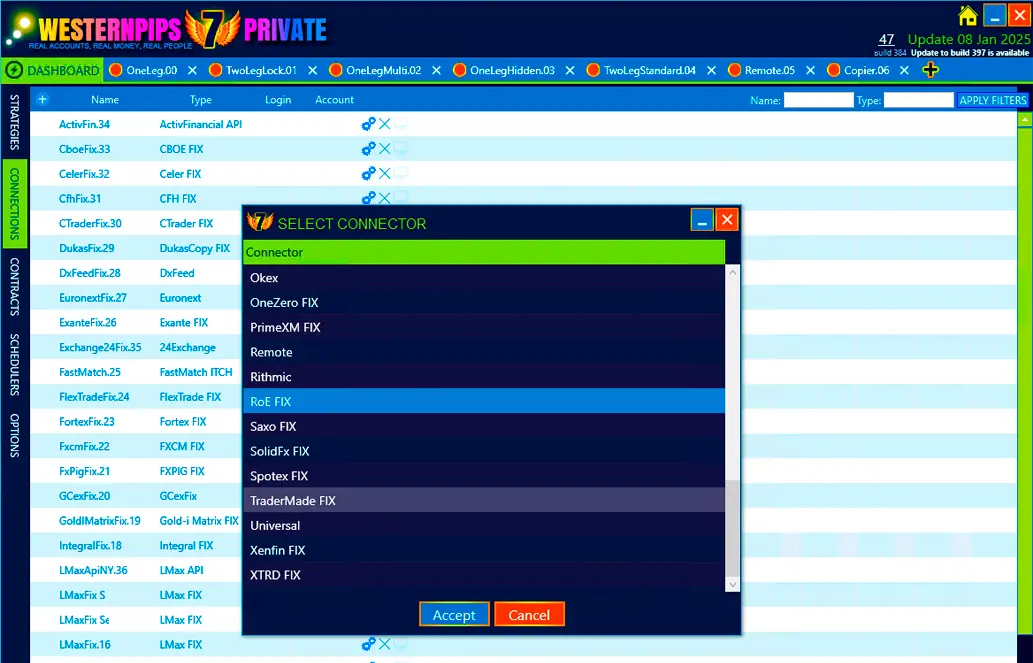
Westernpips Private 7 provides multiple supported FIX/API connectors and market-data integrations. Examples listed on this page include:
- CFH, Integral, Fortex, PrimeXM, OneZero, Celer, SolidFX, Math Trade, TradeMade, FXCM, Goldi Matrix, OGM, RoE, and Xenfin
- Market data feeds: Activ Financial, DXFeed, Rithmic, FastMatch, and 24Exchange
This infrastructure allows traders to access multi-venue execution, real-time price comparisons, and cross-asset latency arbitrage — all from a single platform.
Westernpips Private 7 manages FIX sessions automatically, handling supported quote streams and execution connections for FX, indices, metals, and futures.
FIX API and HFT Technology Guides
Keep up-to-date on the most relevant advances in latency arbitrage technology with the following research video.
Westernpips Back Tester is a module for historical strategy testing using recorded market ticks from trading sessions. It allows traders to simulate trades, analyze slippage, evaluate risk and compare parameters before considering live trading.
Test Strategies with Recorded Tick Data Backtesting helps traders inspect strategy behavior before live use. Westernpips Back Tester allows users to evaluate latency-arbitrage configurations with recorded quotes, simulated slippage and execution analytics. Whether you are testing OneLegMulti, OneLegHidden, TwoLegStandard or another latency-based strategy, results should be assessed across different market conditions. Backtests have limitations and do not predict future performance.
Westernpips Private 7 is high-frequency trading (HFT) software for configuring and testing arbitrage workflows in Forex, CFD, futures and cryptocurrency markets. The guide covers installation, activation, menus, connection settings and available strategy configurations.
In latency arbitrage, a gap is a price difference between the reference feed and the execution venue. Slippage is the difference between the expected and actual fill price; it can be favorable or unfavorable. Compare quotes, spreads, commissions and actual fills before assessing a signal.
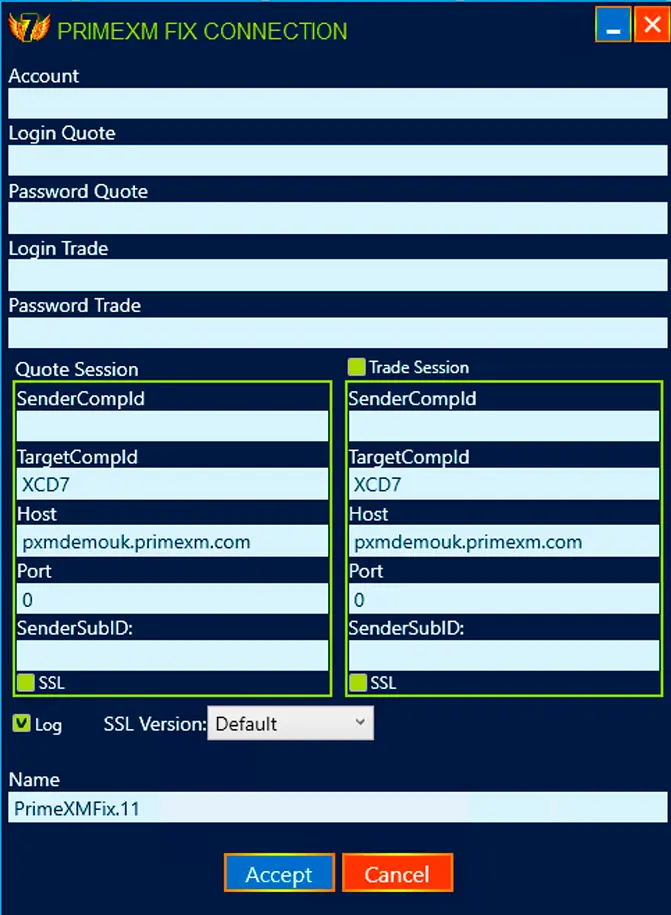
This guide explains how to connect Westernpips Private 7 to a liquidity provider through PrimeXM FIX API. It also covers common connection issues—including authorization errors, session drops, invalid credentials and delayed order routing—and provides troubleshooting steps.
Professional traders who wish to deploy FIX in live markets often face the challenge of configuration, session management, and latency testing.
Westernpips Private 7 simplifies this process by integrating FIX access directly into a ready-to-use high-frequency trading environment.
Within its interface, users can configure supported FIX connections, monitor latency between feeds and execute orders according to their strategy and counterparty permissions.
Westernpips Private 7 provides a practical implementation of FIX connectivity for independent and proprietary traders who do not want to build every infrastructure component from scratch.
Frequently Asked Questions
What is a FIX engine?
A FIX engine manages FIX sessions, message encoding and decoding, sequence numbers, heartbeats, reconnection and message recovery between trading counterparties.
Does FIX API guarantee the lowest latency?
No. FIX supports efficient electronic execution, but end-to-end latency also depends on the venue, network route, hosting location, risk checks, application design and counterparty infrastructure.
How do traders obtain FIX API access?
FIX credentials and trading permissions are normally issued by a broker, exchange, ECN or liquidity provider after its technical, commercial and compliance requirements are met.
What is needed for a production FIX connection?
A production setup typically requires counterparty credentials, a FIX specification or rules of engagement, network connectivity, symbol mapping, pre-trade risk controls, monitoring, message persistence and tested recovery procedures.
Explore high-frequency trading monitoring, reports and trading advisor examples to understand how strategies may behave under live market conditions.
Where identified on the statements page, reports may include live-account data. Review the account type, date range, fees, drawdown and verification method before interpreting any result.
Past performance, examples and backtests do not guarantee future results.
Westernpips Group develops technology for market-data analysis and high-speed trading connections. Our team works with industry protocols — including ITCH, FIX, FAST and binary APIs — to build algorithmic tools for latency-sensitive trading workflows.
These tools are designed to combine market-data processing, configurable strategy logic and supported execution connections. Availability and performance depend on the broker, venue, account permissions and infrastructure used.
Trading and arbitrage involve risk. Users should test configurations, monitor execution quality and apply appropriate risk controls before considering live deployment.
Westernpips FIX API and HFT Trading Tools
Since 2007, Westernpips has developed arbitrage and low-latency trading technology.
Our work focuses on configurable tools for market-data analysis, strategy testing and algorithmic execution.
The software supports algorithmic trading and arbitrage workflows across markets including Forex, CFDs, futures and cryptocurrencies. Users remain responsible for broker authorization, configuration, compliance, risk limits and trading decisions.


Contact Us
If you are a trader or investor and you are interested in HFT trading technology, please Contact Us for advice.
westernpips_hft_trading[email protected]


Online Support 24/7
If you have questions about Westernpips Software products please Contact Us.