
 Low-Risk HFT Trading
Low-Risk HFT Trading with latency arbitrage
Updated 6 October 2026 · Westernpips
Is HFT Latency Arbitrage High Risk?
At Westernpips, we approach HFT risk differently from traditional trading risk. In latency arbitrage, positions may remain open for only seconds, which can substantially reduce exposure to market direction. Our risk model focuses on small position sizes, predefined loss limits and avoiding martingale or grid-based exposure. Westernpips Private 7 is the HFT trading platform we use to implement this approach in practice, supporting latency-arbitrage strategies including OneLeg, OneLegMulti and TwoLeg with fast reference feeds and configurable risk parameters. Execution, slippage, infrastructure and broker conditions remain separate risks that every trader must consider.
Why the lowest-risk forex approach is a minimum lot, a 1–5 point stop, and a broker check that finishes in an hour — with no martingale and a test deposit of $50–$150.
People who type “safest forex trading strategy” usually receive one of two answers. A lesson that says risk one percent per trade. Or a robot that looks calm for three weeks and then doubles the lot until the deposit is gone.
Both answers skip the only question that decides whether a method is low-risk: what is the largest loss one trade can produce, and what happens to that loss after eight losers in a row.
Retail HFT latency arbitrage has a dull answer. The position opens at the broker’s minimum lot. The stop is 1 to 5 points. The lot grows only after the system has already filled in sync with that broker. Three to five trades are enough to see the sync, and the check fits inside an hour. The deposit that can host the test is $50–$150.
That is a bound on loss. It is not a bound on profit, and it is not a claim that forex has become safe. A late fill, a spread wider than the stop, or a broker that rejects the order still loses money. The rest of this page is the arithmetic and the checks.
Why “Safest” Means a Capped Loss, Not a Guaranteed Win
A forex method is low-risk when three things are true at the same time. Every order carries a hard stop the broker has accepted. That stop is small relative to the deposit. The next order does not get larger because the previous one lost.
Most products sold as “safe” fail the third test. A grid adds a new position as price walks away. A martingale multiplies the lot so that one winner can pay for the losers. The equity curve looks smooth because the loss is being stored in position size. The account dies on the day the stored loss no longer fits inside the free margin.
Manual trading with a one-percent rule passes the third test and fails the second one for a small account. A 30-pip stop at 0.01 lot on EURUSD is about $3. On a $100 deposit that is already 3 percent, before spread and slippage. To force the risk down to 1 percent you need either a smaller contract than the broker offers or a wider account. The stop cannot be wished down to one percent if the chart structure needs 30 pips.
Latency arbitrage is the retail case where the stop really can be that short. The trade is not a view on the next hour of EURUSD. It is a view that one quote is late. If the late quote catches up in your favor, the trade is done. If it does not, the position is cut after a few points, while the lot is still the minimum. There is nothing to “let breathe.”
How HFT Latency Arbitrage Keeps the Stop at 1–5 Points
A retail price is the end of a chain. A tier-1 liquidity provider prints a price, an aggregator forwards it, a broker applies its own markup and filters, and only then does the number appear in MetaTrader. A faster feed, sitting closer to the start of that chain, sees the move first.
Latency arbitrage trades that gap. The fast feed says the price has already moved. The broker’s quote has not. The order is sent to the slower quote. If the broker fills while its price is still old, the position is on the right side of a move that has already happened on the fast feed. The hold is measured in a short burst of ticks, which is why a stop of a few points is coherent. A directional scalp held for minutes is not entitled to the same stop. Noise of that length is larger than 5 points on any liquid pair.
The full mechanism — gap, slippage, and why the feed has to be earlier than the terminal — is covered in Latency Arbitrage in Forex Trading and How It Works. This page stays on the risk budget: lot, stop, deposit, and the hour you spend deciding whether a broker can host the strategy at all.
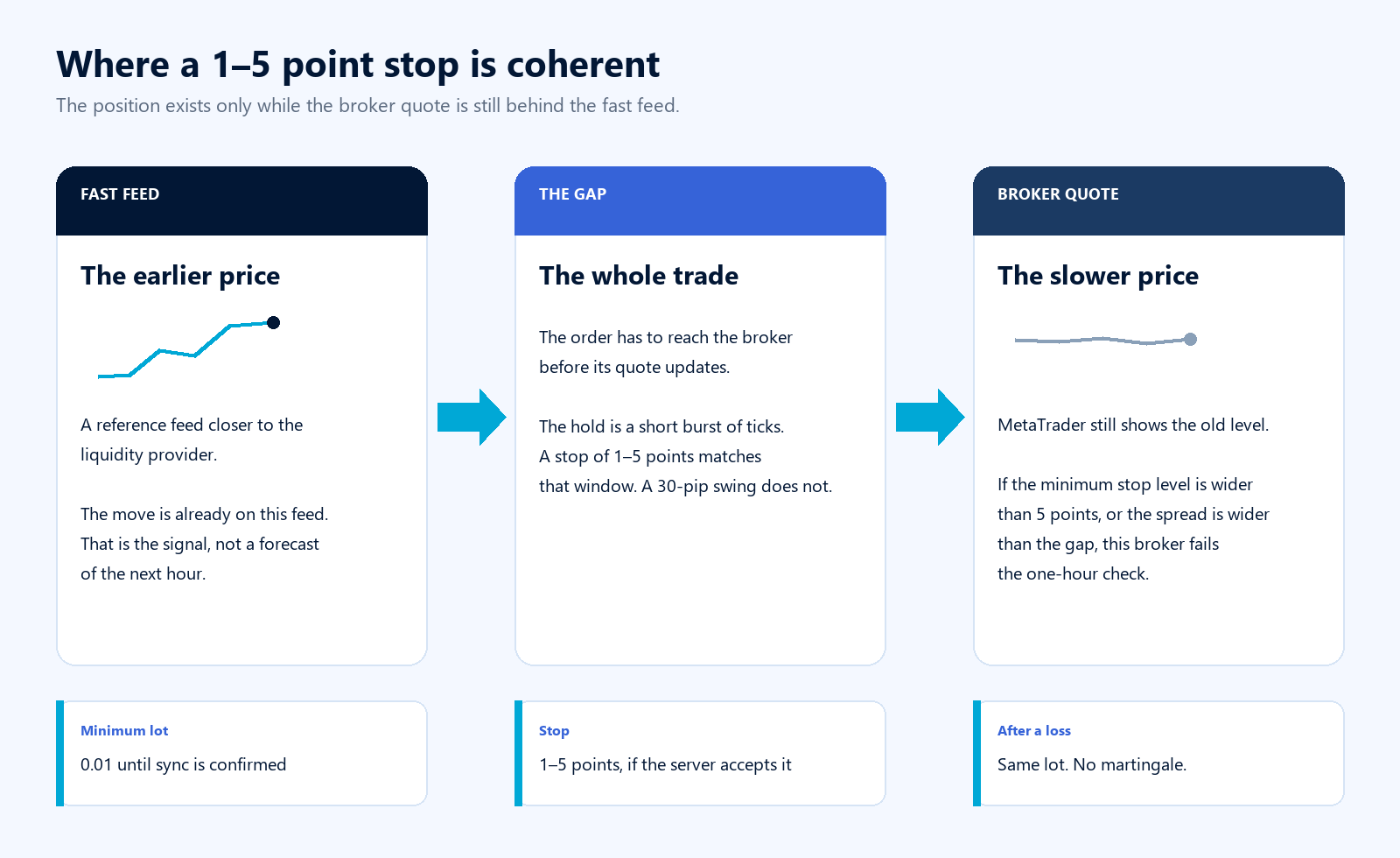
The trade exists only while the broker quote is still behind the fast feed
Two conditions make the short stop real, and both are checked before any size is added.
- The broker must accept the distance. If the symbol’s minimum stop level is 10 points, a 5-point stop is a rejected order, not a risk plan. That broker fails the test.
- The live spread must be smaller than the gap you are trying to capture. A 0.8-pip spread is 8 points. A 5-point stop placed inside that spread does not describe the trade you will actually get. The order should not be sent.
When either condition fails, the correct action is to stop on that symbol or that broker. Raising the lot does not repair a stop the server will not take.
The Facts, Without the Sales Adjectives
These are the operating facts of a retail HFT latency-arbitrage test. Each one is expanded below. None of them is a forecast of monthly return.
| Fact | What it means on a live account |
|---|---|
| Lowest-risk retail structure | Hard stop on every order, minimum lot at the start, lot unchanged after a loss |
| Stop loss | 1–5 points (0.1–0.5 pips) where the broker’s stop level and the spread allow it |
| Dollar risk at 0.01 EURUSD | About $0.01 to $0.05 per stopped trade, before spread and commission |
| Starting lot | The broker minimum, almost always 0.01 on a standard cent or classic account |
| When the lot may increase | Only after execution has been confirmed. A loss is not a reason to add size |
| Broker check | 3–5 fast trades. The session fits in one hour |
| Test deposit | $50–$150. Enough margin and buffer for the minimum lot. Not a working salary |
| Martingale, grid, averaging | None. Each trade is independent and already at the smallest stop the logic can use |
| Who can run it | A retail account with a fast reference feed and a broker that fills inside the gap |
Minimum Lots at the Start. Size Moves Only After the System Is Proven
The first lot is the smallest volume the account can send. On most retail forex accounts that is 0.01. The point of the small lot is information, not income. You are buying a measurement: does this broker fill the order while its quote is still behind the fast feed, and does it honor a stop of a few points.
A loss at that size is supposed to be cheap enough that you can look at the fill and decide. It is not a signal to “get it back” on the next ticket. The lot stays where it is through the test, through the next session, and through a volatile hour. It steps up once, by a size you wrote down in advance, only when the same execution shows up again.
| Stage | Lot | You may move forward when |
|---|---|---|
| Test | Broker minimum (usually 0.01) | 3–5 trades in one session show acceptable sync |
| Confirmed | Still the minimum | The same slippage, stop behavior, and spread hold up on another session, including a fast market |
| Scaled | One predefined step up | Execution is stable. A losing trade never triggers the step |
This is ordinary risk control. A system that only “works” after you raise the lot was never confirmed. It was under-sampled. If the second session requotes, widens the spread, or returns fills after the broker price has already caught up, you return to the minimum or you leave the broker. You do not average the bad session away with a bigger order.
The Smallest Stop on Retail Forex, and the Drawdown It Actually Produces
A 1–5 point stop is the smallest distance that still matches the trade. The adverse move you are willing to sit through is the failure of a short-lived gap, not a swing low. Because the hold is so short, the open loss does not have time to become a floating drawdown measured in tens of pips. The position is either completed or cut.
Put that on a $100 test account, EURUSD, 0.01 lot:
| Event | Cash loss | Share of a $100 account |
|---|---|---|
| 1 stopped trade, 1 point | $0.01 | 0.01% |
| 1 stopped trade, 5 points | $0.05 | 0.05% |
| 20 stopped trades, 5 points | $1.00 | 1% |
| 50 stopped trades, 5 points | $2.50 | 2.5% |
Fifty losers in a row at the maximum planned stop still leave most of a $100 deposit intact. That is the drawdown shape people mean when they call this the low-drawdown forex approach: many tiny, finished losses, each one known before the order is sent. Compare that with a single manual trade risking 30 pips at the same lot — about $3, more than the entire fifty-trade HFT example — or with a martingale streak, which is in the next section.
Spread and commission sit on top of the stop, and on a micro lot they are often the larger number. A 0.2-pip spread costs about $0.02 per 0.01 lot; a 0.8-pip spread costs about $0.08, which is already more than a 5-point stop. The stop caps the adverse price move. It does not refund the spread you paid to get in. If the gap you capture is smaller than spread plus commission plus slippage, the tight stop keeps the account alive and the strategy still loses. Survival and profitability are different measurements. The one-hour broker check is where you see which one you have.
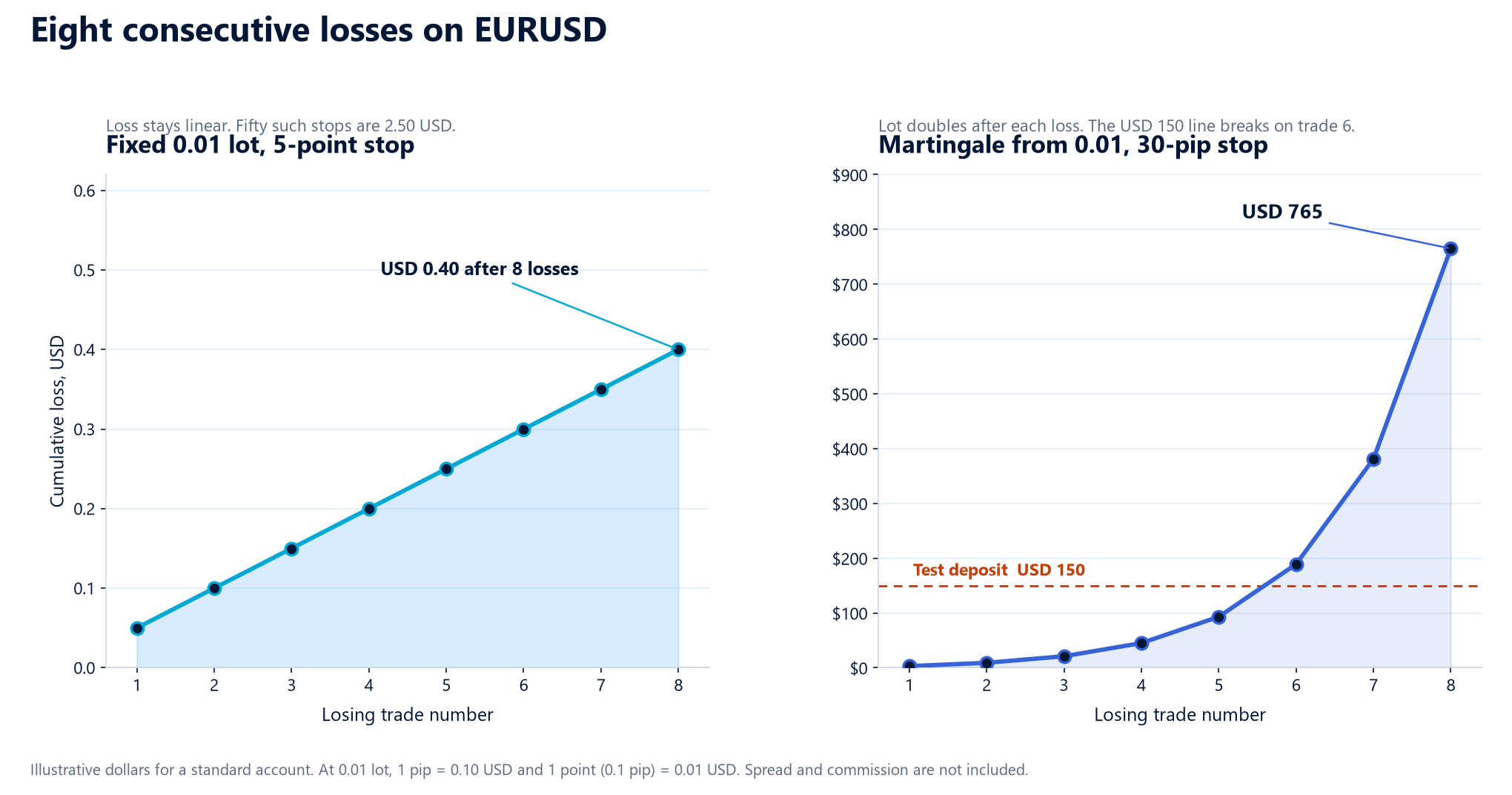
Eight losing trades. A fixed minimum lot stays near 0.40 USD. Martingale crosses a 150 USD test deposit on trade 6.
No Martingale. The Losing Streak Is Linear on Purpose
Martingale exists to repair a loss that was too wide to accept. The next lot is sized so one winner covers the previous losers. Latency arbitrage has nothing to repair in that sense: the stop is already at the minimum the signal can justify, and the next signal does not know about the last fill. Adding size after a loss would mix two different ideas and keep only the dangerous one.
The arithmetic is why accounts that “never use a big stop” still go to zero. Eight consecutive losses, EURUSD, illustrative:
| After 8 losses in a row | Lot path | Approximate cash loss | $150 account |
|---|---|---|---|
| HFT, fixed 0.01, 5-point stop | 0.01 on every trade | $0.40 | Still a test account |
| Same fixed lot, if the stop were 5 full pips | 0.01 on every trade | $4.00 | About 2.7% down |
| Martingale from 0.01, 30-pip stop, lot doubles | 0.01 → 0.02 → 0.04 → 0.08 → 0.16 → 0.32 → 0.64 → 1.28 | About $765 | Margin call well before trade 8 |
| What changed | The stop got wider and the lot became a function of the losing streak. Either change is enough to sink $150. Together they make it certain. | ||
The martingale total is $3 × (28 − 1) = $765, because each 30-pip loss at 0.01 lot is $3 and the lots are powers of two. A $150 deposit does not survive past the sixth step ($96 on that ticket alone, on top of $93 already lost). The HFT column is boring because it was designed to be. Forty cents is not a monthly target. It is proof that a bad hour cannot empty the account when the lot is frozen and the stop is a handful of points.
Grid and averaging fail the same test under a different name. They hide the growing size across several tickets instead of one doubled ticket. The margin math at the end of the trend is the same math.
Three to Five Trades. The Broker Check Fits in an Hour
You do not need a month of history to learn whether a broker is in sync with the system. Synchronization is a property of the path — feed, terminal, server, stop distance — and it shows up on the first fills. Three to five fast trades are a large enough sample to see a pattern and a small enough sample to finish inside an hour, because you are not waiting for a directional setup. You are waiting for the next gap the feed can see.
What those trades are allowed to prove: the order reaches the broker while the gap is still open, the fill is inside the planned stop, the server accepts a 1–5 point stop, and the spread on that symbol is smaller than the gap. What they are not allowed to prove: that the next hundred trades will make money. A single lucky fill is not a pass. A single news spike with a 20-point spread is not a verdict on the whole broker either. You want the same behavior on several tickets in a normal hour.
Read the client agreement before the deposit, not after the first withdrawal. Search it for arbitrage, latency, toxic flow, and off-market prices. A broker that prohibits the style will fail the commercial test even if the first five fills look perfect. How to read execution, slippage, and account type is laid out in How to Find the Best Broker for Arbitrage Trading.

Sync is a property of the path between the fast feed, this server, and the broker
| What you measure | Pass | Fail — do not raise the lot |
|---|---|---|
| Signal to fill | The order is in the market while the broker quote is still behind the fast feed | The fill arrives after the broker price has already caught up |
| Slippage | Inside the planned 1–5 point stop | Fill beyond the stop, requote, or off-quote |
| Stop distance | The server accepts the 1–5 point stop | Minimum stop level is wider than the strategy |
| Spread | Typical spread is smaller than the gap | Spread consumes the gap on every attempt |
| Sample | 3–5 trades, same session, same behavior | One flattering fill, or a freeze during the test |
If the hour fails, the expensive mistake is to deposit more and hope the next broker-plugin, the next spread filter, or the next latency spike was a one-off. Treat a failed hour as a closed test. The $50–$150 was the budget for learning that answer.
The Minimum Deposit Is $50–$150. Here Is What That Money Is For
Margin is not the constraint. At 0.01 lot on EURUSD near 1.10, the notional is about $1,100. At 1:100 the margin is about $11. At 1:500 it is a little over $2. A $50 deposit covers the margin several times. The rest of the $50–$150 is a buffer for spread, commission, and a run of stopped micro-trades while you decide whether the broker is usable.
That range is the smallest account on which the HFT test is honest:
- Below $50 the balance is so close to commission and a single widened spread that you cannot tell a failed sync from an empty account.
- $50–$150 is enough for the minimum lot, the one-hour check, and a second session if the first one passed.
- Above that is optional until the check has passed. Money that arrives before the five fills is money you cannot diagnose.
A working book is a different decision from a test. Once a broker has passed, and only then, capital can move toward the range Westernpips documents for ongoing HFT arbitrage — on the order of $2,000 — so that a normal commission schedule and a normal number of trades are visible in dollars, not in cents. Growing a small account and withdrawing in stages beats funding the scaled lot with borrowed money. A strategy with a 5-point stop does not become safer because the deposit was a loan.
Cent accounts change the dollar column, not the logic. If 0.01 on a cent account is one hundredth of a standard micro lot, the stop in cash shrinks again and the statistical noise of each trade gets louder. You may need more than five trades to see slippage clearly. You still do not need martingale, and you still do not raise the lot to make a failed broker look alive.
Retail Access to HFT: What You Get, and What Still Belongs to Banks
“HFT for retail” is a phrase brokers and software vendors both abuse. The precise version is narrower and more useful. Institutional high-frequency trading colocates beside an exchange matching engine, reads a direct binary feed, and spends seven figures a year to arrive a few microseconds earlier. That stack is described with real budgets in High-Frequency Trading Infrastructure: How Much Does It Cost. A $100 forex account is not entering that race, and it does not need to.
The retail version uses the same principle on a slower, wider gap. Broker quotes update in milliseconds, sometimes tens of milliseconds, because they sit at the end of the liquidity chain. A fast feed from a professional source, delivered to a terminal that can act on it, is early relative to that quote. The edge is the delay between two prices a retail client is allowed to see. The position size stays at a lot a retail margin account can hold. The stop stays at a distance that delay can justify.
What the retail stack includes in practice:
- A fast reference feed, not the broker’s own chart as the only clock
- Execution close enough to the broker’s server that the order still meets the old quote
- A hard stop of 1–5 points on symbols where the stop level and the spread allow it
- Fixed minimum size until sync is confirmed
- An hour of live fills before any serious deposit
What it does not include: a seat at Nasdaq, an FPGA on the critical path, or a microwave route from Chicago to New Jersey. If a page tells you a retail login is the same machine Citadel runs, close it. The technology a retail client can actually use is the feed-versus-broker comparison, automated, with the risk limits above. Westernpips has built that layer for forex, CFDs, futures, and crypto since 2007; the product path is at the bottom of this page. The risk rules do not change when the logo does.
High-Frequency Trading Software and Latency Arbitrage
Comparison: Where Retail HFT Sits Against the Strategies People Call Safe
| Martingale / grid | Manual, 1% rule | Retail HFT latency arbitrage | |
|---|---|---|---|
| Idea of the trade | Price will come back; size grows until it does | A directional view held for minutes to days | One quote is late; the position is finished when the quote catches up |
| Stop | Often none, or wide enough to “never hit” | Typically 15–80 pips, set by the chart | 1–5 points, if the broker accepts it |
| Lot after a loss | Doubles or a new grid level is added | Unchanged if the trader is disciplined | Unchanged. Size steps up only after sync is confirmed |
| Starting size | Often already large enough that the last step fits the dream, not the margin | Whatever hits the 1% number | Broker minimum |
| Deposit that matches the method | Looks fine at $100 until the streak | Usually $1,000+ if the stop is honest | $50–$150 to test. More only after the broker passes |
| 8-loss illustration, EURUSD | Hundreds of dollars, often a margin call | About 8% if each trade really was 1% | About $0.40 at 0.01 and a 5-point stop |
| What ends the account | One trend longer than the grid | Oversizing, no stop, or a gap through the stop | Late fills, spread wider than the stop, or size added before the check |
| Risk shape | Smooth, then a cliff | Linear, if the 1% rule survives contact with a small account | Linear and small, for as long as the lot stays frozen |
The middle column is a sound way to trade a view. It is a poor way to trade a $100 account, because the minimum lot and a structurally valid stop rarely equal 1 percent of $100. The right column is a sound way to trade a quote delay. It is a poor way to trade a forecast of next week’s European Central Bank meeting. Pick the column that matches the signal you actually have.
A Start Sequence That Matches the Risk
- Read the agreement. If algorithmic trading or latency is prohibited, the hour-long test is unnecessary. Choose another broker.
- Deposit the test amount only — $50 to $150. Leave the rest of the capital in your own account.
- Trade the minimum lot on a symbol whose specification shows a stop level inside 1–5 points and a typical spread inside the gap you expect.
- Take 3–5 trades and write down signal-to-fill time, slippage, spread, and whether the stop was accepted. Stop the clock at one hour.
- Pass or leave. A pass means the same clean behavior on those tickets. Anything else means the broker failed. Do not repair it with size.
- Repeat on a second session before the first size step. A fast market belongs in that second session, because that is when stops and spreads lie.
- Scale by a step you decided yesterday. Keep a daily loss cap in dollars. The cap is a number of minimum-lot stops, not a feeling.
A longer onboarding path, including the software side, is in Getting Started Making Money in HFT. The sequence above is the risk sequence. It stays the same if the software screen changes.
What a 1–5 Point Stop Does Not Protect
The bound works when the order you planned is the order you received. Several ordinary events break that assumption. Naming them is part of running the strategy, not a footnote under a profit screenshot.
- Spread wider than the stop. Around news, the roll, and the open of a thin session, a major pair can print a spread of several pips. A 5-point stop is then a fiction. The system has to refuse the trade. If it sends it anyway, the loss is the spread, not the stop.
- Slippage past the stop. A stop-loss order is a request. In a gap or a freeze the fill can be worse. The one-hour check exists to see whether this broker does that on ordinary tickets. It cannot see a future halt.
- A fast feed that is wrong, or merely late itself. If your “early” price is stale, you buy a lag that is not there and the short stop becomes a sequence of small losses. Many small losses still add up once you have scaled the lot. This is why size waits for a second session.
- Broker restrictions after you are profitable. Some firms widen execution, cancel fills, or close the account when they decide the flow does not suit the book. A clean first hour does not sign a permanent contract. Keep the scaled capital at a size you can move.
- Leverage applied to a lot you raised too early. The 0.05-dollar stop becomes a 5-dollar stop at 1.0 lot, and a slipped fill becomes a large fill. Leverage did not create that loss. The size step did.
- Confusing a passed sync test with an edge. Five good fills mean the pipe works. They do not mean the gap, after spread and commission, is positive over the next month. Keep the two questions in separate columns of the same notebook.
Used with those limits, retail HFT latency arbitrage is the lowest-risk structure available to a small forex account: a minimum lot, a stop of a few points, a deposit of $50–$150 while you check the broker, and no martingale sitting under the equity curve. Used as a story about risk-free daily income, it is the same product as every other story that ends with a doubled lot. The technology does not make that choice. The lot size does.
FAQ: Safest Forex Trading Strategy, Deposit, Stop, and Broker Check
Westernpips Private HFT Trading Tools
Since 2007, Westernpips has been a global leader in arbitrage technology for low-latency traders.
Our mission is to continuously innovate, refine, and deliver advanced solutions in algorithmic trading — helping not only our own teams but also our customers, partners, and investors achieve consistent profitability.
We specialize in high-frequency algorithmic trading and arbitrage across multiple markets, including Forex, CFDs, futures, and cryptocurrencies. With a reputation built on innovation and results,
Westernpips continues to push boundaries, empowering traders with the speed, precision, and efficiency required to thrive in today’s markets.


Contact Us
If you are a trader or investor and you are interested in HFT trading technology, please Contact Us for advice.
westernpips_hft_trading[email protected]