


 Complete Guide · Updated 29 October 2026
Latency Arbitrage: How It Works and How to Test It
Latency arbitrage is a trading strategy that profits from a quote that is out of date: a trader sees a price change on a fast source and trades against a slower venue or broker before it updates. The edge comes from speed, not from forecasting direction. In our recordings of gold quotes at three retail brokers, the stale quote lasted a median of 34–56 ms.
- Definition: latency arbitrage trades a stale quote against a price that is already public elsewhere. It needs speed, not a forecast.
- Stale-quote window: in three retail gold sessions the median was 34–56 ms, and the delay at which the mean result reached zero ranged from about 40 ms to over 150 ms.
- Net edge: in the worked EUR/USD example a 2.0 pip headline gap leaves 0.8 pip after costs, and a late order loses 1.6 pips.
- Legal status: not illegal in most jurisdictions, but brokers and prop firms set their own rules, and the practice is contested: in May 2026 a US appeals court let the IEX options exchange, built with a speed bump, proceed.
Latency arbitrage in numbers (2026)
- Stale-quote window
- Median 34–56 ms on XAUUSD at three retail brokers (30-point gap); 22–35% of windows closed within 20 ms, 19–31% stayed open longer than 100 ms.
Source: Westernpips XAUUSD Latency Study (2026) - Edge after costs
- 2.0 pip gap → 0.8 pip net (8 USD per standard lot); late order −1.6 pips.
Source: worked example below, hypothetical quotes. - On exchanges
- About one race per minute per FTSE 100 stock, typically 5–10 microseconds; a “tax” of 0.42 basis points of volume.
Source: FCA Occasional Paper 50, QJE 2022.
Retail figures are displayed quotes on three single sessions, not executed trades.
Latency Arbitrage Definition: Trading a Stale Quote Against a Faster Price Feed
Latency arbitrage is trading against a quote that has not yet reflected a price change already public elsewhere. It is narrower than high-frequency trading in general: it needs speed but no forecast of price direction, unlike statistical arbitrage, news trading or scalping. Budish, Cramton and Shim (2015) define it as arbitrage rents from symmetrically observed public information: everyone can see the new price, and whoever acts first collects the profit from a quote that has not moved yet. If a strategy depends on predicting where the price goes next, it is not latency arbitrage.
How it differs from the closest idea: triangular arbitrage needs three related pairs to be out of line at one moment, while latency arbitrage needs only one instrument quoted by two sources of different speed.
How Latency Arbitrage Works in Forex: Six Steps and a Costed EUR/USD Example
Latency arbitrage works in six steps: a fast feed updates, software compares it with the broker quote, checks that the gap covers costs, sends the order while the broker quote is still stale, confirms the fill and closes, and logs the result. In the EUR/USD example below, a 2.0 pip headline gap leaves 0.8 pip after costs when the order is in time and loses 1.6 pips when it is late, so the order must be in time more than 66.7% of the time to break even.
-
Fast feed updates
A new bid or ask arrives from the reference source.
-
Compare bid and ask
If the fast bid is above the broker ask, or the broker bid is above the fast ask, by more than the threshold, a window is open.
-
Check costs and delay
The gap must cover spread already inside it, commission and expected slippage, and your round-trip time must be shorter than the window.
-
Send the order
Buy at the broker ask, or sell at the broker bid, while the slow quote is still stale.
-
Check the fill and close
Confirm execution, then close when the gap is gone, a take-profit or stop is hit, or the quote has already moved.
-
Log and review
Store signal time, fill time, slippage and rejections so you can see whether the displayed gap was really traded.
How a Forex Broker Quote Reaches Your Terminal: LP Feed, Aggregator and Pricing Engine
A retail quote starts at a liquidity venue and is copied, marked up and republished before it reaches your terminal; each step adds delay.

Latency Arbitrage Example: EUR/USD Trade With Spread, Slippage and Commission
All quotes below are hypothetical. They are chosen to make the arithmetic visible, not to describe a recorded trade or to suggest a return. Where an assumption drives the result, it is stated.
Example 1: Order Arrives in Time, +0.8 Pip Net on a 2.0 Pip Gap
Quotes have five decimals, so one pip is 0.00010. The broker quotes a 1.0 pip spread. A fast liquidity-provider feed and the broker both show EUR/USD at 1.08500 bid just before the event. At time zero, the fast feed jumps.
| Time | What happens | Prices |
|---|---|---|
| 0 ms | The fast feed bid moves up | Fast bid 1.08500 → 1.08530 |
| 2 ms | Software compares the fast bid with the broker ask. The cross-side gap exceeds the 1.5 pip threshold, so it signals a buy | 1.08530 − 1.08510 = 2.0 pips |
| 14 ms | The order reaches the broker and fills. The broker quote is still stale | Fill 1.08512 (0.2 pip slippage) |
| 60 ms | The broker reprices | Bid 1.08526 / ask 1.08536 |
| 62 ms | The position is sold at the broker bid | Exit 1.08526: +1.4 pips from entry |
| Net | After a 0.6 pip round-turn commission (6 USD per standard lot) | 1.4 − 0.6 = 0.8 pip |
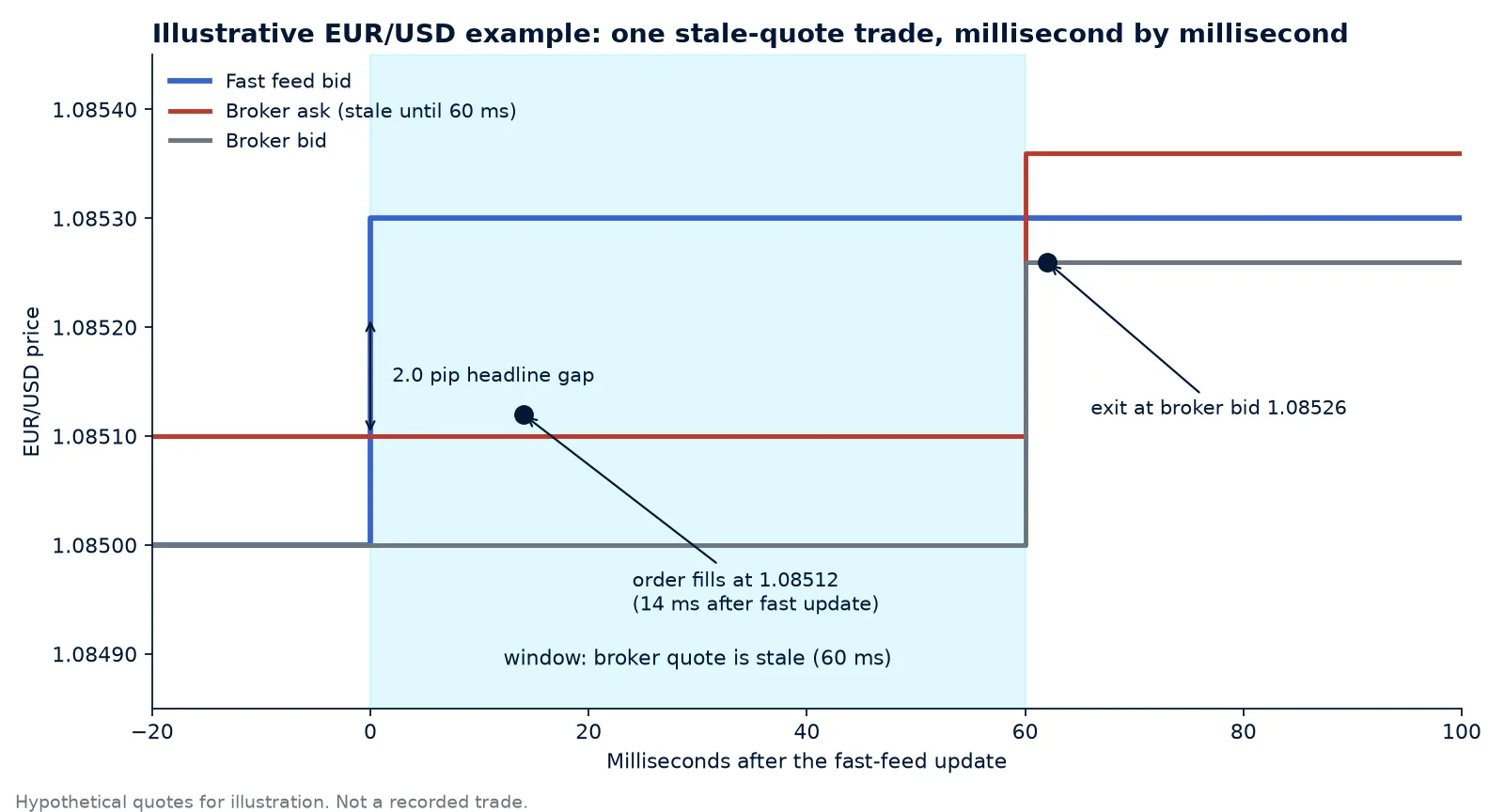
Read the result for what it is. The headline gap was 2.0 pips. Costs took 1.2 of them: 0.4 because the broker’s repriced bid sits below the fast bid, 0.2 slippage on entry and 0.6 commission. At a standard lot of 100,000 units, with a pip worth 10 USD on EUR/USD, 0.8 pip is 8 USD. At 0.10 lot it is 0.80 USD, and at the minimum 0.01 lot it is 0.08 USD. The strategy is a high-volume, thin-margin business, not a few large winners.
Example 2: Order Arrives Late, −1.6 Pips on the Same Signal
Keep every price from Example 1 and change one thing: the order now takes 75 ms to reach the broker, for instance from a more distant server. The broker repriced at 60 ms.
- Entry: the buy fills at the new ask, 1.08536.
- Exit: closing at the new bid, 1.08526, costs 1.0 pip, the full spread.
- Result: commission adds 0.6 pip, so the trade makes −1.6 pips, or −16 USD per standard lot.
The payoff is lopsided: +0.8 pip when the order is in time, −1.6 pips when it is late. To break even, the order must be in time more than 1.6 / 2.4, which is 66.7% of the time, before counting rejected orders. Some brokers do not fill late orders at all; they reject them with last look, which turns this loss into no trade, and is one of the defences described below. A fast signal does not guarantee a fast fill. It guarantees only that you reach the broker’s queue sooner than you would otherwise.
Round-Trip Time and Break-Even: How Fast an Order Must Reach the Broker
Because a late order loses twice what a timely one earns, it must be in time more than 66.7% of the time to break even. In a simple model where the stale window averages 80 ms, that means a round-trip time below about 32 ms. Real windows are wider and shaped differently, as the measured data below shows.
Why Broker Quotes Go Stale and How Long the Stale-Quote Window Lasts
Quotes go stale because every price is a message that takes time to travel, be processed and be republished. Distance, serial processing queues, price consolidation and the broker pricing chain create gaps that last from microseconds on exchanges to tens of milliseconds at retail brokers. A stale quote can be traded only if it stays wrong for longer than it takes you to see the change and reach it.
Light needs several milliseconds between Chicago and New York and tens of milliseconds between London and New York. Nothing removes that floor.
Matching engines, gateways and risk checks handle messages one at a time. Budish and co-authors name continuous trading plus serial processing as the root cause.
A consolidated price is computed after exchange data arrives, so firms with direct feeds can know a better price first (Wah and Wellman, 2013).
A retail quote passes through a liquidity provider, an aggregator or bridge, a markup engine and the trading server. Each step adds delay and can filter updates.
Stale-Quote Research: FCA, BIS and Academic Evidence on Exchanges and Dark Pools
On exchanges the evidence is strong. According to the UK Financial Conduct Authority (Occasional Paper 50, 2020; later Quarterly Journal of Economics, 2022), London Stock Exchange message data show about one race per minute per FTSE 100 stock, a typical race of 5–10 microseconds, roughly 20% of volume in races and a cost of 0.42 basis points of volume. According to the Bank for International Settlements (Working Paper 1115, 2023), a study of dark pools estimated that at least 4% of dark trading happens at stale prices, with high-frequency firms on the profitable side 96–99% of the time. No comparable neutral study exists for retail forex, so published windows of 50–200 ms and profits of 0.5–3 pips are vendor figures to verify, not facts.
Stale-Quote Window Measured at Three Brokers on XAUUSD: Median 34–56 ms
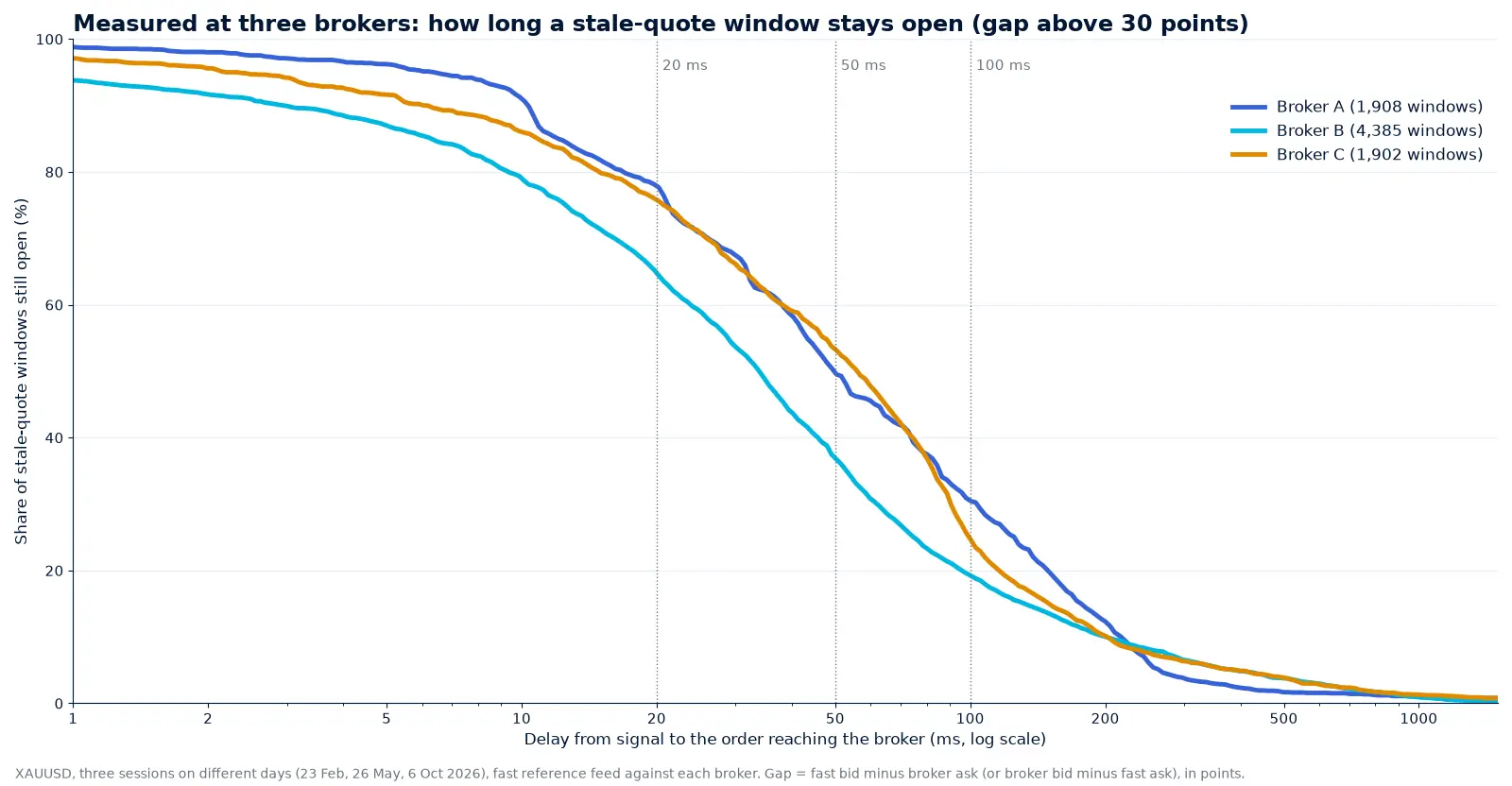
At three retail brokers, XAUUSD quotes stayed stale against a fast feed for a median of 34 to 56 ms at a 30-point gap. The figures come from tick recordings of three single sessions on different days, so they are worked case studies, not a ranking of brokers. The spread of windows was wide: 22% to 35% closed within 20 ms, 19% to 31% stayed open longer than 100 ms, and the mean result per signal reached zero at about 40 ms, 90 ms and beyond 150 ms. A wide broker spread can absorb most of the edge, so measure the delay at which your own broker stops paying.
To replace borrowed numbers with measured ones, we ran the method described in the testing section on tick files saved from three Westernpips research sessions: XAUUSD on three different days, a fast reference feed against three retail brokers, called A, B and C (names withheld). The full method, robustness checks and limits are in the Westernpips XAUUSD Latency Study (2026). These are three single sessions, so they are worked case studies, not a ranking of brokers or a statement about the market.
A window opens when the cross-side gap between the two sources exceeds a threshold and closes when it falls back. The gap is net of both spreads. The table uses a 30-point gap (a point is 0.01 USD per ounce). For gold, 1 pip is taken as 10 points, so 30 points is 3 pips. The “result” columns, in points, are the mean gross move per signal on displayed quotes if the order reached the broker 30 or 100 ms after the signal and was closed one second later, with the spread paid.
| Broker | Broker quote updates per second | Median window | 90th percentile | Open longer than 100 ms | Result at 30 ms | Result at 100 ms |
|---|---|---|---|---|---|---|
| A (spread 10 points) | 2.7 | 50 ms | 217 ms | 31% | +22 | +10 |
| B (spread 12 points) | 9.2 | 34 ms | 200 ms | 19% | +12 | −1 |
| C (spread 46 points) | 6.2 | 56 ms | 201 ms | 25% | +2 | −17 |
Types of Latency Arbitrage: One-Leg, Two-Leg Lock and Hedge Compared
Latency arbitrage is traded in three main forms: one-leg, two-leg (lock) and hedge across two accounts. All three use the same signal, a fast feed that moves before the broker quote, and differ in how many positions and accounts carry the trade. One-leg needs one account and holds each trade for seconds, while the two-leg and hedge forms hold a pair of opposite positions for longer and pay spread and commission on both legs. Choose the form by the broker’s rules on holding time and by how many accounts you run, then test it at the minimum lot.
| Type | How it works | Accounts | Holding time | Main cost or risk |
|---|---|---|---|---|
| One-leg | Trades only the slow broker; the fast feed is used purely as a signal | 1 | Seconds | Late fills, and broker rules on very short trades |
| Two-leg (lock) | Opens a pair of opposite positions, a Buy and a Sell, on one account or across two, and holds them for a set time | 1–2 | Seconds to minutes | Spread and commission paid on two legs |
| Hedge across two accounts | When a gap appears between two brokers, opens opposite positions at each and closes both when prices realign | 2 | Until prices realign | Two sets of costs and two sets of broker rules |
Latency Arbitrage Requirements: Fast Feed, Regulated Broker, Co-Located Server and Software
A latency arbitrage system needs five parts: a fast reference feed, an execution connection to the broker, decision logic, risk controls and hosting close to both endpoints. This holds for an exchange and for a retail broker alike, and the slowest part sets the speed of the whole system. Distance is usually the largest item in the latency budget, which is why a lower ping to the wrong endpoint does not help. Choose hosting and connections by the round-trip time you have measured yourself, not by brochure figures.
| Item | Minimum to test | Professional setup |
|---|---|---|
| Capital | A small deposit you can afford to lose, traded at the minimum lot | Margin for several symbols and brokers, with size limited by the fills you actually get |
| Fast feed | One executable reference feed | Two or more feeds compared, the faster one confirmed by measurement |
| Broker | One ECN or STP account at a broker licensed by a recognised regulator (for example FCA, CySEC or ASIC), with segregated client funds and terms that allow fast trading | Several vetted brokers, licences checked on regulator registers, written answers on the rules, withdrawals tested |
| Hosting | A VPS in the broker’s region with measured round-trip time | A server co-located in the same data centre as the broker or feed |
| Connection | MetaTrader or API | FIX |
| Software and logs | Records ticks and fills | Recording, backtesting with delay and slippage, alerts and a stop-all control |
Co-location. For retail forex the usual answer to distance is co-location: a VPS or server in the same data centre as the broker’s trading server. Many brokers host their MetaTrader and cTrader servers in Equinix data centres such as LD4 and LD5 near London and NY4 in Secaucus, New Jersey; IC Markets, for example, lists NY4 and LD5. Inside one campus the round trip is a small fraction of a millisecond; between New York and London it is tens of milliseconds. Find out where your broker’s server actually is and measure the round-trip time from your own server: in the simple break-even model above, the edge is gone at about 32 ms.
Latency Arbitrage Risks: Slippage, Last Look, Broker Restrictions and Legal Status
The main risks of latency arbitrage are costs that exceed the gap, late or rejected orders, broker restrictions and, on leveraged retail accounts, the ordinary risk of losing capital. In the worked example only 40% of the headline gap survives costs, and a late order loses twice what a timely one earns, so a broker test at the minimum lot comes before any size. Use a broker licensed by a recognised regulator and ask whether client funds are segregated.
- Costs: in the worked example 60% of the headline gap is lost to costs, and a late order loses twice what a timely one earns.
- Broker action: wider spreads, last look, added delay, restricted accounts or a closure under the client agreement.
- Backtests: displayed quotes ignore rejections, slippage and competition.
- Broker safety: check the licence on the regulator’s public register, ask whether client money is segregated and whether negative balance protection applies.
How Brokers Limit Latency Arbitrage: Wider Spreads, Last Look and Execution Controls
Brokers and liquidity providers stop latency arbitrage with wider spreads, last look, execution-quality controls, limits in the client agreement and, on exchanges, changes to market design. They do it because the party holding the stale quote is the one that loses money on every fast trade. The IEX exchange adds a delay of about 350 microseconds to orders. Watch your own fill logs for slippage, rejection rate and hold time, because a change in execution quality shows up there first.
| Defence | How it works | Where you meet it |
|---|---|---|
| Wider spreads | Price in the expected cost of being sniped, as the FCA paper describes for exchanges | Everywhere, usually invisibly |
| Last look | The liquidity provider holds an order briefly and may reject it if the price moved. The Global Foreign Exchange Committee’s guidance describes it as a limited price and validity check, and says liquidity providers should not trade on information from the client’s trade request during the last-look window | Some ECNs and bank liquidity providers |
| Execution-quality controls | Asymmetric slippage, requotes, added delay or rejections for accounts whose fills look unusually good | Broker servers, described by brokers and by firms that sell the controls |
| Quote filtering and smoothing | The broker’s bridge or pricing engine filters, throttles or smooths the incoming feed, limiting how many price updates reach the trading server or dropping short spikes, so a brief move may never appear as a tradable quote | MetaTrader bridges and broker pricing engines |
| Account measures | Limits on instruments, lot size or holding time, set in the client agreement | The client agreement |
| Market design | Speed bumps (IEX adds a delay of about 350 microseconds), frequent batch auctions, randomised execution times, or an order type that fixes the execution time | Exchanges and proposed rules; Budish and co-authors, the BIS and Kuhle (2023) study them |
Is Latency Arbitrage Legal? Regulation, Broker Terms and Prop-Firm Rules
Latency arbitrage is legal in most jurisdictions, but each broker decides whether its accounts allow it. Regulators target manipulation, spoofing and fraud rather than speed: arbitrage trades a price gap that already exists, while manipulation creates one. Many retail brokers, market makers in particular, limit or forbid latency-based and very short trading in their client agreements, while ECN and STP brokers are usually more open to fast trading. Read the client agreement before depositing and choose a broker whose terms fit the strategy; this page is not legal advice.
- Read the terms before the deposit: Look for words such as arbitrage, latency, minimum holding time, scalping and abusive trading, and ask the broker in writing if something is unclear.
- Start with a small test deposit: Check execution, slippage and a withdrawal before you scale up.
- Choose an algorithm that fits the broker’s terms: Many brokers restrict very short trades but allow positions held for a set time. TwoLegLock and OneLegHidden in Westernpips Private 7 are built for that case: they let you take trades that last longer, so the account stays within the broker’s rules on holding time. Brokers generally object to ultra-short trades rather than to longer positions, which is why this form is less likely to lead to restrictions. It is not a guarantee, because each broker decides for itself. Rules differ from broker to broker, so check the holding-time and arbitrage clauses of your own agreement and confirm in writing if anything is unclear.
Latency Arbitrage Fairness Debate: Speed Bumps and the 2026 Eleventh Circuit Ruling
Whether latency arbitrage is harmful is contested, and in 2026 the dispute reached a US appeals court. Critics, led by Budish and co-authors, treat it as a tax on investors that buys no better prices: the FCA study put it at 0.42 basis points of volume and about 5 billion US dollars a year in global equities. On 29 May 2026 the Eleventh Circuit denied Citadel Securities’ petition against the SEC’s approval of the IEX options exchange, whose design includes a speed bump. The ruling concerns exchange rules, not retail forex, but it shows that regulators and courts accept speed-bump designs as a response to stale quotes.
Choosing a Latency Arbitrage Setup: Which Form Fits Your Broker’s Rules
Choose the form of latency arbitrage by what your broker allows and what your measurements show, not by what looks fastest. If recorded windows are shorter than your round-trip time, change the broker or the hosting before you change the strategy; if the broker restricts very short trades, a longer-holding two-leg form is the one to test; if you trade for a prop firm, the rules almost always rule the strategy out.
Test the one-leg form (OneLegMulti in Westernpips Private 7) at the minimum lot and compare fills with the recorded gaps.
Test a two-leg form such as TwoLegLock, which lets you hold trades longer, and confirm the holding-time rule in writing.
Fix hosting or choose another broker first. In the simple break-even model the edge disappears at about 32 ms.
Do not use it. FTMO, for example, lists delay-exploiting strategies among its forbidden practices.
How to Test a Broker for Latency Arbitrage: Record Quotes, Measure the Window, Check Fills
You can test a broker for latency arbitrage by recording its quotes alongside a fast feed and measuring how long the cross-side gap stays above your costs. The test needs two simultaneous recordings, timestamped by one clock on your own server, and about an hour of data per symbol. Applied to three XAUUSD sessions, this method found median stale-quote windows of 34 to 56 ms, and a delay at which signals stopped paying that ranged from about 40 ms to over 150 ms between brokers. Before funding an account, finish with three to five orders at the minimum lot and compare the real fills with the recorded gaps.
- Record both sources: Log every tick from the fast source and from the broker, each with the time it arrived at your server. Use one clock for both. Source timestamps and local arrival timestamps are different things; keep both.
- Compute cross-side gaps: For a buy, fast bid minus broker ask. For a sell, broker bid minus fast ask. Spreads are already inside these numbers, so do not subtract them again.
- Find the windows: A window opens when the gap exceeds your cost threshold and closes when it returns to zero or below. Record its size and how long it lasted.
- Look at the distribution: How many windows per hour, how long the median lasts, how often they exceed your measured round-trip time. If most close in a few milliseconds, no hosting will rescue the idea.
- Test fills at the minimum lot: Send three to five orders on different days, across the London and New York sessions. Record signal-to-fill time, slippage, rejections and whether stops are accepted.
Latency Arbitrage FAQ: Legality, Speed, Profitability, Brokers and Software
What is latency arbitrage?
How does latency arbitrage work in forex?
Is latency arbitrage legal?
Is latency arbitrage still profitable in 2026?
How fast do you need to be?
Is latency arbitrage the same as front-running?
Which brokers allow latency arbitrage?
Do prop firms allow latency arbitrage?
What software is used for latency arbitrage?
Sources and Methodology: How the Latency Arbitrage Figures Were Produced
Figures on this page come from three places: our own tick recordings of gold at three brokers, hypothetical worked examples with every cost shown, and published regulator and academic papers. Each is labelled where it appears, and all were checked against the sources below on 29 October 2026.
- Retail gold figures come from tick recordings of three sessions at three brokers made with Westernpips Private 7, a fast reference feed against each broker. They are displayed quotes, not executed trades; method, checks and limits are in the Westernpips XAUUSD Latency Study (2026) and in the open research paper.
- EUR/USD and stock examples use hypothetical quotes written by Westernpips; every cost is shown and the arithmetic can be repeated.
- The break-even estimate comes from a simple model with stated assumptions (80 ms mean window, exponential distribution), not a forecast.
- Exchange and dark-pool figures are quoted from the regulator and academic papers listed below; they do not describe retail forex.
- Budish, E., Cramton, P. and Shim, J. (2015). The High-Frequency Trading Arms Race: Frequent Batch Auctions as a Market Design Response. Quarterly Journal of Economics, 130(4), 1547–1621. doi.org/10.1093/qje/qjv027
- Aquilina, M., Budish, E. and O’Neill, P. (2020). Quantifying the High-Frequency Trading “Arms Race”: A Simple New Methodology and Estimates. Financial Conduct Authority, Occasional Paper No. 50. www.fca.org.uk/publications/occasional-papers/occasional-paper-no-50-quantifying-high-frequency-trading-arms-race-new-methodology
- Aquilina, M., Budish, E. and O’Neill, P. (2022). Quantifying the High-Frequency Trading “Arms Race”. Quarterly Journal of Economics, 137(1), 493–564. doi.org/10.1093/qje/qjab032
- Aquilina, M., Foley, S., O’Neill, P. and Ruf, T. (2023). Sharks in the dark: quantifying HFT dark pool latency arbitrage. Bank for International Settlements, Working Papers No. 1115. Published in Journal of Economic Dynamics and Control, 2024. www.bis.org/publ/work1115.htm
- Wah, E. and Wellman, M. P. (2013). Latency arbitrage, market fragmentation, and efficiency: a two-market model. Proceedings of the 14th ACM Conference on Electronic Commerce. doi.org/10.1145/2492002.2482577
- Global Foreign Exchange Committee (2021). Guidance paper on last look, published alongside the FX Global Code (Principle 17). www.globalfxc.org/docs/gfxc_report_last_look.pdf
- LMAX Exchange (2017). TCA and Fair Execution: The Metrics That the FX Industry Must Use. Transaction-cost-analysis white paper (fill ratio, price variation, hold time, spread, market impact). www.lmax.com/FX-TCA-Transaction-Cost-Analysis
- Kuhle, W. (2023). Latency arbitrage and the synchronized placement of orders. Financial Innovation, 9. doi.org/10.1186/s40854-023-00491-5
- U.S. Court of Appeals for the Eleventh Circuit (29 May 2026). Citadel Securities v. SEC, No. 25-13631: petition for review of the SEC’s approval of the IEX options exchange denied. media.ca11.uscourts.gov/opinions/pub/files/202513631.pdf
- Financial Conduct Authority (2019). FCA confirms permanent restrictions on the sale of CFDs and CFD-like options to retail consumers (rules apply from 1 August 2019): leverage limits of 30:1 to 2:1, 50% margin close-out, negative balance protection and a standardised risk warning. www.fca.org.uk/news/press-releases/fca-confirms-permanent-restrictions-sale-cfds-and-cfd-options-retail-consumers
- European Securities and Markets Authority (2018). ESMA adopts final product intervention measures on CFDs and binary options: leverage limits from 30:1 (major currency pairs) to 2:1, 50% margin close-out, negative balance protection and a standardised risk warning; CFD measures applied from 1 August 2018. www.esma.europa.eu/press-news/esma-news/esma-adopts-final-product-intervention-measures-cfds-and-binary-options
- FTMO (2026). Forbidden Trading Practices (FTMO Futures). ftmo.com/en/futures/forbidden-trading-practices/
- Vinsky, A. (2026). How Long Do Stale Quotes Last? Westernpips research paper (CC BY 4.0). Also on SSRN (10.2139/ssrn.7655440) and SocArXiv (10.31235/osf.io/cg2yv_v1); code on GitHub (AlexanderVinsky/stale-quote-windows). doi.org/10.5281/zenodo.23364414

Trader and developer of software for latency arbitrage and HFT trading with more than 19 years of experience. He founded Westernpips in 2007 and leads the development of Westernpips Private 7, its FIX and API connectors and the tools used to record and analyse quotes and fills.
Read next
- Forex quotes explainedBid and Ask, price feeds and how to measure your broker delay.
- Fast quote providersWhere the fast side of the gap comes from.
- How to find a broker for arbitrageExecution, slippage and broker terms in a 2-week test.
- Best arbitrage strategyLatency, lock, triangular, statistical and hedge arbitrage compared.