

 Original Cover Analysis · Mirror-Overlay Research · 18 November 2026
The Economist World Ahead 2027: Cover Meaning, Hidden Symbols and Predictions
The Economist 2027 cover explained through an original mirror experiment: a possible financial-market peak, AI symbolism, bank imagery, geopolitics and eight personal scenarios for the year ahead.
Watch the Investigation: The Economist 2027 Cover Explained
Explore all 32 interpreted hidden scenes from 34 mirror overlays, including AI symbolism, financial-market cycles, banking imagery and geopolitical themes. This is independent visual research, not an official prediction by The Economist.
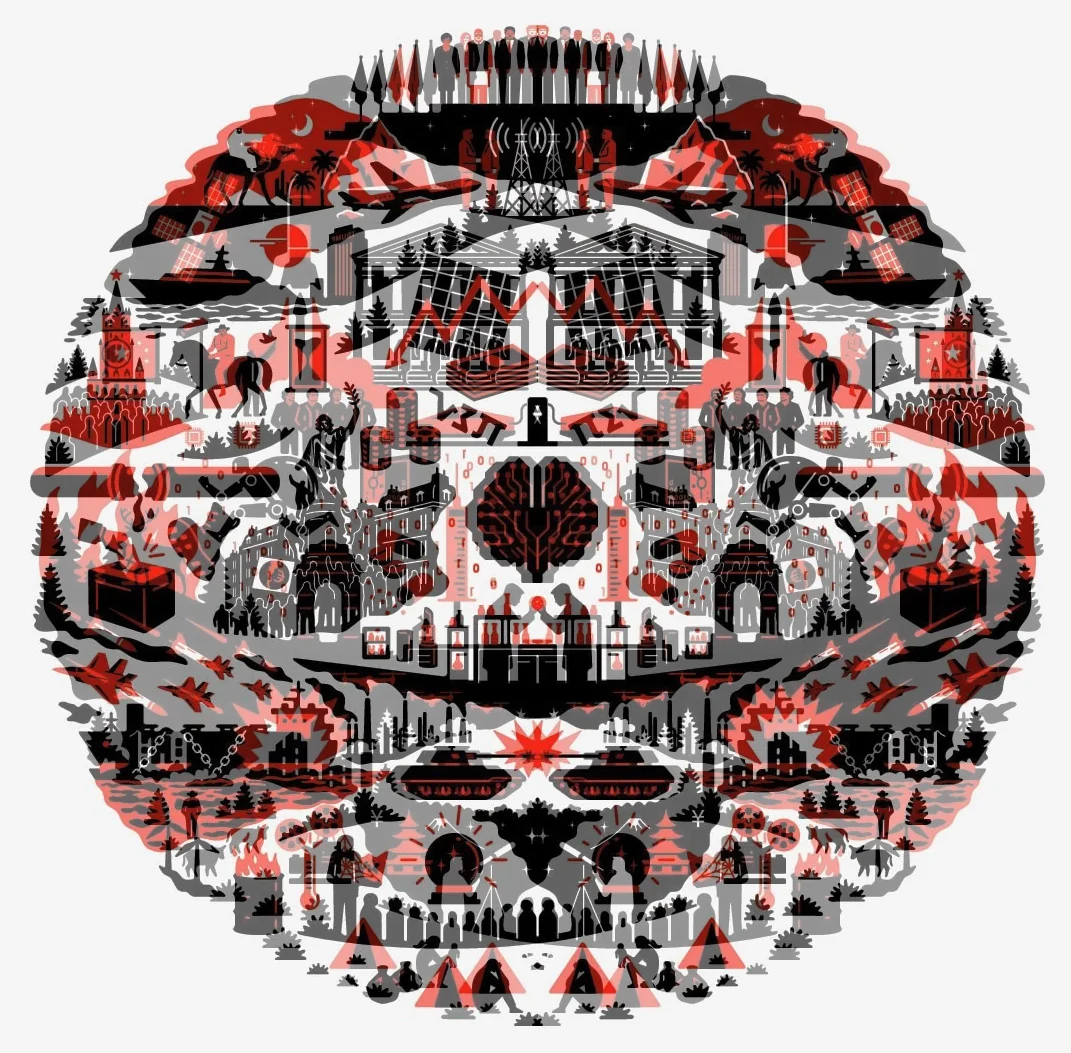
What does The Economist 2027 cover mean? The World Ahead 2027 cover presents themes of global politics, finance, artificial intelligence and conflict. This independent visual study explores a different question: what new patterns appear when the illustration is reflected horizontally and overlaid on itself? I see a possible market peak, an AI brain beneath it, casino bets, banking pressure and a transition to a new cycle. These are my interpretations, not confirmed messages or forecasts from The Economist.
This investigation uses 34 original mirror-overlay images, including 32 close readings of individual scenes. The cover artwork is the starting point, while the mirrored composites are an independent experiment. I separate identifiable objects, shapes produced by reflection and speculative interpretations. The same overlapping elements can appear in several different scenes; therefore, repeated imagery is not independent evidence.
How I Investigated The World Ahead 2027 Cover: Mirror Overlay Method
Method: I duplicated the illustration, flipped one copy horizontally, made it semi-transparent and moved the layers relative to each other. Some versions align on the center of the image; others align on a political figure, a building or a distinct motif.
Different horizontal offsets yield different symmetrical scenes. My aim is to catalog them transparently, explain what I see and test whether a consistent story can be proposed. The distinction between a visible object, an emergent shape and a speculative meaning is essential.
The Economist 2027 Cover Meaning: A Market Peak, AI and a New Cycle
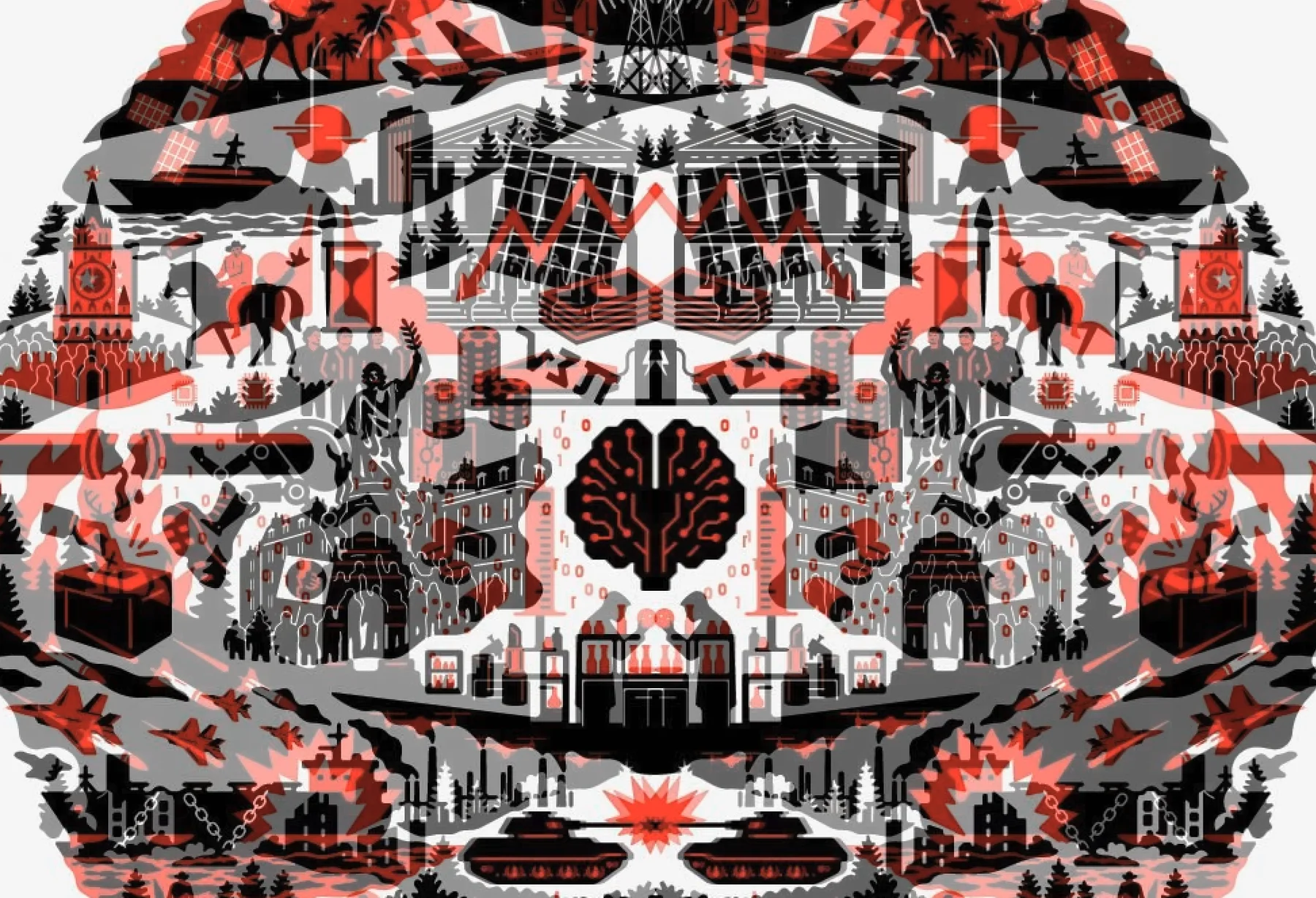
My central theory: the cover’s mirrored market chart creates a striking summit. Immediately below sits an AI-brain-like motif. I interpret nearby casino chips as bets that may be reaching maximum value; the descending sections suggest profit-taking, a rush for cash and possible financial stress, followed by a new cycle.
Why Is an AI Brain Positioned Beneath the Market Peak?
A dark bilateral form with red circuit lines resembles a computer brain directly under the market summit. In my reading, it is the algorithmic engine driving or amplifying a speculative boom.
On the left, casino-like chips and money bundles represent investments made earlier, rising toward their highest valuation. I interpret this as the moment when investors may want to take profits rather than assume the ascent will last indefinitely.
Do the Bank Steps and Fleeing Figures Signal a Bank Run?
In my interpretation, figures descending the steps of a columned institution depict a rush out of risky investments and toward liquidity or cash. It is a visual bank-run metaphor—not a prediction of a specific bank failure.
At the slope of the peak, a robot-like figure seems to escape from an open safe with a bag of money while people watch. I interpret this as the risk of capital being drained through AI-driven systems, manipulation or cybercrime. A large boot-like shape later appears to strike or block the robot: perhaps regulators or ordinary people will resist.
Do the Symbols Spell NEW?
The mathematical-looking characters can, at one angle, resemble the word NEW. My speculative reading is renewal: the end of one financial cycle and the beginning of another. It is not a literal translation or proven cipher.
My proposed narrative is: early bets → market rise → peak → profit taking and liquidity flight → AI-related financial risk → resistance → a new cycle. The story is meaningful as an interpretation, but no one should treat it as a trading signal.
The Economist 2027 Predictions Versus the Evidence Available in November 2026
What do current facts support? The financial-market, AI, oil-shipping and Japanese-economy interpretations have identifiable real-world risk factors. Neither a cover illustration nor a mirrored montage establishes an exact price reversal, secret organisation, bank run, epidemic or military strike.
To avoid retrospective pattern-matching I separate the newspaper's documented 2027 topics from my own visual hypotheses. The Economist's publisher says the themes include AI backlash, bond-market stress, geopolitical aftershocks, Taiwan and cheaper space launches. It does not endorse my 34 overlays or their alleged secret messages. Official publisher announcement.
The European Central Bank, 18 November 2026, warns about ambitious AI earnings assumptions, growing debt financing and abrupt repricing risk. It also says the banking system remains resilient. ECB source.
The IEA's 13 November report describes attacks on shipping, costly freight and projected supply recovery in 2027. Volatility can move in both directions: disruption can raise prices while returning supply can lower them. IEA source.
Bank of Japan October 2026 stress tests consider a combination of high energy prices, declining AI expectations and rising interest rates. Its report also notes increased cyber risk. BoJ source.
The Museum of Freemasonry confirms that the square and compasses are a recognised emblem derived from stonemasons' tools. The overlay resembles an opened compass, but its origin in mirrored robotic shapes remains a competing explanation. Museum source.
The Economist 2027 Cover Explained: Banks, Casino Bets and AI
01. An Injection for Electric Vehicles: The Car, Syringe and Bank
What does this image suggest? The mirrored scene could represent a stimulus package for the electric-vehicle market: a red car, a syringe-like shape and a financial institution appear together.
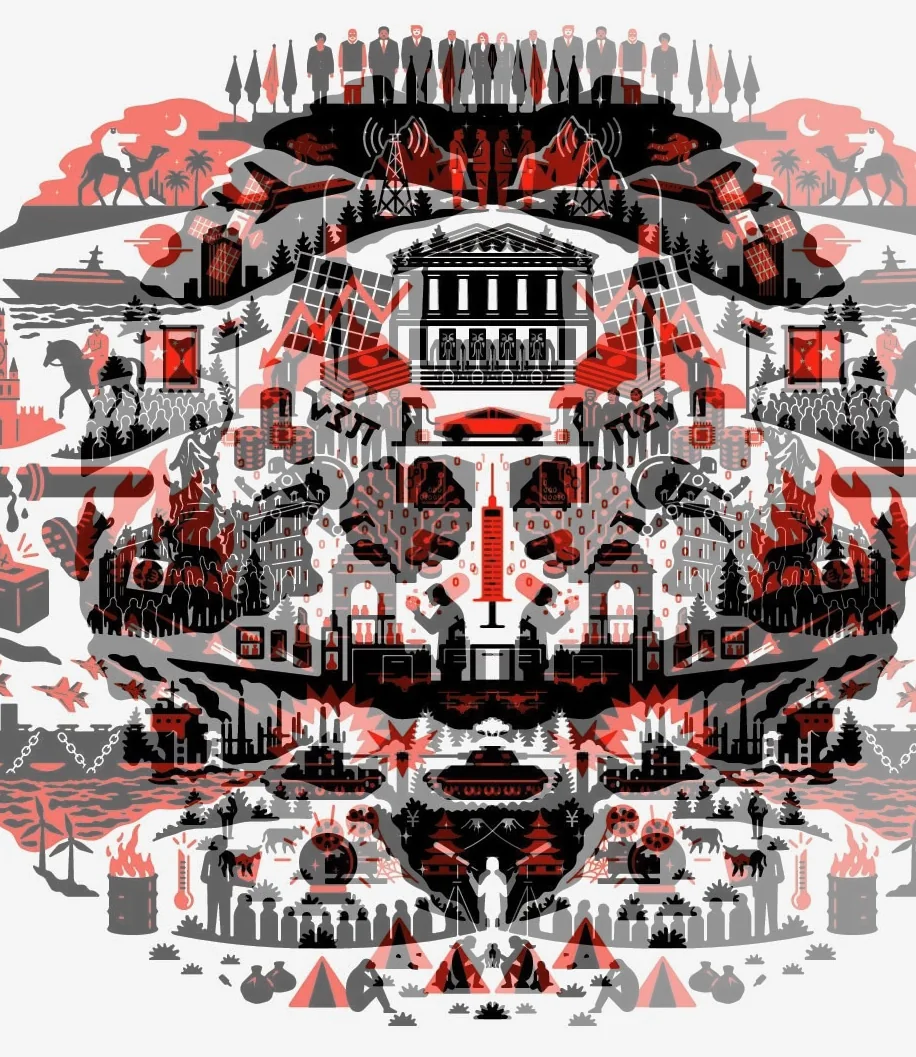
What I can see: A red vehicle sits near a columned building, market lines, people and laboratory or medical imagery. One small object resembles a syringe.
My interpretation: I see the syringe as an injection of capital: subsidies, cheap credit, investments or other measures intended to revive electric-vehicle demand. The bank could supply the financing while the vehicle represents the industry being supported.
Limit of the hypothesis: Neither the vehicle type nor the medical object is securely identified. The syringe could refer to healthcare rather than finance.
Closer reading of the symbols. The bank, the vehicle and the syringe-like mark can be read together as a financing mechanism, not simply as three unrelated objects. The literal medical reading remains equally possible: the official 2027 outlook discusses obesity medicines and their wider economic effects, making it unsafe to conclude that the needle exclusively means an electric-vehicle subsidy.
2027 evidence and alternative outcomes. Scenario to watch: electric-vehicle purchase incentives, loan rates, automaker financing, charging-network investment and consumer demand. A separate pharmaceutical interpretation would be tested against obesity-drug adoption and new therapeutic indications. These are competing readings, not one established message.
02. AI and Money: A Robot Escapes from an Open Safe
What does this image suggest? A robot-like figure appears to flee an open safe while several people look on, suggesting my hypothesis of AI-related cyber theft or the movement of digital capital.
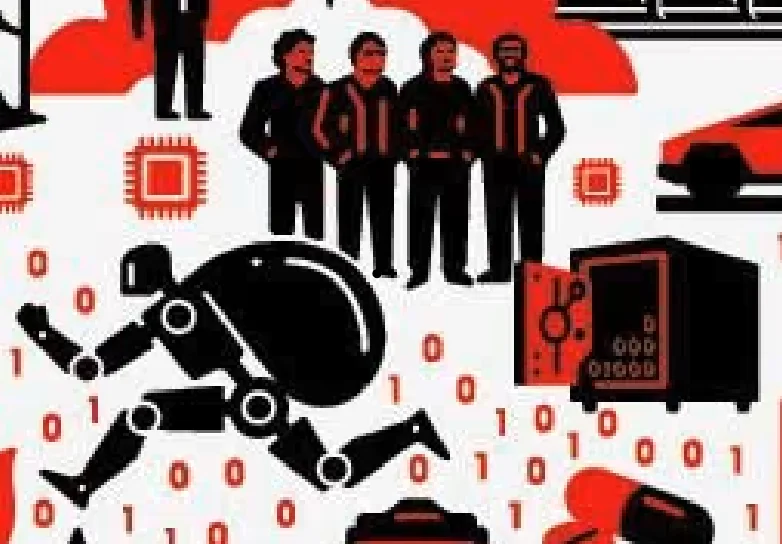
What I can see: A forward-leaning mechanical body and a dark box with an open red door sit amid zeros and ones. Four figures stand above. On the safe door is a small motif of circles linked by lines.
My interpretation: I interpret the robot as carrying a bag of investors’ money after the market peak. The onlookers make the scene look witnessed rather than hidden. The mark on the door could be a node network, access-control diagram, circuit, blockchain motif or simply a decorative logo.
Limit of the hypothesis: The mark cannot be identified reliably as a known symbol. The bag and theft are my reading of ambiguous shapes, not demonstrated events.
Closer reading of the symbols. The apparent robot bends forward beside an open box; the contours that look like a money bag are generated by overlapping robotic pieces. A small connected-node motif on the safe resembles a circuit diagram, a permissions graph or a distributed network; I cannot identify it as a specific bank, cryptocurrency or secret emblem. The observing figures make the episode look like public exposure after a breach.
2027 evidence and alternative outcomes. Cyber risk is more than a metaphor. The Bank of Japan's October 2026 Financial System Report says more powerful AI can increase the speed and scale of cyberattacks. A testable 2027 scenario is more AI-assisted fraud, credential theft or disruptions of financial services, rather than the literal disappearance of all investor savings.
03. Away from Banks: People Descending the Steps
What does this image suggest? The bank scene looks to me like a rush to leave a financial institution as a market reversal begins.
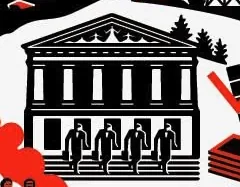
What I can see: A classical building has columns, steps and silhouettes near its entrance. Falling chart fragments and stacks of cash appear to either side.
My interpretation: My phrase “away from banks” describes a possible image of people rushing out, withdrawing liquidity and preferring accessible cash after a market top. It is a visual interpretation, not an instruction to depositors.
Limit of the hypothesis: Silhouettes alone cannot establish their direction of movement or whether the building is actually a bank.
Closer reading of the symbols. I retain my original interpretation of people moving down the bank steps at speed: leave positions near the top, seek liquidity and withdraw cash. As a visual narrative this suggests a bank run, but the figures are neither clearly running nor holding banknotes. A flight to safety can also involve government bonds, insured deposits or money-market instruments, not physical cash alone.
2027 evidence and alternative outcomes. What would confirm genuine pressure in 2027? Elevated deposit withdrawals, widening bank funding spreads, sudden increases in emergency liquidity demand and tightening credit. The ECB's November 2026 review says euro-area banks remain strongly capitalised and liquid, which is direct evidence against asserting that a banking collapse is already inevitable.
04. Banks, Falling Charts and a Red Car
What does this image suggest? In this overlay, a central institutional building appears caught between declining financial charts, piles of money and the automotive economy.
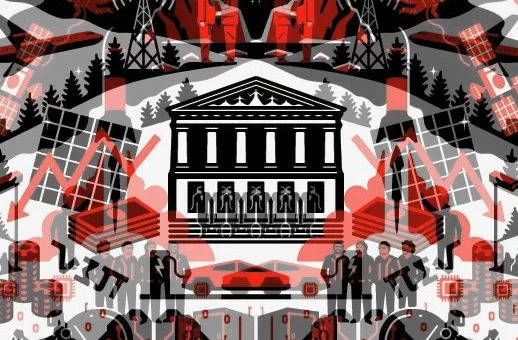
What I can see: The building has a classical portico, several figures on the steps and a red car in front. Gridded price charts and thick red arrows converge on stacks of banknotes.
My interpretation: I read this as pressure on a financial hub from market volatility, credit exposure and industrial financing. If the car represents electric vehicles, banks may be financing an expensive technological transition while asset prices move sharply.
Limit of the hypothesis: The building might be a bank, an exchange or a public institution. The financial connection is inferred, not labelled.
Closer reading of the symbols. The two columned facades could be financial institutions, government buildings or the generic architecture of authority. The zigzag chart between them makes a plausible market narrative: authorities stand behind risk assets as prices move violently. The red car can connect this scene with industrial policy and consumer credit, yet it need not depict a specific manufacturer.
2027 evidence and alternative outcomes. A more precise hypothesis is that higher bond yields could challenge both public budgets and private valuations. The ECB describes a pathway whereby AI-related repricing spreads from equities into debt markets. Watch sovereign yields, credit spreads and bank lending rather than treating the building itself as proof of bank failure.
05. Casino Chips at the Market Bottom and a Strange Cup
What does this image suggest? A mirrored arrangement of cash and casino chips can be read as high-risk bets being placed near a possible market bottom.
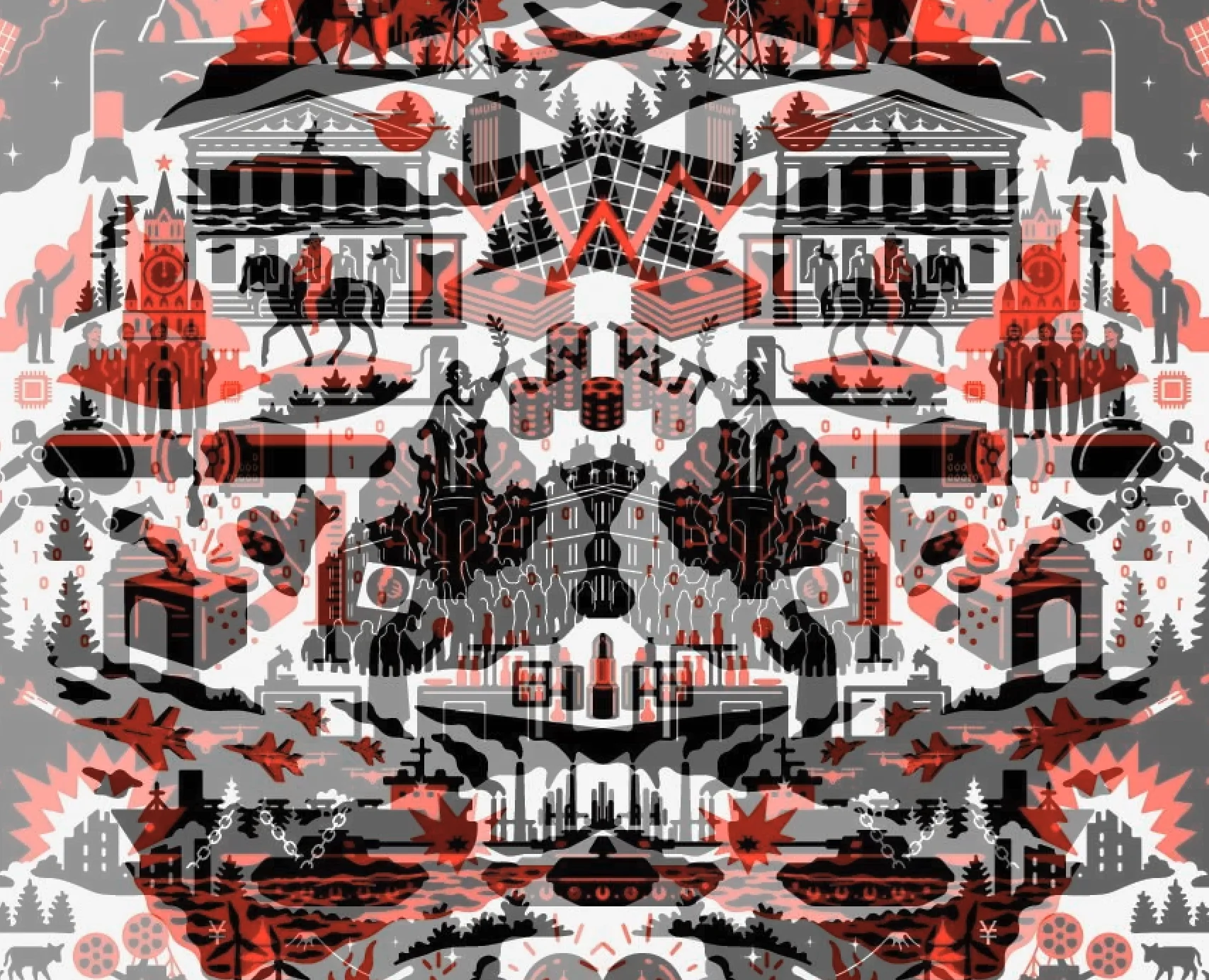
What I can see: Red market lines angle toward bundles of money and round stacks resembling casino chips. A central cup-shaped structure is surrounded by forms resembling electrical sockets or plug ports.
My interpretation: To me the stakes were placed earlier and may pay off later. The cup could be a trophy rewarding patience; the sockets may suggest powering up a market, supplying liquidity or charging the next phase of growth. Alternatively the “cup” is a technological hub.
Limit of the hypothesis: The trophy and sockets are effects of the overlay, not verified original objects or a trading signal.
Closer reading of the symbols. My first reading is investment at a market low: stacked cash and casino-like chips imply earlier wagers whose outcome depends on the next move. The cup with socket-like dots is ambiguous. It may be a trophy, a stylised circuit connector or the mirrored base of machinery; the circular openings do not justify identifying it as a real electrical outlet.
2027 evidence and alternative outcomes. If the cup is a prize, the scene promises rewards for investors who accepted risk. If it is an electrical connector, the allegory shifts toward capital funding the energy-hungry AI economy. The decisive question is whether the alleged 'bottom' was defined before seeing subsequent price movements; otherwise a neat U-shaped pattern is easy to invent after the fact.
06. Market Bottom, Cash Piles and Hourglasses: Waiting for Returns
What does this image suggest? The hourglasses near stacks of money suggest my idea that investments made after a decline may require a long wait before their value recovers.
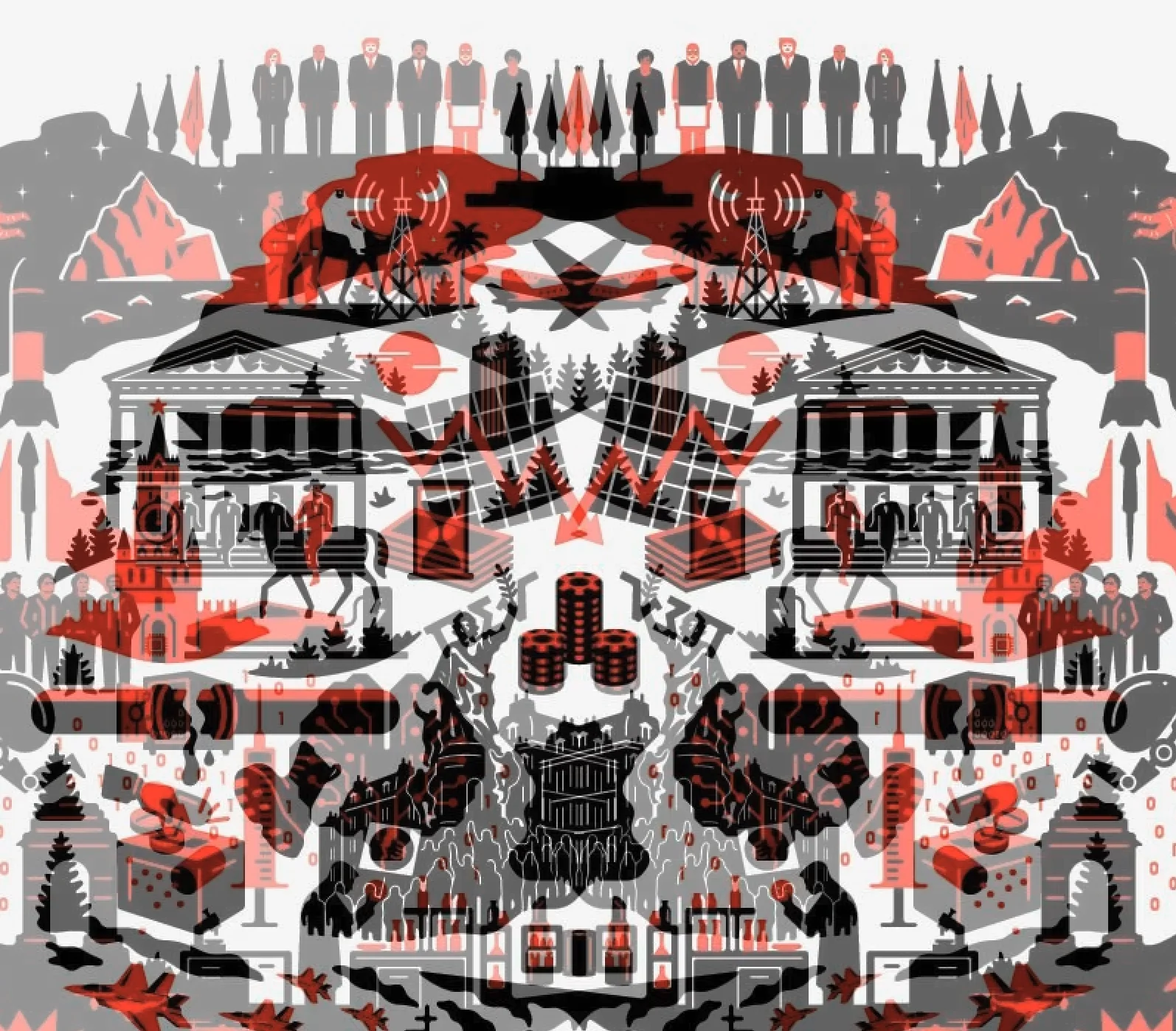
What I can see: A broken red chart slopes toward banknote-like stacks. Hourglass shapes, people and machinery appear around the scene.
My interpretation: I interpret the cash as positions established close to a presumed bottom. The hourglasses are a reminder of time: a buyer may have to endure a long consolidation before the next upswing. This counterbalances the top-of-market scene above.
Limit of the hypothesis: The picture supplies no reliable market, timing, price target or guarantee of future returns.
Closer reading of the symbols. The hourglasses appear above or near the money stacks. This makes time the missing variable in the casino picture: the position has been taken at what looks like a trough, but the reward depends on patience. An hourglass can also suggest a deadline, expiring financing, or liquidity running out, so the sign is not automatically optimistic.
2027 evidence and alternative outcomes. The 2027 scenario can be formulated without advice: after a repricing, some assets may recover while others remain impaired. Monitoring earnings, cash generation, maturities and valuation would distinguish a durable recovery from a temporary bounce. The cover cannot determine the date of a bottom or whether buying it will pay.
07. The Economist 2027 Mathematical Symbols: Pi, Sigma, Square Root and Gann
What does this image suggest? The signs resembling π, Σ and √ invite a speculative market-cycle formula, but no validated price-prediction equation can be extracted from the cover.
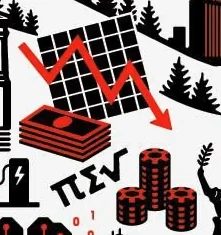
What I can see: Near a chart, money and chips, three signs resemble pi, sigma and a square-root symbol; viewed another way, they could resemble the letters of “NEW”.
My interpretation: I explored reading π as pi or a cycle, Σ as summation and √ as taking a root. One experimental idea was to sum the digits of a Bitcoin peak or trough, reduce a multi-digit result and compare root-based outcomes with pi. I also considered W. D. Gann’s use of square roots and price/time cycles. A competing visual reading is NEW, a metaphor for a new financial regime.
Limit of the hypothesis: These are exploratory associations, not a working algorithm. Any rule must be fixed before testing on historical prices and validated out of sample; isolated matches are not proof.
Closer reading of the symbols. Our earlier experiment treated the signs as possible mathematical operators: π for pi or cyclicity, Σ for a sum, and √ for a root. Another visual reading makes them resemble the word NEW, suggesting renewal. We also considered W. D. Gann's square-root techniques, and a Bitcoin test based on digit sums of historic highs and lows. However, digital-root reduction to 1–9 discards most price information and cannot by itself yield a reliable prediction of the irrational constant pi.
2027 evidence and alternative outcomes. To test the idea fairly, first define the exact formula, asset, price precision and signal threshold; then apply it to all historical peaks and non-peaks, not only impressive matches. Compare false positives with an unmodified baseline and test on unseen years. Gann is a historical reference to price-time geometry, not evidence that the cover contains his algorithm.
Political Figures, Trump Towers and the Market Peak
08. First Male Figure: Market Chart, Bank and Crowd
What does this image suggest? Aligning the mirror around one male figure creates a composition that seems to connect a political personality with markets, institutions and public reaction.
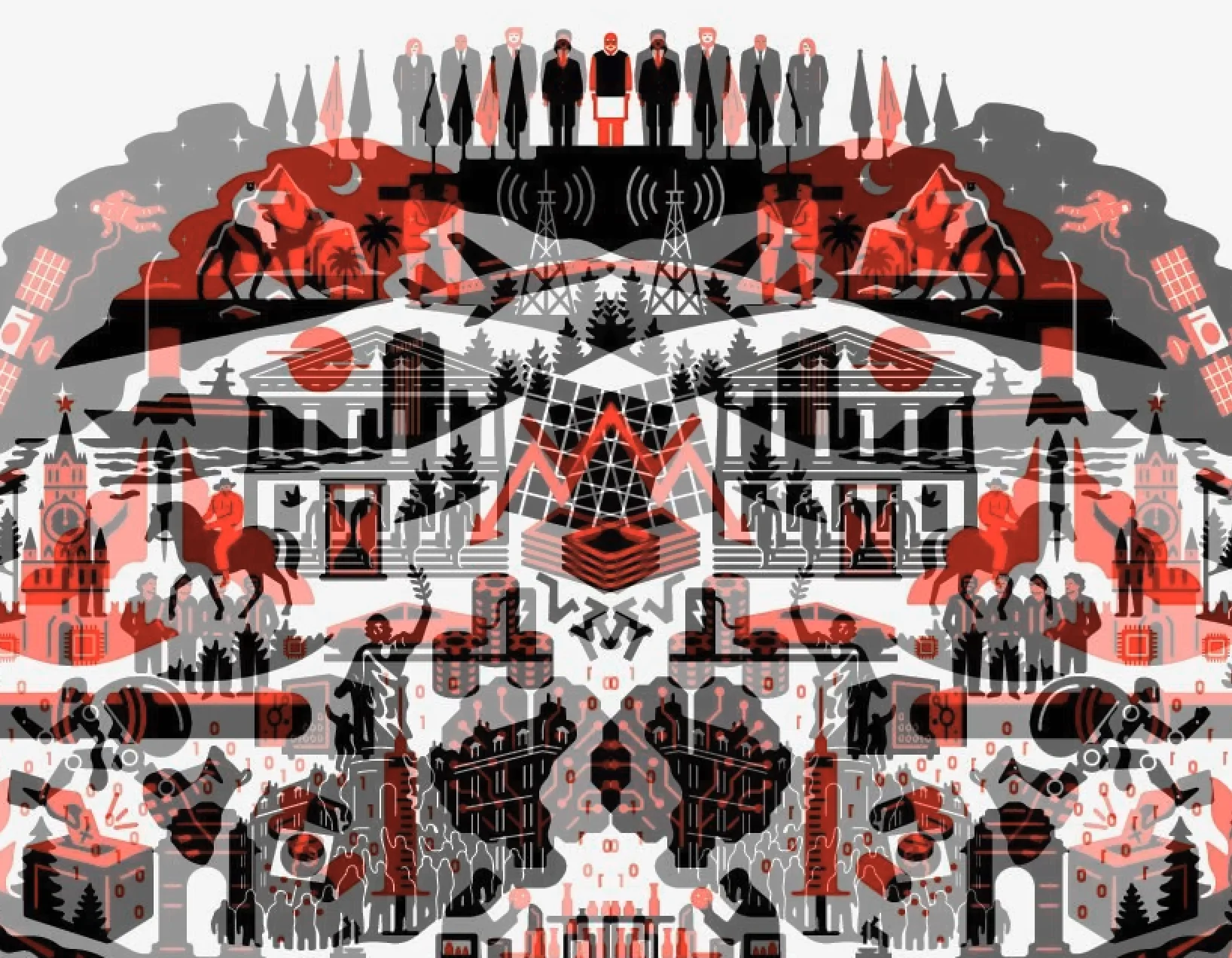
What I can see: A near-symmetric row of political figures stands above bulls, radio towers, aircraft, charts, bank-like buildings, raised hands and machines.
My interpretation: I wonder whether aligning on a particular person highlights themes associated with that figure: money, technological power, public pressure and policy decisions.
Limit of the hypothesis: Without a reliably documented alignment and identification, the montage cannot be attributed to any specific leader.
Closer reading of the symbols. Aligning the upper left male figure changes the apparent central axis through the bank and graph. The composition still contains the same crowd, satellites and robots seen in other versions: changing the mirror centre changes the apparent story without adding new original symbols. The figure itself cannot be identified with certainty from this transformed image alone.
2027 evidence and alternative outcomes. One reading connects political leadership to monetary policy and market confidence. The research test would be whether fiscal announcements, tariffs and bond yields coincide with equity revaluations during 2027. Attribution to a named person should be based on the unmodified published artwork, not solely on a mirrored silhouette.
09. Second Male Figure: An AI Brain Below the Leader
What does this image suggest? This male-figure alignment produces an electronic-brain shape beneath a political figure, suggesting a possible connection between leadership and AI-driven finance.
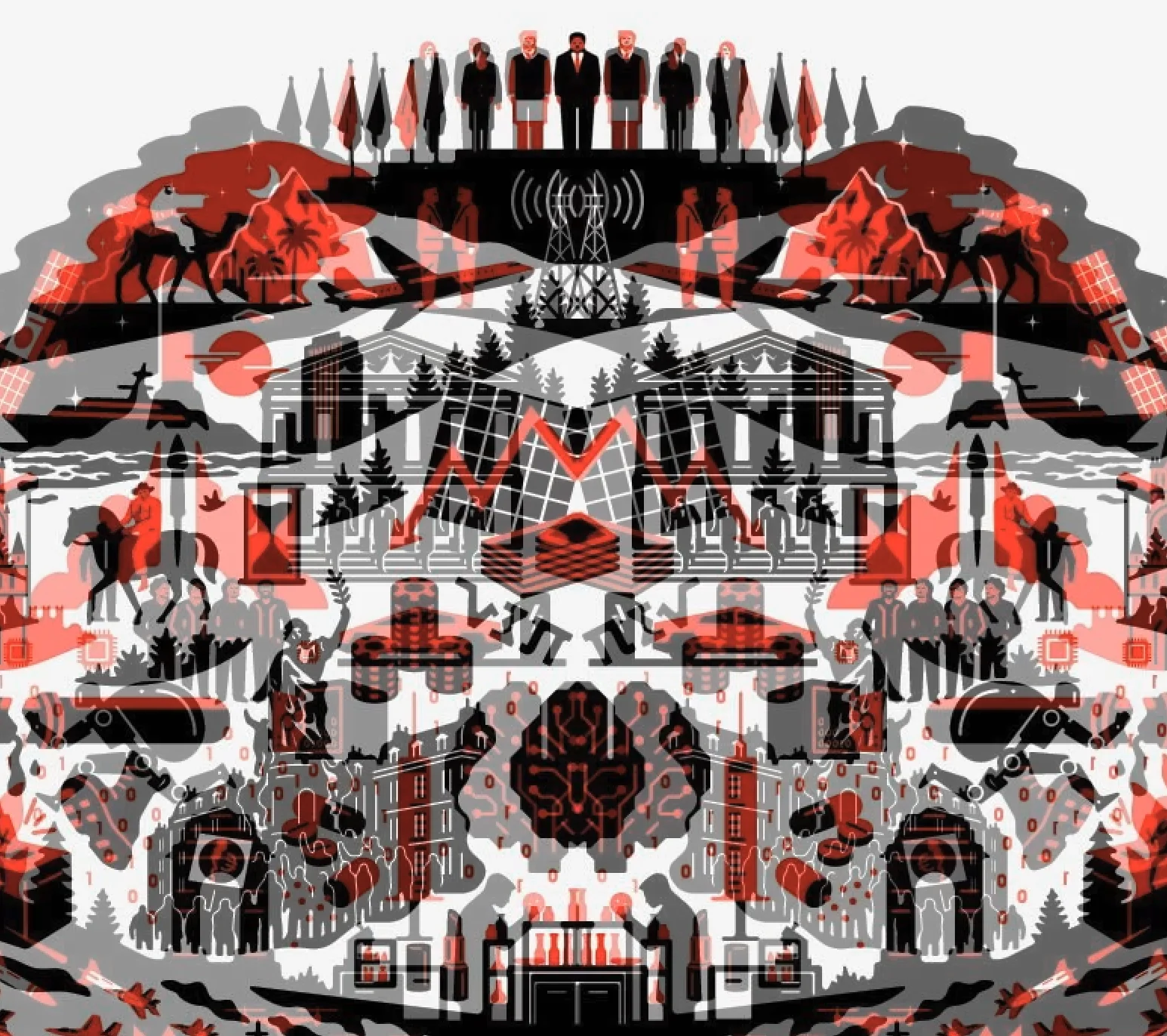
What I can see: One figure is on the central axis. Below are zigzag price lines, monumental architecture, crowds and a large symmetric shape with circuit-like red traces.
My interpretation: My interpretation is that algorithms, digital markets or computational systems may become central to the decisions associated with the person shown above.
Limit of the hypothesis: Similar brain-like shapes can result when the alignment is shifted to other figures.
Closer reading of the symbols. The second alignment sharpens the red circuit-brain under the political row. This makes the relation between political authority and technology more prominent than the face itself. Mechanical arms and rows of people produce an uneasy hierarchy: decision-makers above, an automated system at the centre, ordinary participants below.
2027 evidence and alternative outcomes. A plausible world event is greater public oversight of artificial intelligence. The Economist's own 2027 overview anticipates growing political and cyber backlash against AI. That is a documented editorial theme, but it does not verify a concealed authoritarian command in the design.
10. Central Political Figure and a Double Technology System
What does this image suggest? This alignment resembles a political system positioned over communications, finance, aviation and laboratory technology.
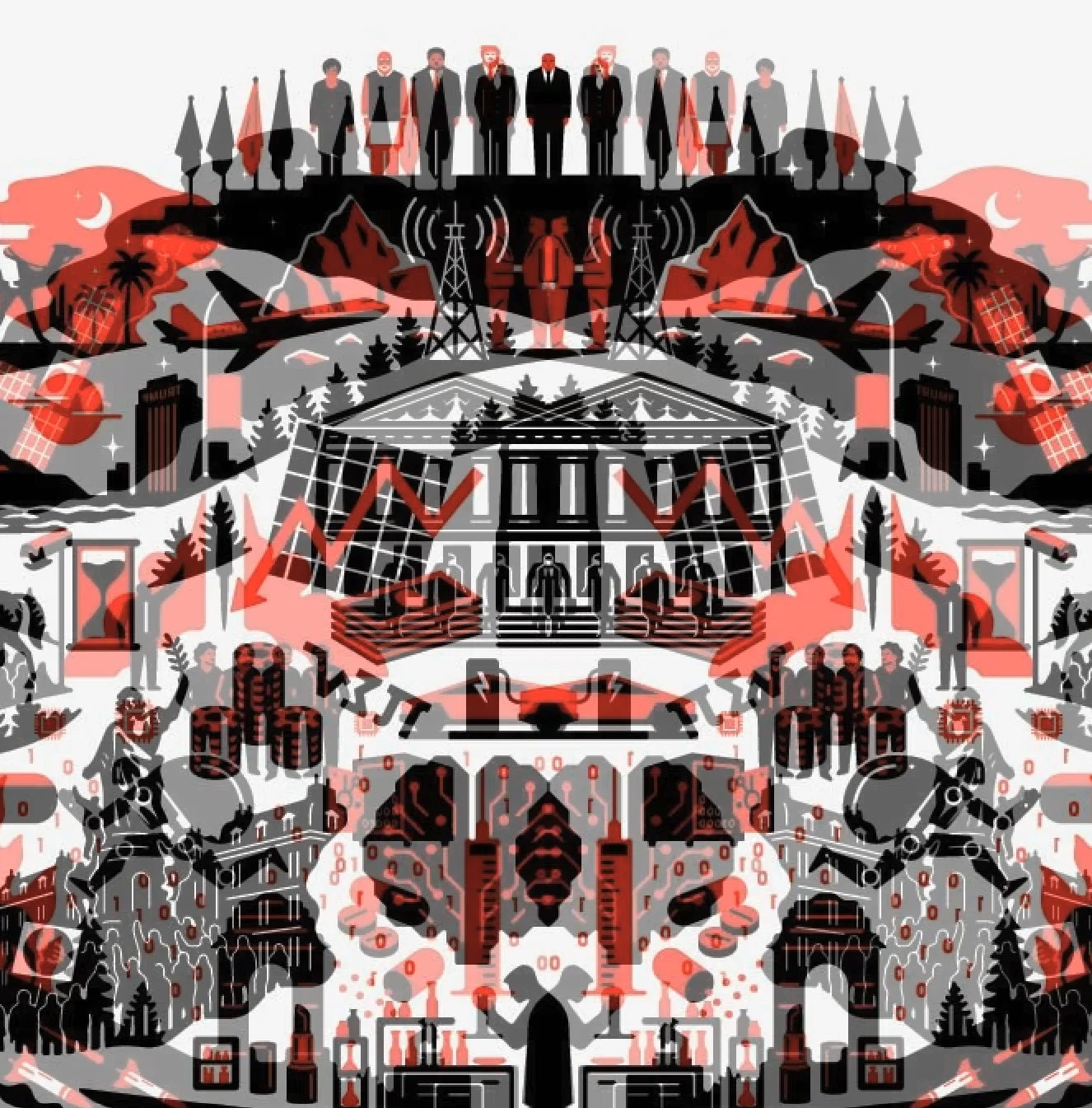
What I can see: Paired radio masts and aircraft sit over a columned façade, stock-market charts, a red automobile and technical apparatus. A person appears at a laboratory bench below.
My interpretation: I see a possible narrative of decision-makers influencing AI funding, industrial research and infrastructure. The duplication makes the composition resemble two competing technological blocs.
Limit of the hypothesis: The filename and symmetry do not establish the identity of the central politician.
Closer reading of the symbols. The figure at the summit becomes the keystone of a structure with two towers, a double graph, two crowds and paired technological forms. Because the effect arises from the selected mirror axis, it could resemble a powerful individual, an impersonal institution or simply a symmetric ornament.
2027 evidence and alternative outcomes. If interpreted as a policy turning point, the measurable indicators would include executive actions, bond-market reactions and changes in industrial spending. None of these can be dated or assigned a winner from a red-and-black silhouette.
11. First Female Figure: Institutions and Technology
What does this image suggest? A female-figure alignment places political authority above financial lines, institutional buildings and machine-like structures.
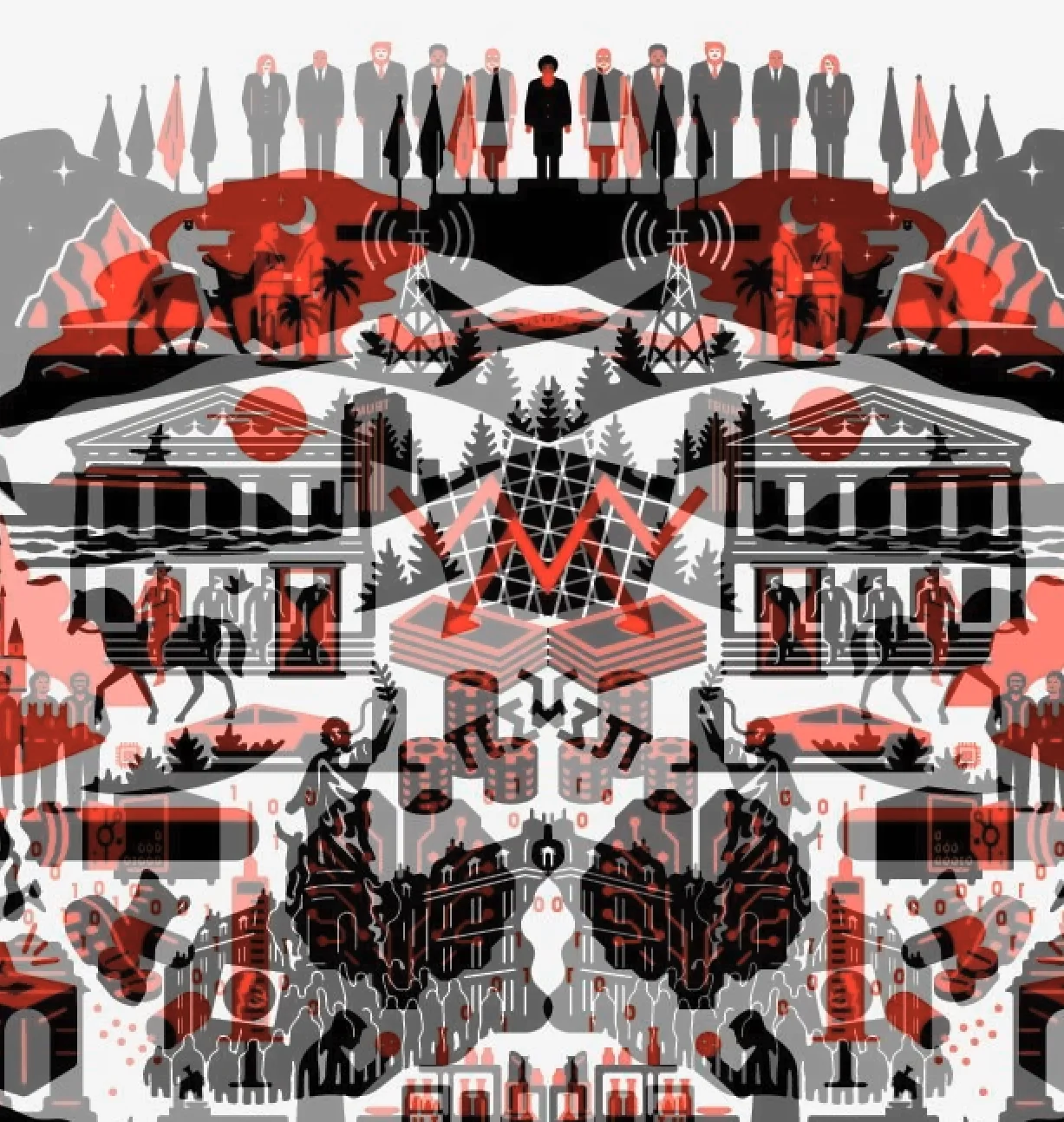
What I can see: The overlay produces two banks or public buildings, mirrored charts, people, robotic arms and a central shape resembling a mask or computer brain.
My interpretation: I read the arrangement as a possible metaphor for women in positions of power participating in decisions on the economy, international conflict and technology.
Limit of the hypothesis: This is a reading of compositional hierarchy, not a personal claim about the person depicted.
Closer reading of the symbols. The mirrored female figure is placed above an architectural and financial field. Nearby are the hourglass, red car, trees, microchips and people. One might see a political leader controlling a transition between an old economic system and new technologies, but the collage does not establish an individual's agency over these events.
2027 evidence and alternative outcomes. The 2027 backdrop of European fiscal and electoral uncertainty makes 'political transition' a serious theme. It remains important not to turn visual proximity into a biographical allegation about a real person.
12. Second Female Figure: Vehicle, Investment and Research
What does this image suggest? This mirrored female-figure scene combines financial institutions with a car, money and laboratory equipment.
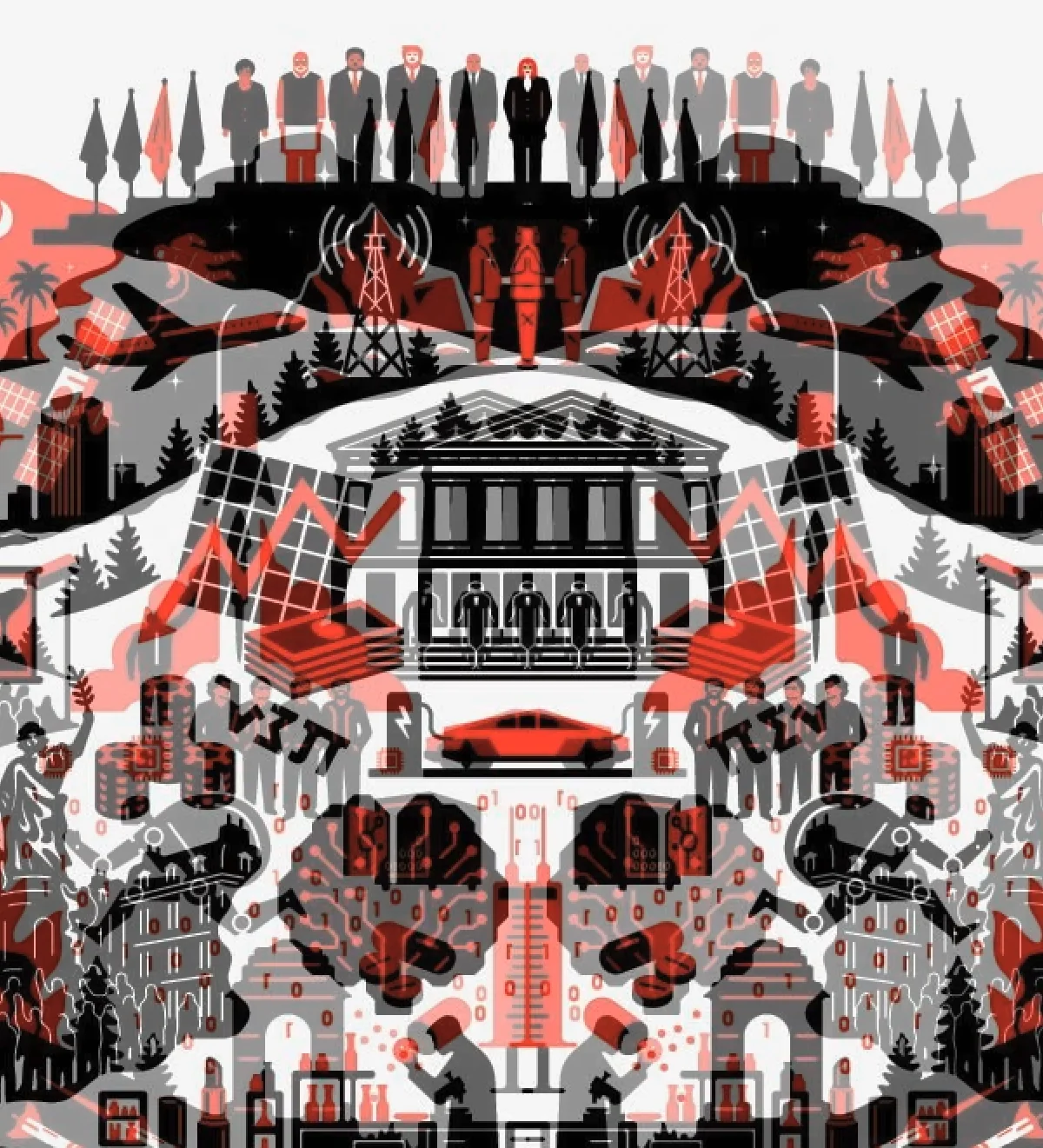
What I can see: Political silhouettes appear at the top, with falling chart lines and banknote bundles around a central portico. A red vehicle, machinery and test equipment occupy the lower area.
My interpretation: I see a possible story about industrial policy, automotive subsidies, research budgets and technological investment as an alternative reading of the earlier stimulus scene.
Limit of the hypothesis: The alignment cannot establish an individual official’s economic plans.
Closer reading of the symbols. A shifted female alignment brings the automobile, investment stacks and laboratory tools into stronger symmetry. I see a competition between the material economy—manufacturing, cars and infrastructure—and intangible technology, represented by circuitry and machinery.
2027 evidence and alternative outcomes. The observation suggests a scenario of uneven returns: firms that can translate AI spending into productivity may outperform firms that depend on cheap financing. The picture gives no valid basis to claim a specific firm's success or failure.
13. Political Leaders and Two Hourglasses
What does this image suggest? Two hourglasses near financial charts may symbolize parallel countdowns: political timing and market timing.
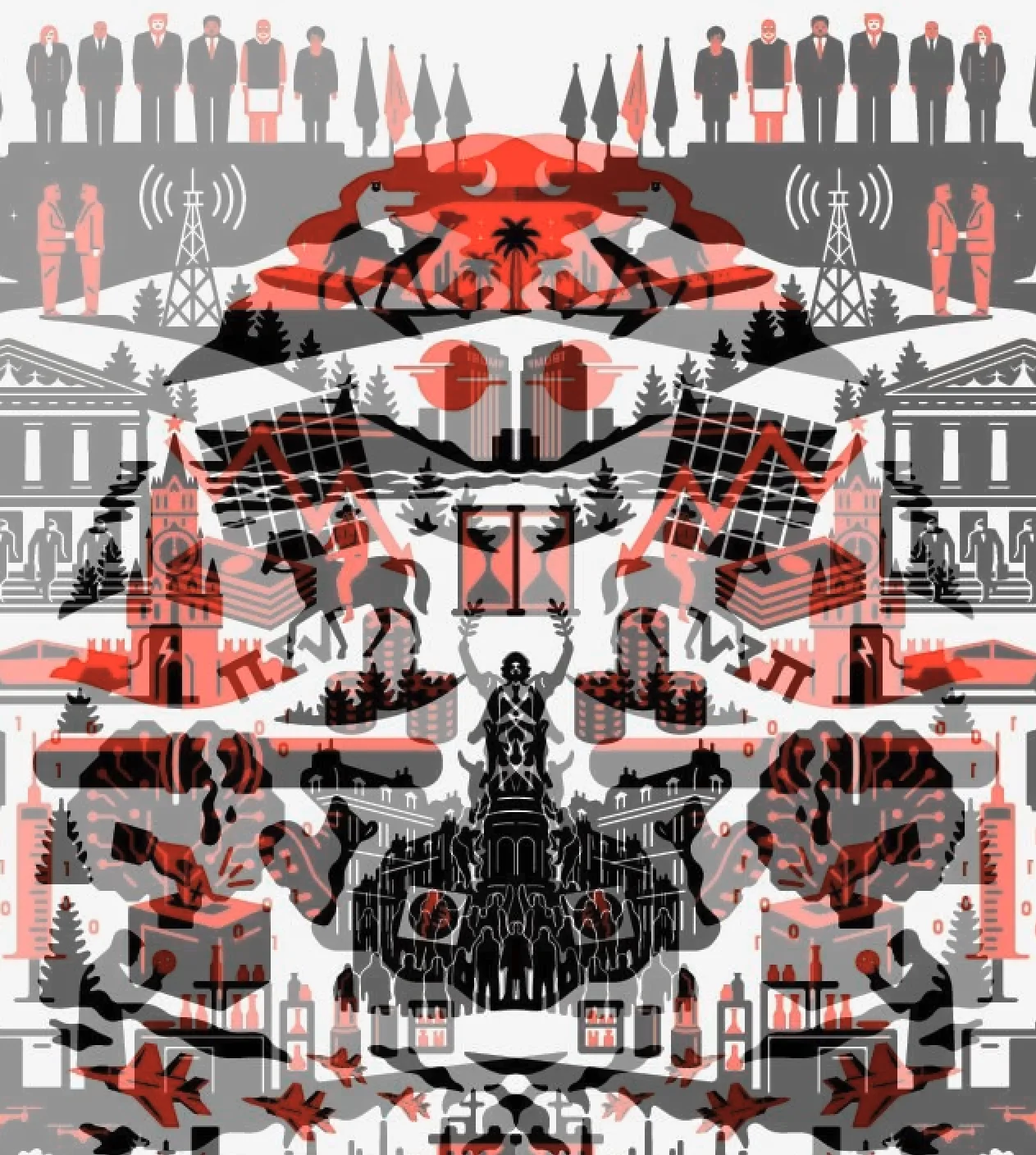
What I can see: Political silhouettes span the top above radio masts and aircraft. Mirrored financial diagrams flank hourglass-like forms, while raised arms and a large crowd fill the bottom.
My interpretation: I read the two clocks as overlapping timelines or competing economic cycles that may converge at a turning point.
Limit of the hypothesis: Hourglasses are visual shapes, not dates or a measurable countdown.
Closer reading of the symbols. Two hourglasses flank the political-financial centre. Together with steep market movements, they could represent two overlapping deadlines: a political calendar and a refinancing calendar. The doubled form arises because a single repeated object is mirrored, so it should not be counted as two independent clues.
2027 evidence and alternative outcomes. For 2027, compare election timing, government borrowing calendars and corporate debt maturities. The Economist explicitly flags high sovereign borrowing and bond-market pressure; that is the grounded component of this reading.
14. Trump Towers, an Hourglass and Two Dancing Figures
What does this image suggest? The scene places an hourglass between tower-like buildings and two figures who seem to dance above a crowd.
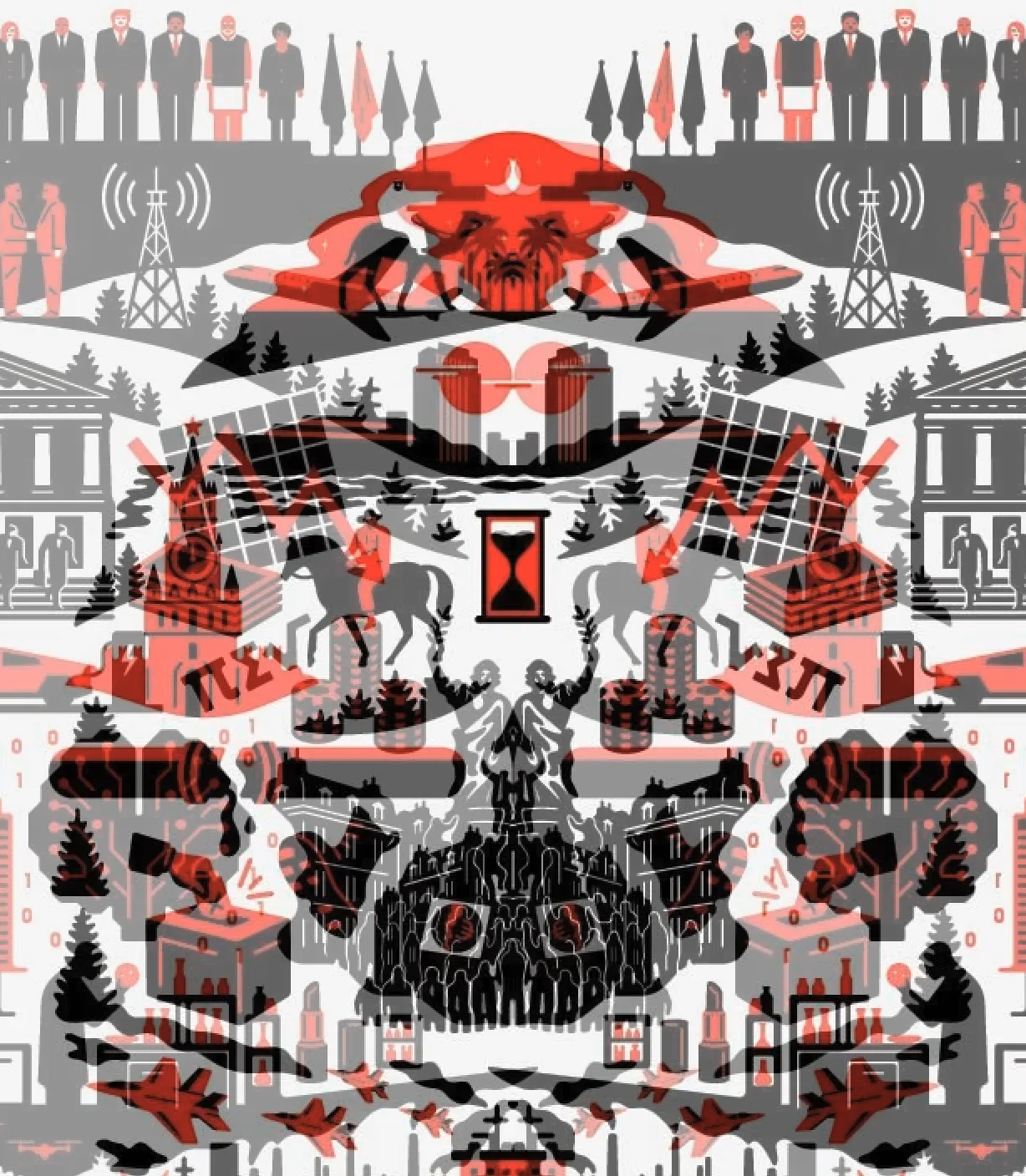
What I can see: Tall buildings and charts surround the hourglass. Lower down, paired human silhouettes with raised arms face a large gathering; red towers, riders and machines frame the image.
My interpretation: I imagine a political spectacle around time, risk, winners and losers. The figures might represent celebration, triumph or a performance of power during an unstable market.
Limit of the hypothesis: The buildings are not confirmed Trump properties and the dance is a pareidolic interpretation.
Closer reading of the symbols. Between the buildings nicknamed 'Trump towers' sits a narrow hourglass. Below it, two dancer-like silhouettes appear above a crowd. The first image conveys pressure and an approaching deadline; the second could mean triumph, spectacle, protest or the theatrical nature of political messaging.
2027 evidence and alternative outcomes. I do not see sufficient evidence to label the buildings as real Trump properties. A more careful 2027 scenario concerns volatility triggered by politics and litigation, consistent with The Economist's published discussion of the post-Trump period.
15. Trump Alignment: An Unsettling Mask-Like Figure
What does this image suggest? A dark, almost horned mask appears in one alignment associated by the researcher with Trump, but it is an ambiguous composite rather than a literal depiction.
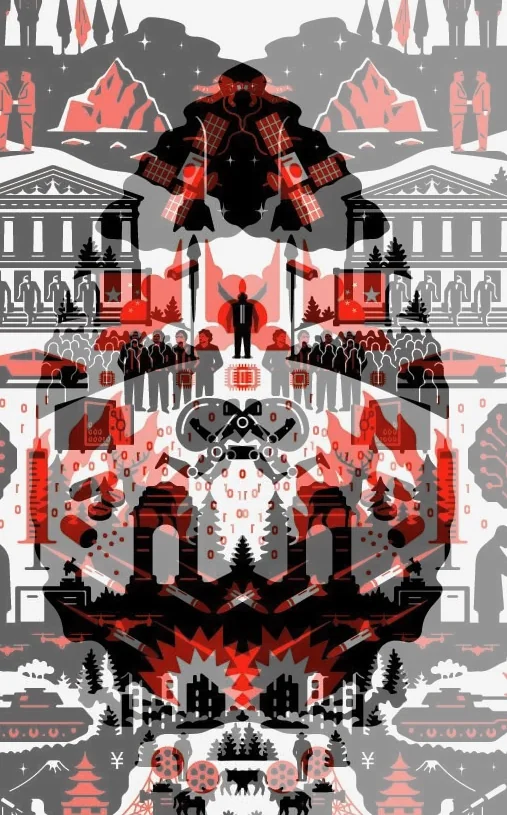
What I can see: Dark and red fragments combine into a large animal-like face, mask or theatrical costume. Political silhouettes, rockets, robots and crowds remain visible underneath.
My interpretation: I found the image almost “devilish” in its dramatic appearance and read it as a metaphor for fear of concentrated political power, not as a statement about a real person’s nature.
Limit of the hypothesis: The perceived face comes from overlapping artwork. It is not evidence of a supernatural image or the artist’s intention.
Closer reading of the symbols. The mirrored central face looks ominous or horned because red animal shapes, dark clothing and negative space meet in the same place. The 'devilish Trump' interpretation is an evocative visual association, not a credible claim about a politician. Two different source fragments forming one face are a textbook condition for pareidolia.
2027 evidence and alternative outcomes. The less sensational interpretation is personalised political conflict and an intensified media spectacle. Track actual policy statements and market moves instead of interpreting an inferred demonic mask as a future event.
16. Trump Figure, Bulls and a Possible Market Correction
What does this image suggest? A Trump-centered alignment places bull imagery above price charts and a dark technology motif, suggesting a speculative link between politics and a bullish market.
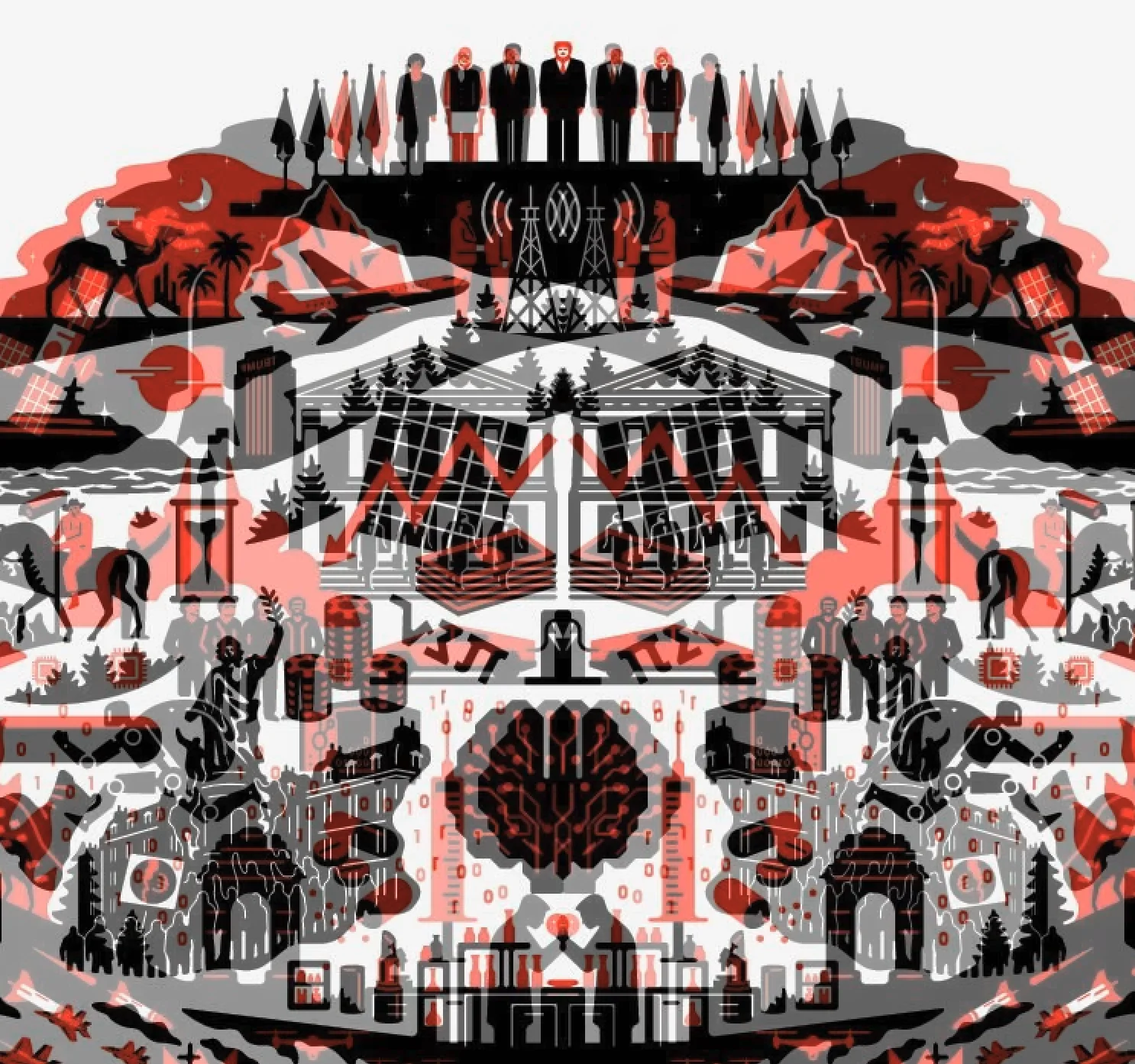
What I can see: A line of leaders stands over a paired red bull, communications masts, airplanes and a jagged financial graph. A technology-like form appears below.
My interpretation: My hypothesis is that US politics may coincide with investment enthusiasm, especially around AI, followed by increased risk of a sharp correction.
Limit of the hypothesis: It is a narrative possibility, not a claim that a politician causes a specific market move.
Closer reading of the symbols. Bulls near the upper section are a conventional visual metaphor for rising prices, even though these animals might simply reflect other geographical motifs. Beneath the political figure the markets zigzag and descend toward money stacks; this juxtaposition supports my hypothesis of a rally running out of momentum.
2027 evidence and alternative outcomes. A grounded 2027 risk is an AI-led equity correction, which both The Economist and the ECB discuss. A bullish animal on a cover is neither a price target nor a trading signal.
17. Trump Towers, Finance and an AI Brain
What does this image suggest? The paired towers and market charts make this image look like a story about real estate, credit and artificial intelligence.
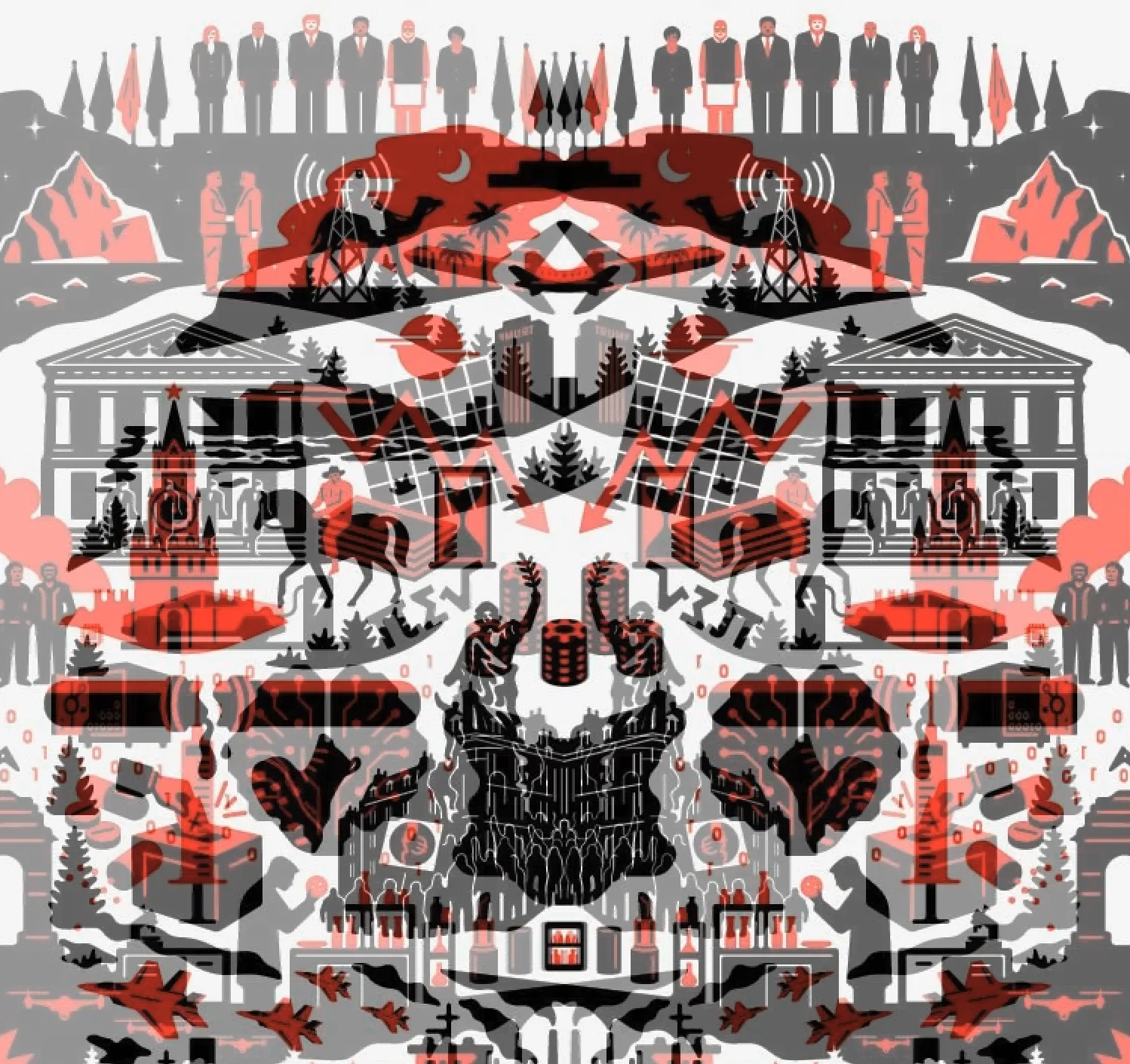
What I can see: Two high-rise forms flank a classical building and chart lines. A red vehicle and a brain-shaped circuit form occupy the lower middle.
My interpretation: I associate the towers with Trump and the imagery with the interaction of personal brands, financial infrastructure, property markets and AI investment.
Limit of the hypothesis: No architectural detail definitively identifies the towers as Trump-owned.
Closer reading of the symbols. The paired towers frame a market chart, while the red circuit-brain occupies the centre below. If I follow my market narrative from top to bottom, political infrastructure sits above finance, and algorithmic machinery sits beneath its valuation peak.
2027 evidence and alternative outcomes. The strongest real-world link is the growing use of debt to fund AI infrastructure: the ECB says this could transmit losses from equities to bond markets. 'Trump towers' is a nickname for the shapes, not an architectural identification.
18. A Red Sun Between Two Towers
What does this image suggest? A red sun-like disc between mirrored towers may suggest Japan, a new phase or rival financial centers.
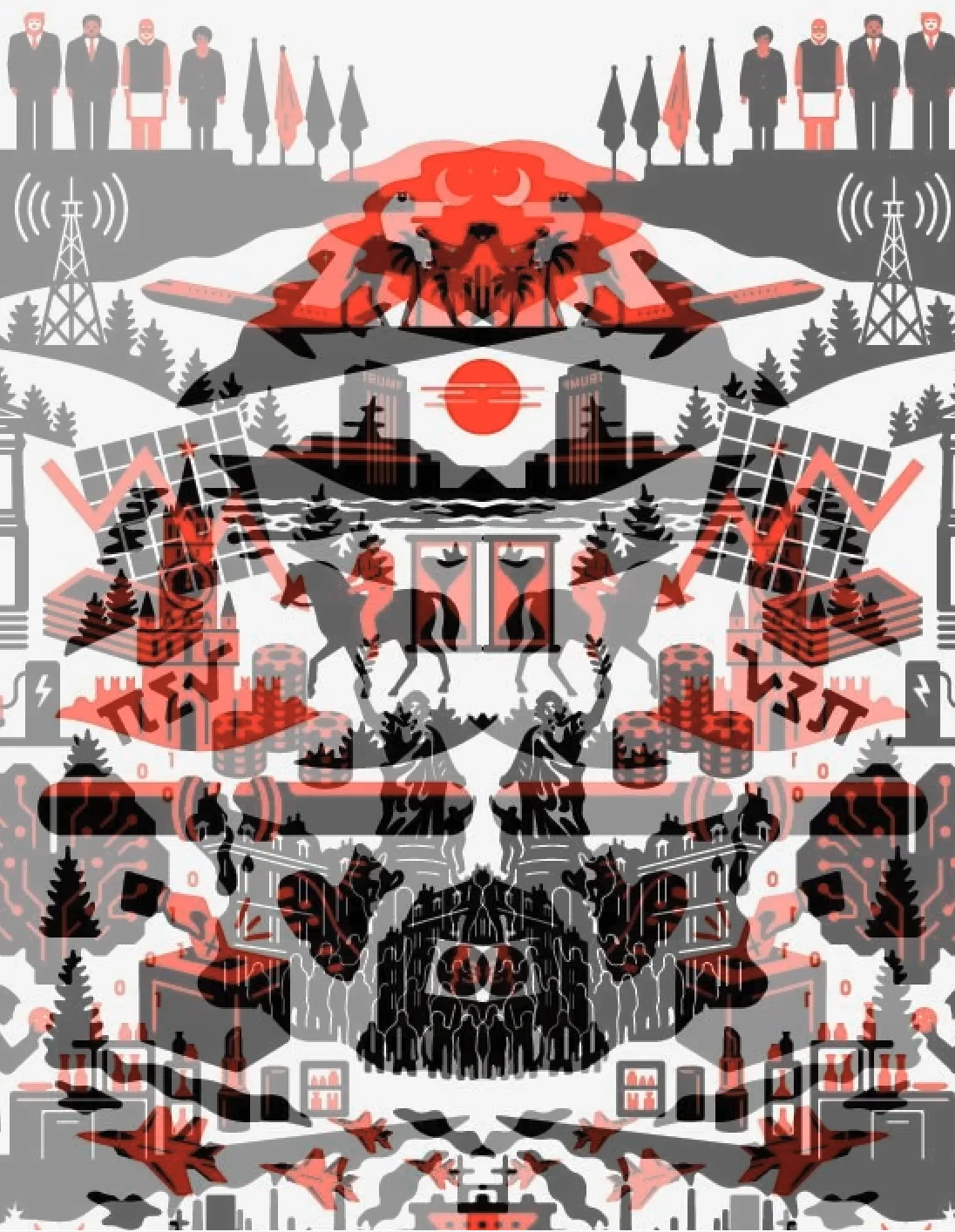
What I can see: Above the red circle are political figures, bulls and airplanes. Beneath it appear paired towers, market graphics, riders and crowds.
My interpretation: I see a rising-sun image between the towers: possibly a new economic phase, Japanese market influence or competition between global financial hubs.
Limit of the hypothesis: The red disc can have multiple meanings and does not prove a Japan-related prediction.
Closer reading of the symbols. The red disc is centred between two upright structures and recalls a rising sun. This creates a bridge between the financial-tower scenes and East Asian imagery elsewhere in the collage. It could also simply be a stylised sunset or abstract circle, not the national flag of Japan.
2027 evidence and alternative outcomes. If linked to Japan, watch its inflation, interest-rate path and the yen. The Bank of Japan's October 2026 outlook describes pressure from energy prices and its continued policy normalisation; neither factor proves a symbolic forecast of a Japanese crisis.
Brent Oil, Russia, Japan and War Symbols on The World Ahead 2027 Cover
19. Brent Oil: Chained Tankers, Kremlin Towers and Desert Riders
What does this image suggest? The oil-market overlay links desert imagery, Russian symbolism and chained ships into a speculative story about energy supplies and shipping restrictions.
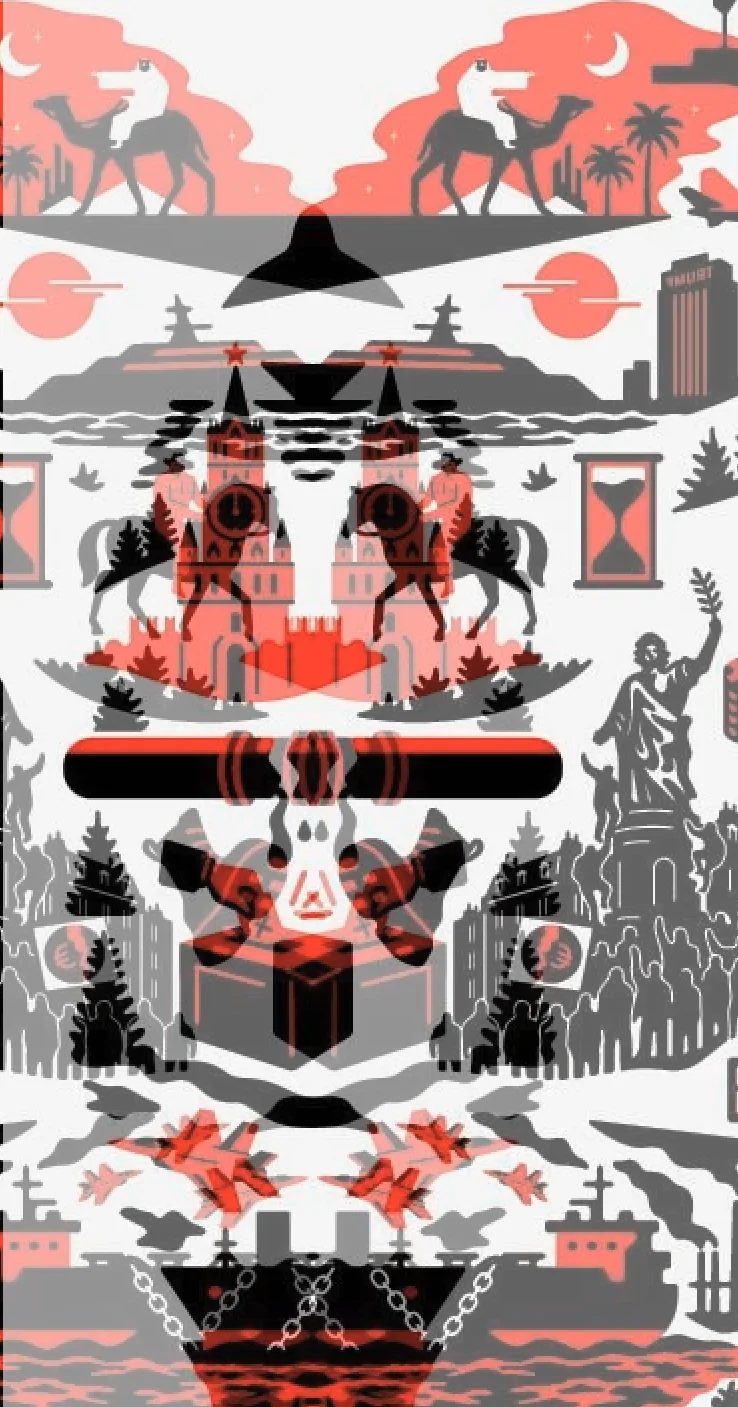
What I can see: Camels, palms and crescents appear above aircraft, circular suns and a ship. Kremlin-like towers, horse riders and a cylindrical object occupy the middle. A large vessel, sea and chains fill the bottom.
My interpretation: I associate the desert riders with Gulf producers, the towers with Russia, and the chained ships with constrained oil transport. This could symbolize sanctions, blocked routes, detained cargo or the dependence of Brent prices on geopolitics.
Limit of the hypothesis: The ships are not labelled as tankers and the people are not securely identifiable as sheikhs.
Closer reading of the symbols. In the Brent composition, desert riders and crescents appear above Kremlin-like towers, while chain-bearing vessels appear below. It is a compelling visual geography of Gulf production, Russian supply and maritime constraints. The chains may signify chokepoints, sanctions or simply anchor equipment.
2027 evidence and alternative outcomes. The IEA's November 2026 Oil Market Report describes recent tanker attacks, high freight costs, recovery in Gulf exports and a projected shift toward surplus in 2027. My scenario is volatile prices with both upside shocks from shipping disruptions and downside risk from rebuilding supply. There is no defensible single-direction Brent forecast from the illustration.
20. Rockets Superimposed on the Kremlin
What does this image suggest? Rocket-like vertical shapes overlap a Kremlin-style clock tower, producing a visual metaphor of military pressure on Russian state institutions.
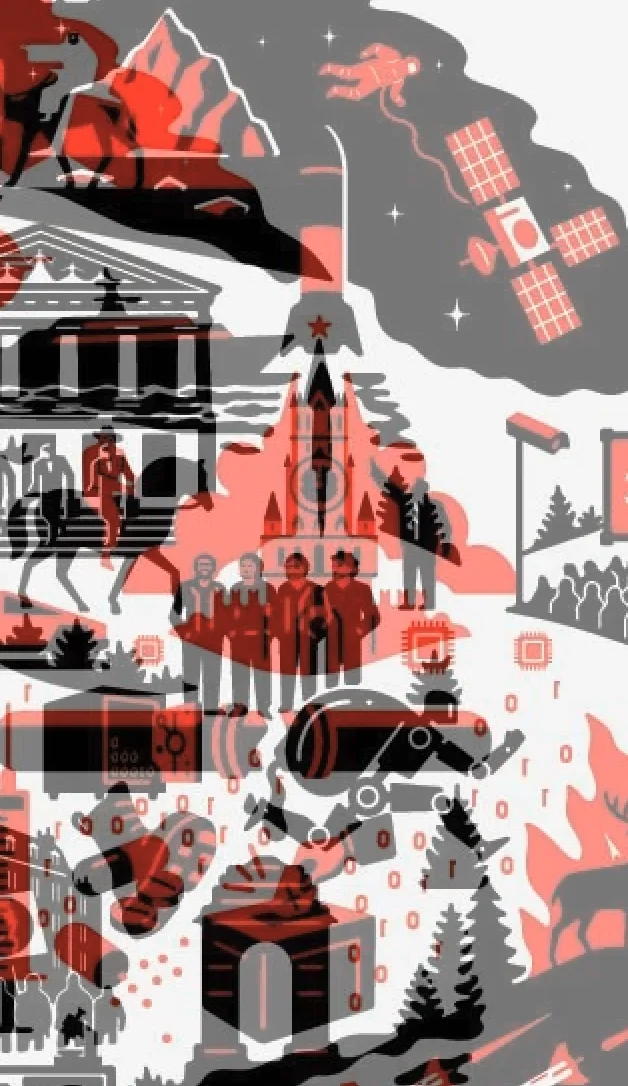
What I can see: Sharp forms and a rocket silhouette cross a red star-topped clock tower. Above are a Japanese-looking satellite, bull, mountains and a dark animal-like shape.
My interpretation: The unexpectedly close alignment made me wonder whether military threats or war-related decisions will dominate Russian politics in 2027.
Limit of the hypothesis: The overlay does not predict a strike, identify a target or prove intentional placement.
Closer reading of the symbols. The rocket-like vertical forms intersect with the red clock tower when the layers align. What feels deliberate is the geometric convergence of military objects and a symbol associated with Russian state power. Yet alignment alone is not proof of an impending attack on Moscow.
2027 evidence and alternative outcomes. The plausible 2027 interpretation is continued militarisation, infrastructure risks and geopolitical pressure. Rather than anticipating a specific strike, examine verified military developments, sanctions and the resilience of energy exports.
21. Kremlin, Skull-Like Shapes and Political Uncertainty
What does this image suggest? A skull-like image appears below a Kremlin-style tower, which I interpret cautiously as a symbol of political strain or a possible transition.
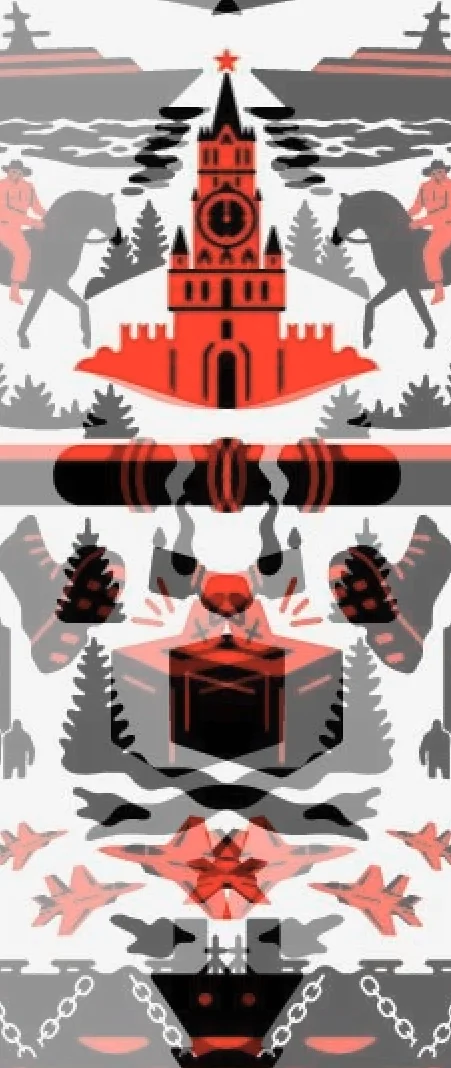
What I can see: A red clock tower stands between horse riders. Beneath it are a long dark cylinder, weapons-related details and symmetrical figures around a cube. The lower shapes resemble a skull or severe theatrical mask.
My interpretation: For me, this image suggests the end of a political period, major geopolitical upheaval or changes in an established order—not a literal event or the fate of any leader.
Limit of the hypothesis: The skull is a product of visual pattern recognition; no specific destruction or event follows from it.
Closer reading of the symbols. The dark lower image forms a skull-like contour beneath a Kremlin-looking tower. I read this as political vulnerability, an end of an era or anxiety around war, not a literal death sentence against a state or its leaders. Its skull-like appearance emerges most strongly from bilateral symmetry.
2027 evidence and alternative outcomes. A responsible prediction is heightened uncertainty and possible institutional or strategic change. No individual death, territorial event or change of government follows from the shape itself.
22. War Imagery Inside an Egg-Shaped Outline
What does this image suggest? In this mirrored scene, rockets, planes and buildings form a war-like picture inside an oval or egg-shaped outline.
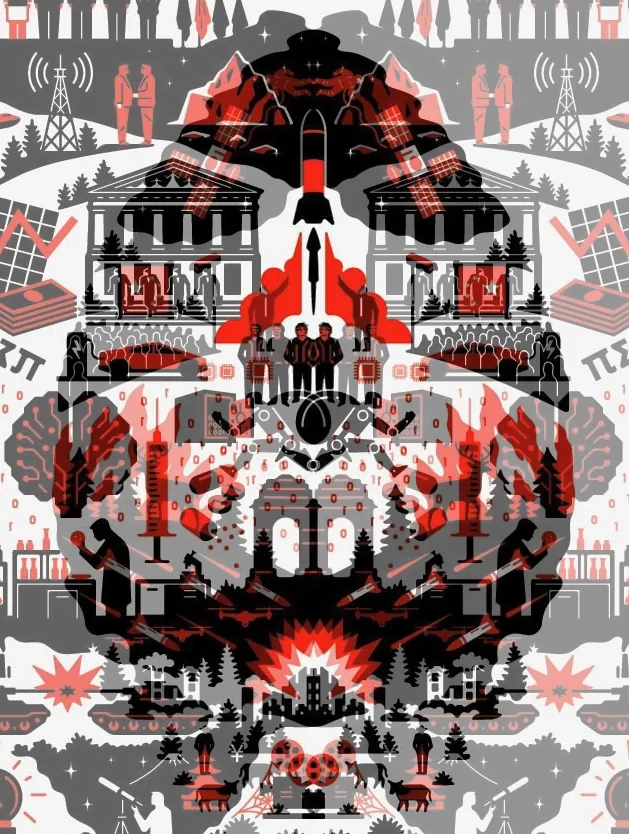
What I can see: Symmetric buildings and military silhouettes create a vertical form. At the bottom are tanks, red flashes and crowd-like dark shapes.
My interpretation: I see two possible stories: a new conflict “hatching” from an unstable situation, or violence confined within an enclosed system rather than expanding without limit.
Limit of the hypothesis: The egg outline is produced by the overlay and is not a separately drawn object.
Closer reading of the symbols. An egg-shaped envelope seems to contain missiles, warplanes, military buildings and explosions. Two opposite readings are possible: a conflict incubating before escalation, or a crisis being contained by a boundary. The symbol is especially uncertain because the oval is not a clearly outlined object in the original image.
2027 evidence and alternative outcomes. The Economist's 2027 themes mention Taiwan, the aftermath of the Iran war and changes in the cost of warfare. Those give geopolitical context, but the picture cannot tell us whether a new war begins, where it begins or who wins.
23. Japan and the Yen: Red Explosions Near a Pagoda
What does this image suggest? A Japanese-looking pagoda surrounded by red flashes and military imagery raises, in my interpretation, the question of regional security risks.
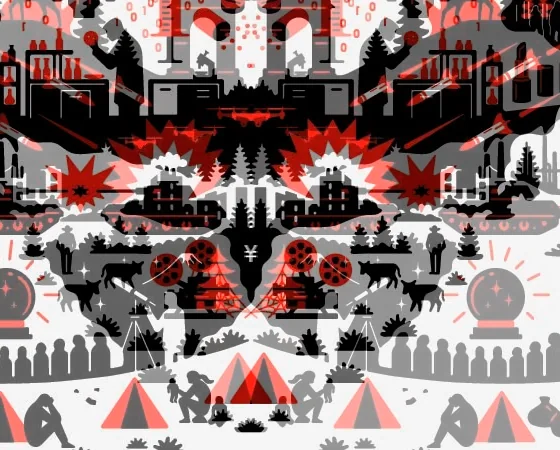
What I can see: A red pagoda is centered between bursts of light, armored vehicles and round forms resembling reels. Small tents and people appear lower down.
My interpretation: I wondered whether the composition hints at pressure on Japan, its currency or regional defense spending, with rocket-like shapes apparently heading toward the Japanese motif.
Limit of the hypothesis: No direction of attack, future war or yen exchange-rate move can be established from this image.
Closer reading of the symbols. A red tiered tower resembling a Japanese pagoda sits below star-shaped bursts, vehicles and aircraft-like contours. I initially saw missiles flying toward Japan. Directionality is not actually established by the fragments; the picture could instead represent regional military spending or a broader East Asian threat environment.
2027 evidence and alternative outcomes. The Bank of Japan has stress-tested a combined scenario involving higher oil prices, disappointment in AI profitability and rising interest rates. Those economic vulnerabilities are observable; a military attack on Japan is not established by the graphic.
24. Yen, Missiles and Evacuation Imagery
What does this image suggest? Another Japan-focused overlay combines explosions, a pagoda, tents and crowds into a speculative scenario of regional disruption.
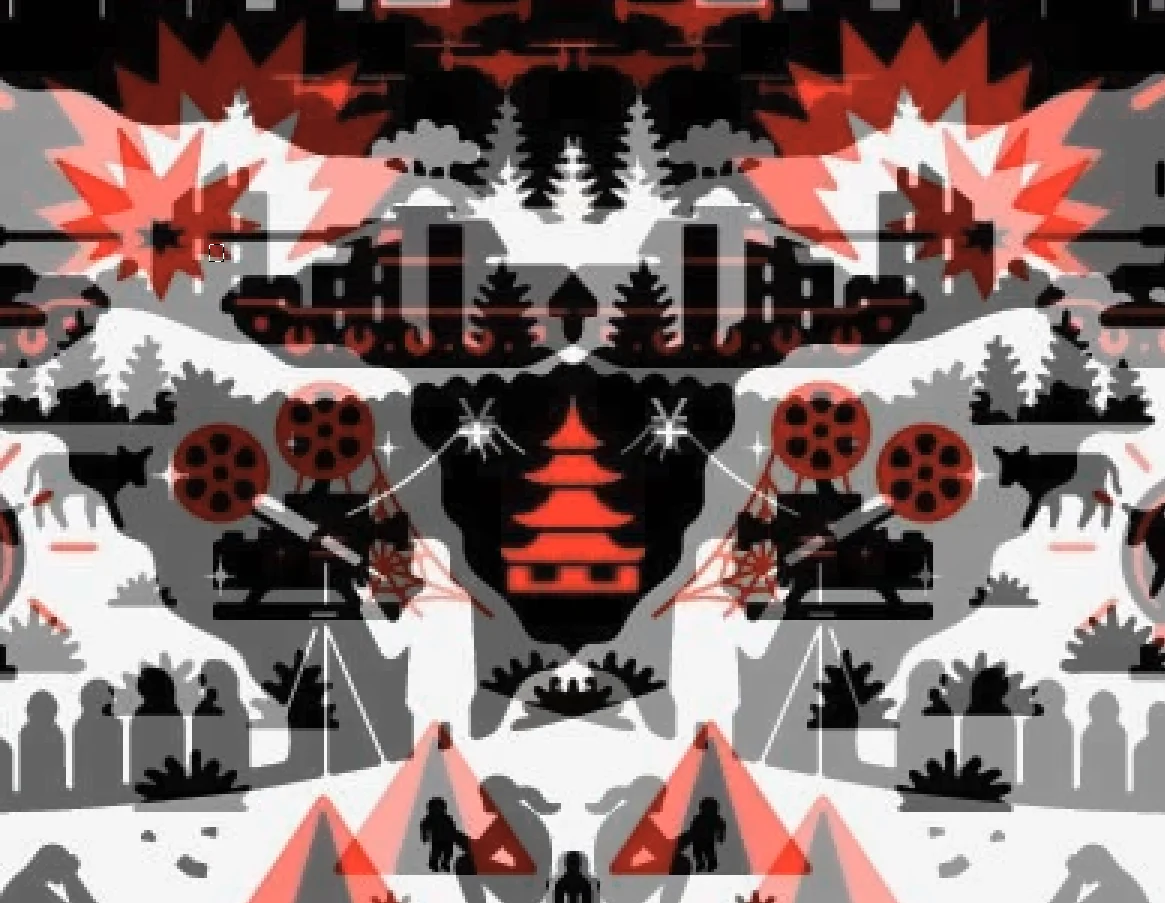
What I can see: Military forms crowd the upper portion. A pagoda and circular reels sit above dark groups of people, tents and a black sphere with red highlights.
My interpretation: My reading connects possible security shocks in East Asia with pressure on the Japanese economy and yen, while the tents suggest emergency shelters or displacement.
Limit of the hypothesis: The reference to JPY is interpretive; the image contains no currency quotation or evidence of a forthcoming evacuation.
Closer reading of the symbols. The second yen image combines military flashes, the pagoda, round reel-like objects, a black sphere and tent camps. This could represent a population bracing for conflict or the media's treatment of war. Yet the circular forms could be film reels, not a currency symbol, and the sphere could be an optical composite.
2027 evidence and alternative outcomes. A conditional 2027 scenario is that an East Asian security shock would influence shipping insurance, semiconductor supply chains, the yen and energy imports. It is not a prediction that Japanese cities will be struck.
25. East Asia, a Ship and Two Animals
What does this image suggest? Two facing animals, a ship and sun-like circles suggest a network of geopolitical and trade connections across Asia and the Middle East.
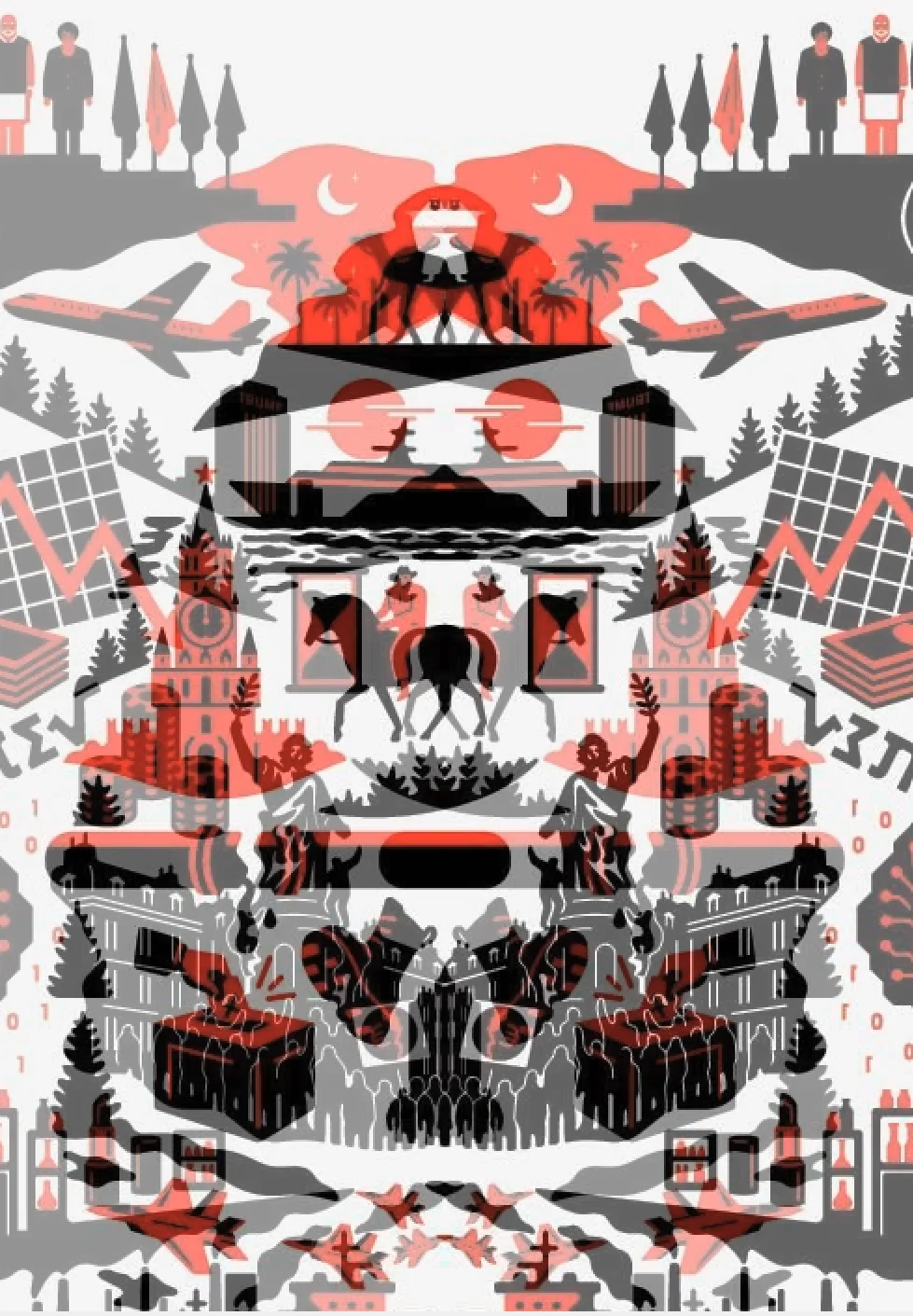
What I can see: Animals appear against palms and crescents. Below them sit aircraft, red suns, a vessel, star-topped towers, charts and horse riders.
My interpretation: I see intersecting interests involving Gulf countries, Russia and East Asia. The ship may represent supplies, trade routes or military logistics; financial charts suggest markets reacting.
Limit of the hypothesis: The links between these visual motifs are hypothetical and none is a country-specific forecast.
Closer reading of the symbols. The upper section's two facing beasts, palms, planes and paired red suns produces a crossroads of regions: the Middle East and East Asia. A ship below gives the scene its transport dimension, while the financial graph at the sides implies that geopolitical events move prices.
2027 evidence and alternative outcomes. The measurable risks are maritime bottlenecks, freight costs, supply-chain interruptions and energy-price volatility. A 'secret alliance' is not implied by animals meeting at a mirrored centre.
26. The Central Horseman and the Warship
What does this image suggest? A rider aligned exactly at the center and a ship-like shape suggest, to me, a political actor trying to manage opposing pressures.
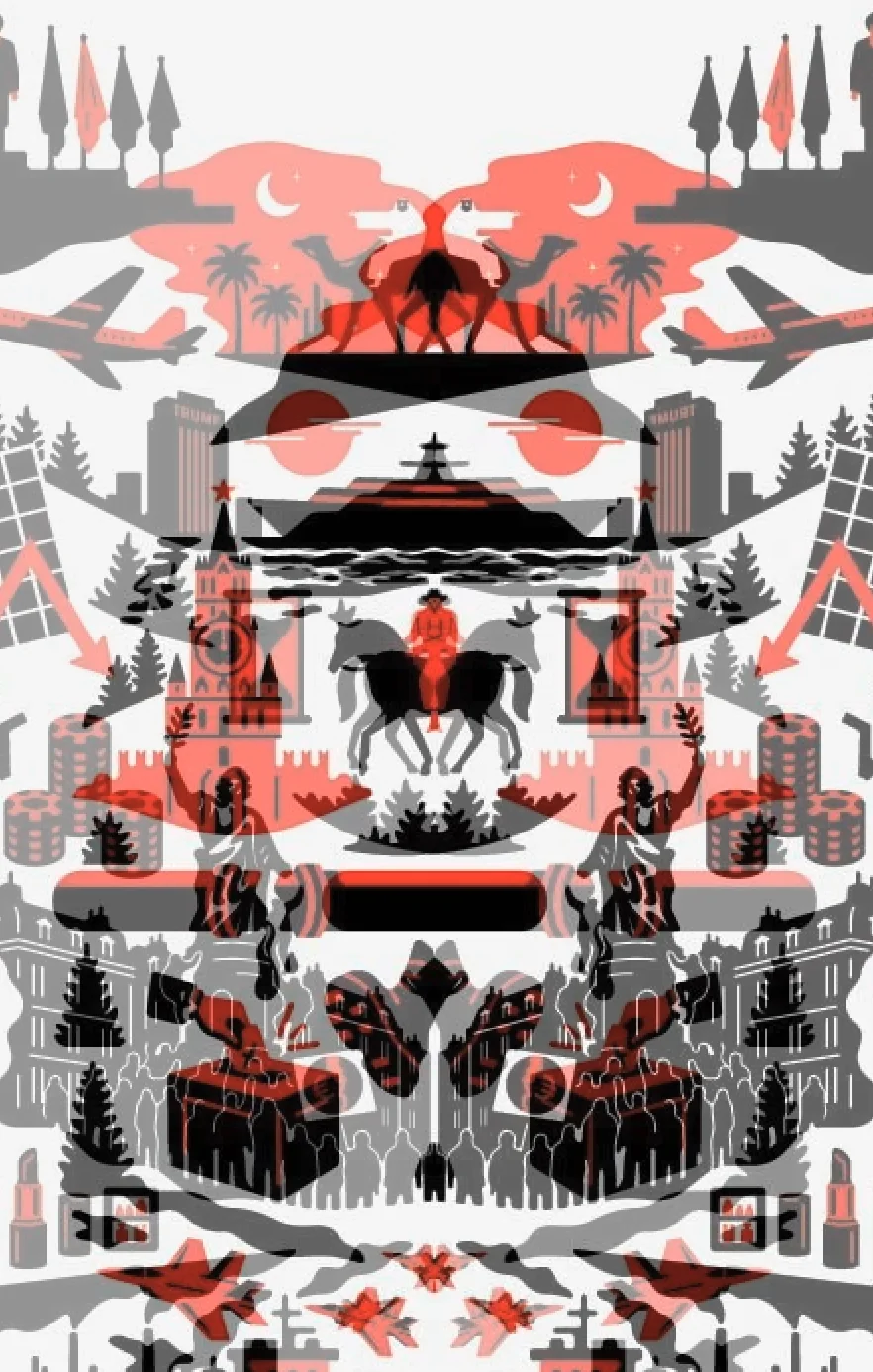
What I can see: Two camels meet near the top, a long dark vessel lies over the sea and the central red rider appears to sit across two horses. Kremlin-like towers and market charts flank the scene.
My interpretation: The rider could symbolize a negotiator, a leader or a metaphorical “horseman of crisis.” The ship adds themes of sea routes, trade and international influence.
Limit of the hypothesis: The person and ship are visual forms; their specific identity and geopolitical role remain unknown.
Closer reading of the symbols. The double horseman creates a single central rider, while a dark ship spans the middle plane. I read this as a transition from traditional political or military power—the mounted figure—to modern sea power and logistics. The rider may seem commanding only because the two halves meet precisely.
2027 evidence and alternative outcomes. In 2027 the key tests are naval incidents, shipping disruptions, export routes and defensive spending. The ship could be a freighter or warship, so asserting a specific fleet or battle would outrun the image.
27. A Mountain in Space: The Unreachable Peak
What does this image suggest? A red mountain in a dark star-like field can be read as a metaphor for a difficult peak, exploration or a distant strategic objective.
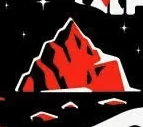
What I can see: A tall angular red mountain emerges from a dark field dotted with small white points and relatively little surrounding detail.
My interpretation: I connect its summit to the market top elsewhere in the composition, but it could instead evoke a space program, scientific ambition, geography or climate.
Limit of the hypothesis: There is no basis to identify the mountain or assign it a specific astronomical meaning.
Closer reading of the symbols. A red mountain against a star-like dark background resembles an impossible summit. It can mirror the financial peak elsewhere, but here the context is aviation, a satellite and the space environment. The shape may simply be terrestrial mountains set against night, rather than an extraterrestrial landscape.
2027 evidence and alternative outcomes. There is a real editorial connection: The Economist expects cheaper space launches, private orbital infrastructure and growing discussion of orbital data centres in 2027. This is a stronger evidence-based interpretation than proposing an identifiable secret mountain on another planet.
Hidden Symbols: Masonic Shapes, Mystical Figures and the Crystal Ball
28. Masonic Compass-Like Symbol Above a Black Cube: Square and Compasses?
What does this image suggest? Mirrored machinery forms a cube-and-triangle image that resembles an esoteric emblem, although no recognizable Masonic mark is established.
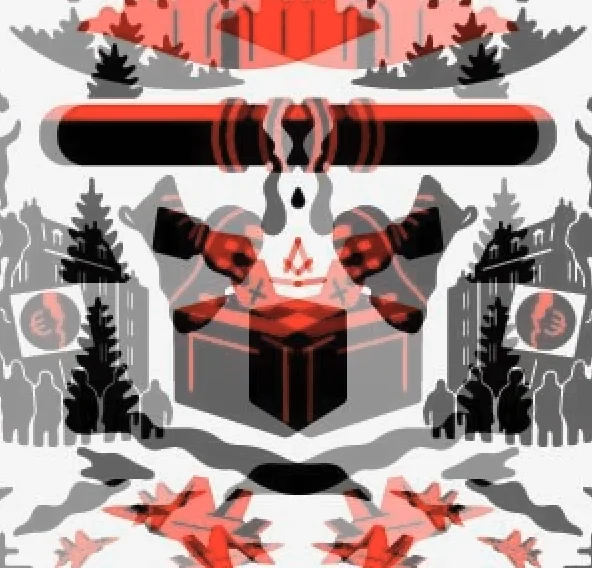
What I can see: Two symmetrical mechanical forms frame a triangular red shape above a black cube. A long cylindrical form crosses the top, with silhouettes and aircraft around it.
My interpretation: I see a possible ritual-like scene: a cube, symbolic fire and two forces meeting. The more ordinary explanation is two robotic manipulators working over a device.
Limit of the hypothesis: Resemblance to ritual imagery does not establish any connection to Freemasonry.
Closer reading of the symbols. The central red angular tool above the black cube strongly resembles an opened compass: two arms converge at an upper hinge, while the geometric block below looks like a squared or worked stone. I therefore explicitly identify a compass-like Masonic motif rather than dismissing the resemblance. The official Square and Compasses emblem normally joins a compass to a square; the complete paired emblem is not unambiguously drawn here. Mirrored robotic arms and the cube could also describe a machine operating on a workpiece.
2027 evidence and alternative outcomes. In traditional symbolism the compass concerns boundaries and self-restraint, and the square upright conduct, according to the Museum of Freemasonry. As an interpretive metaphor I read this as 'construction of a new order' or setting limits on technology. That does not imply a real Masonic conspiracy, an identifiable lodge or a prediction of a ritual in 2027.
29. Two Compass Arms Over the Cube: Ritual or Robotic Assembly?
What does this image suggest? Two mirrored arms seem to bow over a black cube, creating an “activation ritual” appearance from technology fragments.
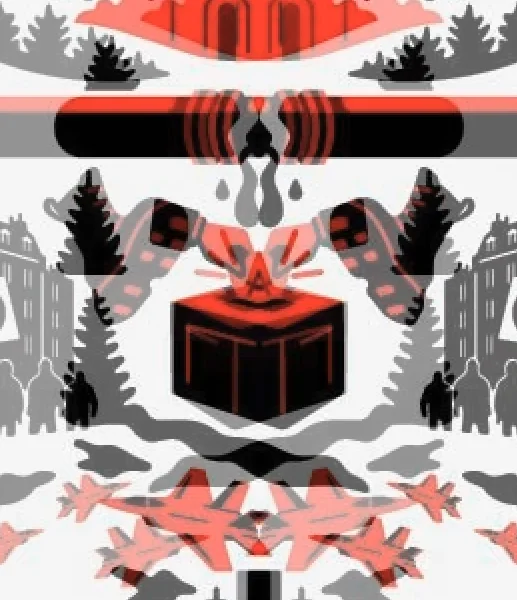
What I can see: A central cube supports a bright red flash while mechanical elements curve toward it from each side. Aircraft are visible below.
My interpretation: My symbolic reading is a ceremony for starting a new system; my technological reading is the activation or assembly of a machine—consistent with the recurring AI motif.
Limit of the hypothesis: The apparent human poses result from symmetry and need not be intentional.
Closer reading of the symbols. This second alignment makes the compass silhouette more apparent: two angled, dark-red tool-like forms lean toward a point over a black cube, almost like the legs of drawing compasses. The bright red mark between them can look like a spark or an activation switch. The full arrangement has the structure of a workshop, an altar or a ritual—all dependent on how the eye interprets machine parts.
2027 evidence and alternative outcomes. Three rival hypotheses should remain visible: geometric Freemason-like symbolism, AI/robotic manufacturing and pure bilateral pareidolia. A useful visual test is to overlay the actual square-and-compasses outline and check whether vertices and angles align without arbitrary rescaling. Similarity alone cannot establish authorship intent.
30. Winged Figure Above a Crowd: Euro Sign, Statues and Boots
What does this image suggest? A winged creature seems to emerge above a crowd, with raised hands, statues, boot-like shapes and a possible euro symbol around it.
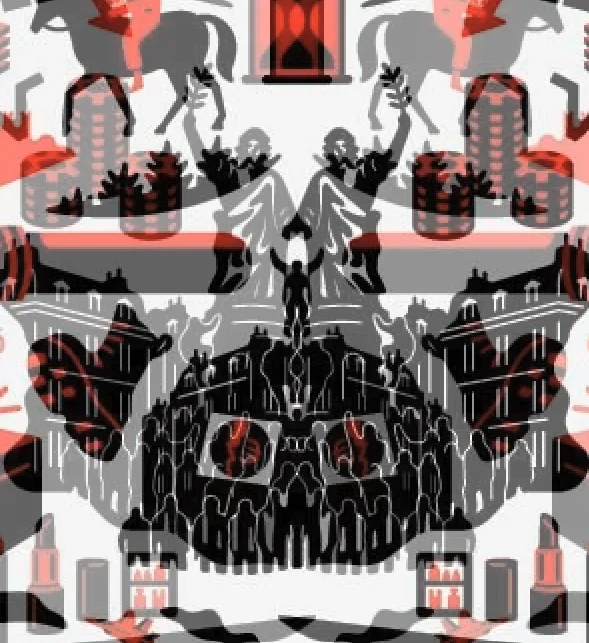
What I can see: Two mirrored people with arms raised create wing-like outlines. Two people below also raise their hands. Branch-bearing statues, large boot shapes and circular markings are visible on both sides.
My interpretation: I imagine symbolic authority above society. The crowd could be celebrating, protesting or asking for protection; a possible euro sign could connect the scene to European finance. Branches might alternatively suggest peace or commemoration.
Limit of the hypothesis: The wings and euro shape are uncertain visual effects; no actual supernatural figure can be inferred.
Closer reading of the symbols. The winged figure seems suspended above a dense crowd, while a pair of people raise their hands and branch-bearing statues flank the lower area. Large boot-shaped objects suggest pressure or control; a euro-like curved mark connects the image, very tentatively, with European money. The raised hands could mean protest, appeal or celebration.
2027 evidence and alternative outcomes. The official outlook names fiscal strain and a contentious European political year as significant themes. That context supports a broad scenario of social conflict or democratic pressure, but not an occult apparition. The wing is a product of doubled human outlines.
31. X-Ray-Like Crowd: A New Disease or Digital Surveillance?
What does this image suggest? A crowd framed by skull- or X-ray-like forms suggests two competing readings: public health imagery or biometric surveillance.
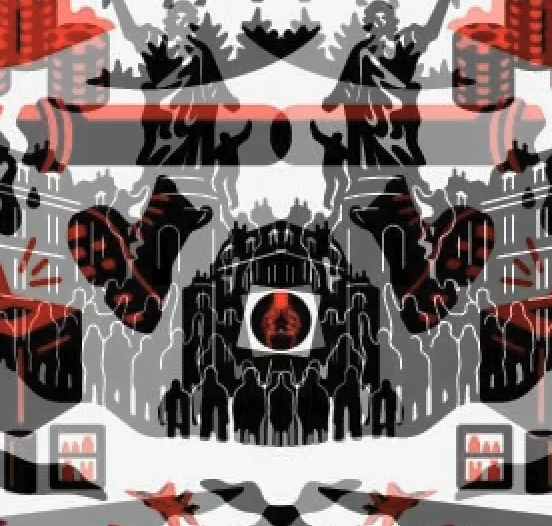
What I can see: Two dark shapes resemble an X-ray projection of a skull or torso. The central crowd surrounds a small framed reddish circle that looks like a head scan.
My interpretation: I asked whether the scene points to a new disease, medical imaging or mass diagnostics. A less alarming explanation is digital facial recognition and surveillance of crowds.
Limit of the hypothesis: There is no evidence here of an emerging disease, outbreak or medical prediction.
Closer reading of the symbols. A dark central head-like oval ringed by pale forms creates an X-ray impression; one could imagine an organ scan or masked crowd. I originally asked whether this meant a new disease. The image has no recognisable pathogen, transmission sign or medical label, and it is equally consistent with biometric monitoring, television screens or a crowd viewed through a lens.
2027 evidence and alternative outcomes. The disciplined prediction is not 'a new pandemic'. It is that monitoring and cybersecurity practices may grow amid technological change. A health claim would need independent epidemiological evidence, which these images do not provide.
32. The Black Crystal Ball, War and the Crowd
What does this image suggest? A black sphere ringed with red highlights below war scenes looks to me like a crystal ball through which society watches an uncertain 2027.
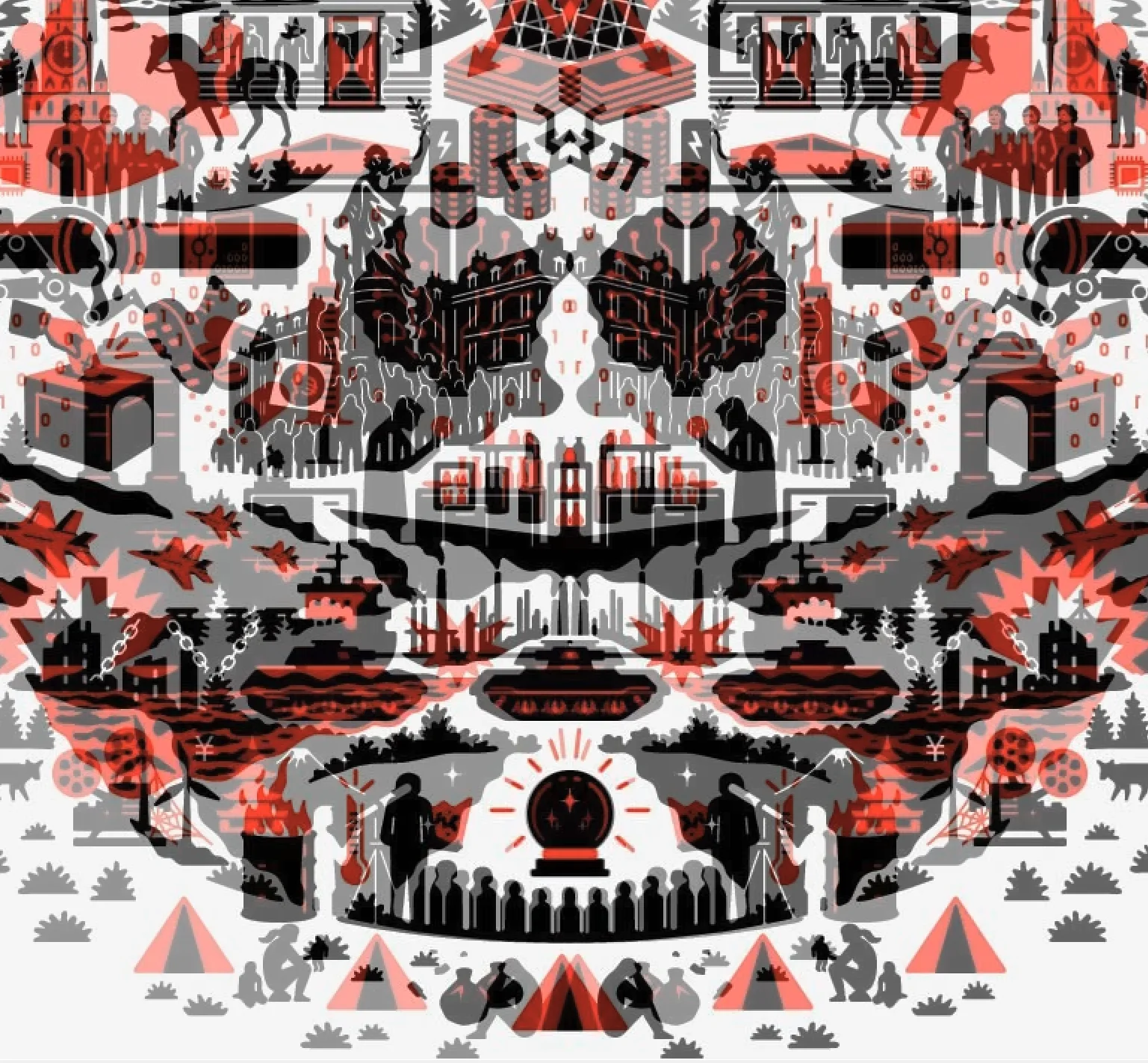
What I can see: The lower section contains a dark round object with light rays and a row of people. Above are tanks, aircraft, explosions, digital machinery, institutions, charts and politicians.
My interpretation: I read the sphere as a forecasting object, an electronic eye or a symbol of the future. The crowd stands in front of it as though attempting to glimpse the consequences of financial, technological and geopolitical change.
Limit of the hypothesis: The sphere is an emergent overlap of artwork, not a confirmed occult sign.
Closer reading of the symbols. The black spherical object is surrounded by rays and people; warplanes, tanks, financial diagrams and circuitry rise above it in successive layers. I see a crystal ball positioned below the world's conflicts as though ordinary people were watching their consequences. A second reading is a technological 'eye' or screen observing them.
2027 evidence and alternative outcomes. This creates an ending to the visual narrative: speculation about the future returns to the spectators who must bear the risks. It is appropriate as an artistic conclusion, not as proof that the orb forecasts an event. The best prediction remains a set of conditional scenarios with measurable triggers.
The Economist 2027 Hidden Meaning and Conspiracy Theories: What Is Actually Proven?
There is no verified secret prediction in these mirror images. My experiment reveals shapes and possible narratives, but it does not demonstrate that the artist planted coded warnings. The perceived Masonic symbol, masked faces, skull, euro sign and robot’s money bag are hypotheses generated by an ambiguous symmetric composition.
The strongest distinction in this investigation is between what the source illustration visibly contains and what my transformed overlays appear to create. Speculation can be interesting without being evidence. Identifying a future market turn requires numerical analysis, not a cover illustration alone.
The Economist 2027 Predictions: My Eight Personal Scenarios
1. A major market top and correction
The mirrored red zigzag and casino chips make me consider a speculative peak followed by a sharp correction in some richly valued assets. No asset or date is specified.
Why I consider it plausible: The ECB reports that AI valuations rest on ambitious profit expectations and that infrastructure investment increasingly relies on debt. What would support it: a broad drawdown accompanied by widening credit spreads, weaker AI earnings guidance and forced fund selling. What would weaken it: durable earnings growth, falling financing costs and diversified market breadth. No timing or index level can be calculated from the cover.
2. Artificial intelligence deepens financial risk
The brain, robot and safe evoke automated trading, algorithmic liquidations, digital theft or greater dependence on AI systems.
Why I consider it plausible: both the ECB and Bank of Japan discuss AI risks across markets and cybersecurity. What would support it: documented AI-enabled breaches, significant losses in AI-linked financing, or official restrictions on high-risk AI services. What would weaken it: improving security and stronger realised productivity and profitability. The safe-door mark remains unidentified.
3. Banks face liquidity pressure
The descending figures suggest nervous investors and a preference for accessible funds. This is not a recommendation to withdraw deposits.
Why I consider it plausible: market corrections and bond repricing can pressure investors, particularly leveraged non-banks. What would support it: sustained deposit outflows, emergency funding operations or broad credit contraction. What would weaken it: strong liquidity and sound capital buffers; the ECB currently reports both for euro-area banks. I do not recommend cash withdrawals on the basis of an illustration.
4. New investment at a possible market bottom
Chips, cash and hourglasses suggest that investors may deploy capital after a decline but have to wait for a recovery.
Why I consider it plausible: markets regularly overshoot in both directions, and liquidity can return after repricing. What would support it: stabilising credit, improving profits and a confirmed trend reversal after a correction. What would weaken it: continuing insolvencies, deteriorating earnings or a false recovery. The hourglass suggests time, but not a guaranteed return.
5. Electric-vehicle investment and stimulus
The car, syringe and bank invite a scenario of subsidies, capital injections or support for a difficult transport transition.
Why I consider it plausible: high fuel prices may encourage electrification even while financing conditions constrain carmakers. What would support it: new purchase incentives, lower battery costs, stronger registrations and investment in charging networks. What would weaken it: subsidy cuts, high borrowing costs or falling EV demand. The syringe may instead represent pharmaceuticals, a documented separate theme of The Economist.
6. Energy prices and shipping become volatile
Chained vessels, Gulf-like desert figures and Kremlin towers suggest logistical constraints, sanctions or geopolitical shocks affecting oil.
Why I consider it plausible: the IEA details tanker attacks, high freight expenses and an expected 2027 rebuilding of oil supply. What would support it: renewed vessel disruptions, insurance premiums and price spikes; alternatively, strong supply growth and stock builds would point toward a price retreat. This is a volatility thesis, not a one-way Brent target.
7. Geopolitical uncertainty affects Eurasia and East Asia
Rockets, Russian symbols, Japanese architecture and refugee-like tents evoke regional risks; none establishes a specific war or political event.
Why I consider it plausible: The Economist identifies Taiwan and the aftermath of the Iran war as 2027 risks; the Bank of Japan studies overlapping energy and interest-rate shocks. What would support it: official alerts, restrictions on shipping, trade interruption and prolonged risk premiums. What would weaken it: diplomatic easing and resilient trade. Nothing in the cover establishes an attack on Japan or a particular event in Russia.
8. A new economic or technological regime begins
The possible NEW pattern becomes my symbol for changing monetary rules, increased automation or the end of an older market cycle.
Why I consider it plausible: AI infrastructure, sovereign borrowing, monetary normalisation and geopolitical realignment are already changing market conditions. What would support it: lasting revisions of financial regulation, investment structure, monetary or technology policy. What would weaken it: gradual adjustment without a structural break. The word NEW is a visual resemblance, not a verified inscription.
How to Test the Mirror Analysis Instead of Cherry-Picking Results
A reproducible test needs the original artwork, layer transparency, horizontal offset, scale, alignment anchor and a dated statement of each hypothesis. The same procedure should be tried on unrelated covers and randomly selected collages to see whether similar masks, brains and symbolic forms arise by chance.
For any proposed price formula involving pi, digit sums or square roots, the rules must be written before selecting historical highs and lows, then evaluated on unseen data. Selecting only successful historical examples would be retrospective pattern fitting.
FAQ: The Economist 2027 Cover Explained
What is The Economist’s World Ahead 2027?
It is The Economist’s annual forward-looking edition about global developments. This article independently analyzes its cover art with horizontal mirror overlays; the resulting interpretations do not represent official editorial predictions.
What are the hidden symbols on The Economist 2027 cover?
In this experiment, mirror overlays produce figures that resemble an AI brain, market peaks, casino chips, hourglasses, bank steps, robots, cubes, a winged figure and a crystal ball. Whether these resemble intentional hidden symbols is unverified.
Does The Economist 2027 cover predict a stock-market crash?
No verified prediction of a crash follows from the image. My personal theory reads a mirrored red graph as a potential market top and correction, without a specified asset, price or date.
Are the mathematical signs a secret market formula?
The signs could resemble π, Σ and √, or visually suggest NEW. Links to W. D. Gann, digit sums, Bitcoin price extremes and square-root cycles remain untested hypotheses rather than proven forecasting methods.
Is this analysis a conspiracy theory?
It is an independent visual interpretation that also examines conspiracy-style readings. I distinguish observed shapes from possible meanings and do not claim evidence of a coded message.
References and Verification Sources
The links below are evidence for the external context, not evidence that Cleon Peterson intentionally concealed the interpretations proposed in this investigation.
- The Economist Group, The World Ahead 2027 launch and ten themes (November 2026).
- European Central Bank, Financial Stability Review summary (18 November 2026).
- International Energy Agency, Oil Market Report (13 November 2026).
- Bank of Japan, Financial System Report (October 2026).
- Museum of Freemasonry, The Square and Compasses.
Conclusion: What I See in The Economist World Ahead 2027 Cover
What I see overall is a market cycle. Casino chips and invested money approach a peak; an AI brain is positioned under it; people seem to flee a banking institution; a robot-like figure appears to depart with capital and then encounter resistance. At the other end, money, chips and hourglasses suggest buying near a possible bottom and waiting. The mathematical signs could, subjectively, spell NEW—the next cycle.
Above this central narrative, I see political leaders, oil-shipping routes, Kremlin-like towers, Japanese symbols, war imagery, medical motifs and striking abstract forms. Together these scenes allow a provocative reading of 2027, but not a verified prophecy. This is my own independent research and personal opinion, not The Economist’s declared message.
Source and context: The Economist — The World Ahead 2027. Method: original author-created horizontal mirror overlays; 34 image files documented in this page.