


 Guide · Updated 9 November 2026
Low Latency Trading: What It Takes to Trade in Milliseconds
Low latency trading means cutting the delay between a price change and your order reaching the market, so that you trade before the information goes stale. It is not a strategy but the software, connections and hosting that let a strategy act in milliseconds. This guide shows where the milliseconds go, how low your latency needs to be and what measured broker data shows.
- Low latency is infrastructure, HFT is a strategy. Exchange HFT races in microseconds; retail broker gaps are measured in milliseconds.
- Measured data beats rules of thumb. In our XAUUSD study, median stale-quote windows at three retail brokers were 34–56 ms.
- The slowest link sets your speed. A fast server does not help if orders run through a slow terminal or the broker adds delay.
- In forex, execution can outweigh speed. Last-look hold times and rejections are set by liquidity providers.
- Measure distributions, not averages. The median and the 99th percentile tell you more than any single ping.
Low Latency Trading Definition: Infrastructure, Not a Strategy
Low latency trading is the practice of minimising the time between a market event and the trader’s response: receiving the price, deciding and getting the order to the venue’s matching engine. The delay is measured in milliseconds, microseconds or, in the fastest exchange systems, nanoseconds. Infrastructure vendors usually call delays under about 10 ms low latency, and round trips below 1 ms ultra-low latency.
Low latency is often confused with high-frequency trading (HFT). HFT is a strategy defined by many short-lived trades; low latency is the infrastructure that makes fast reactions possible, and market making, arbitrage, news trading and large-order execution all use it. Hasbrouck and Saar (2013) draw the same line, measuring “low-latency activity” as strategies that respond to market events within milliseconds.
Why Latency Matters: Stale Quotes, Slippage and Queue Priority
Every millisecond of delay makes your information older and your price less certain. A slow trader decides on stale prices, gets worse fills, stands further back in the queue and loses arbitrage opportunities to faster participants.
- Stale information. By the time a quote reaches you, the market at its source may already have moved. Moallemi and Sağlam (2013) model this as a direct cost of latency; in 2007 one large bank put the cost of each millisecond at about $100 million a year (Wikipedia, citing the press of the time).
- Slippage and rejections. The longer an order travels, the more likely it is filled at a worse price or rejected.
- Queue priority. On order books, earlier orders at the same price are filled first.
- Arbitrage. Gaps between venues, or between a fast price and a broker’s slower quote, last only until someone trades them. This is latency arbitrage.
Low Latency Trading by Market
Low latency matters wherever prices form on electronic order books or market-maker streams. What changes is the scale: exchange markets race in microseconds, while retail forex and CFD brokers create gaps measured in milliseconds.
| Market | Where speed matters | Typical scale |
|---|---|---|
| Equities | Many venues trade the same shares; market makers and arbitrageurs react across all of them | Microseconds, with co-location at each exchange |
| Futures | Central order books whose prices lead related markets | Microseconds; microwave links between trading hubs |
| Spot forex (institutional) | No single exchange: ECNs and bank price streams in a few data centres | Microseconds to low milliseconds |
| Retail forex and CFDs | Broker quotes that lag faster prices; fill quality and slippage | Milliseconds: median stale-quote windows of 34–56 ms in our XAUUSD data |
| Options and bonds | Growing electronic and algorithmic trading | From microseconds on exchanges to slower dealer markets |
| Crypto | Market data over WebSocket, orders over REST, WebSocket or FIX, with rate limits; matching engines often in public cloud regions | Usually milliseconds; hosting in the exchange’s cloud region plays the role of co-location. See crypto latency arbitrage |
Latency Budget: Where the Milliseconds Go
Trading latency is the sum of every step between the price source and your filled order. Network latency is time on the wire, processing latency is time inside software and servers, and execution latency is the time from the order reaching the broker or venue to the fill. The slowest step sets the speed of the whole chain.
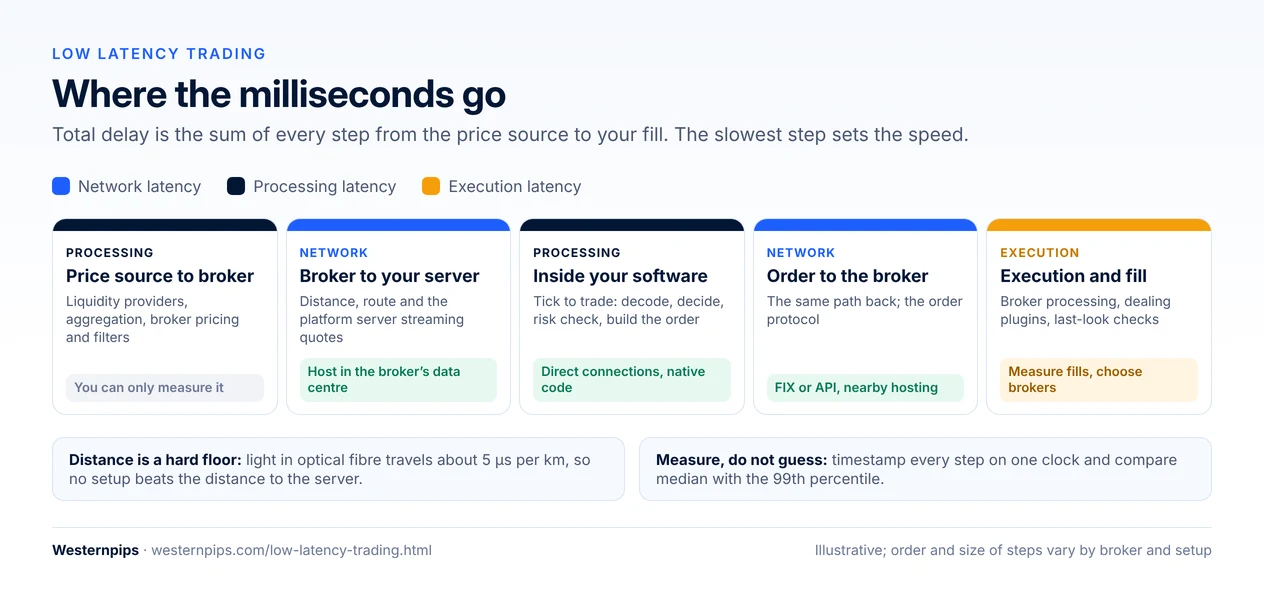
| Step | What adds delay | Typical scale (retail broker setup) | What you can change |
|---|---|---|---|
| Price source to broker | Liquidity providers, aggregation, the broker’s pricing and filters | Not visible directly; it shows up as quote lag. Median stale-quote windows were 34–56 ms in our XAUUSD data | Nothing directly; measure it and choose brokers |
| Broker to your server | Distance, network route, the platform server streaming quotes | Well under 1 ms in the same data centre; about 1 ms of round trip per 100 km of fibre; tens of ms from another city; tens to hundreds of ms over home internet | Host your server in the broker’s data centre |
| Inside your software | Terminals, plugins, scripting layers, logging on the hot path | Microseconds in native code with direct connections; terminal and scripting layers add more and vary in bursts | Use software with direct connections and native code |
| Your order to the broker | The same network path in reverse, the order protocol | The same as the network step above | FIX or API instead of a retail terminal; nearby hosting |
| Execution | Broker processing, dealing plugins, last-look checks by liquidity providers | Set by the broker and its providers, including any last-look hold time; often the largest and least predictable step | Measure fills and rejections; choose brokers by results |
Tail latency matters as much as the average. Around news, markets send thousands of updates in milliseconds and delay grows with the message rate, so a steady setup with a short tail (the slowest 1% of messages) beats a faster average with spikes. By Amdahl’s law, the gain comes from fixing the largest step first.
Distance sets a hard floor. Light in optical fibre travels at about 200,000 km per second, roughly 5 microseconds per kilometre, so a server 100 km from an exchange can never get a round trip below about 1 ms, and London–New York costs close to 28 ms one way over about 5,500 km of cable. That is why trading engines sit in the venue’s own building (co-location), often on equal-length (equidistant) cabling. Between cities, microwave and laser links beat fibre because signals travel faster through air and on straighter routes: A10 cites about 8 ms round trip over microwave against about 13 ms over fibre between CME’s data centre in Aurora, Illinois, and the New Jersey hubs around Secaucus.
Hardware and protocols at the fastest end
- FPGAs and ASICs. Chips that process market data and send orders in hardware. The main gain is determinism: almost the same delay for every message.
- Kernel bypass and SmartNICs. Packets go straight into the application’s memory, skipping the operating system (for example with DPDK). A10 puts a standard network card at 20–50 microseconds and kernel bypass at 1–5.
- Binary protocols and multicast. Simple Binary Encoding (SBE) and exchange ITCH feeds decode faster than text FIX; multicast sends one stream to many receivers.
Exchange data centres, direct feeds and speed bumps
- Where orders are matched. CME Globex runs in Aurora, Illinois; NYSE in Mahwah and Nasdaq in Carteret, New Jersey. Many FX venues and bank price streams sit in Equinix NY4 (Secaucus), LD4 (Slough) and TY3 (Tokyo).
- Direct vs consolidated feeds. In US equities, Regulation NMS links the venues and the securities information processor (SIP) publishes a consolidated best bid and offer. Firms that buy each exchange’s direct feed see changes before the SIP: a built-in stale quote, the same effect this guide measures at retail brokers.
- Speed bumps. IEX delays incoming orders by 350 microseconds through a coil of fibre. In a laboratory market, Khapko and Zoican (2019) found that asymmetric speed bumps cut spending on speed by about 20%, while symmetric ones changed little.
Retail traders rarely need any of this: when the windows you trade are tens of milliseconds, server location and a direct connection matter far more.
Latency Thresholds by Trader Type: Microseconds vs Milliseconds
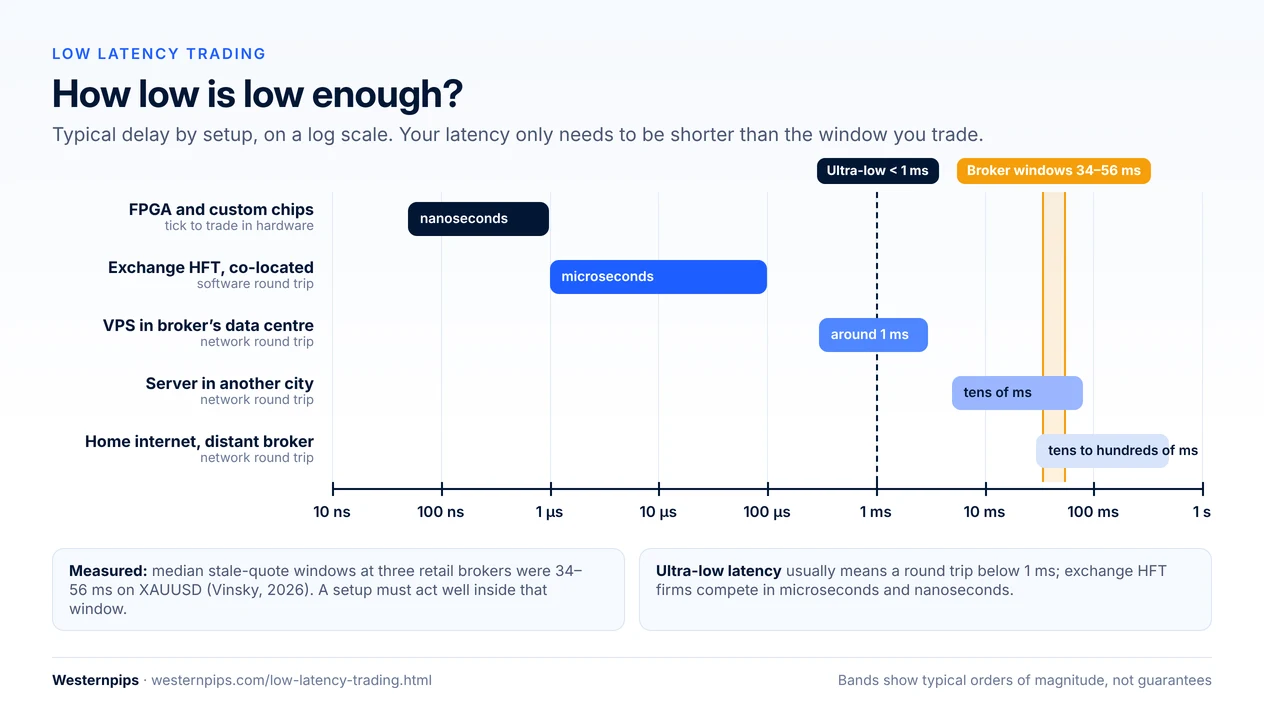
Your latency is low enough when it is shorter than the opportunity you trade. Exchange market makers race in microseconds; a retail trader trading broker quotes needs to beat windows of tens of milliseconds; a swing trader hardly needs low latency at all.
| Who | Typical goal | Usual setup |
|---|---|---|
| Exchange HFT and market makers | Microseconds; below 1 ms round trip | Co-location, direct market access (DMA), FPGA and kernel-bypass network cards |
| Professional retail and broker arbitrage | A few milliseconds to the broker, faster than the stale-quote window | VPS or dedicated server in the broker’s data centre, FIX or API connections, a fast reference feed |
| Automated retail trading (robots, scalping) | Low, stable delay to one broker | VPS near the broker’s trade server |
| Manual and swing trading | A reliable connection | Home or office internet |
Measured Broker Latency: XAUUSD Stale-Quote Data
In our study of XAUUSD at three retail brokers, the median stale-quote window at a 30-point threshold was 50, 34 and 56 ms. Between 22% and 35% of windows closed within 20 ms, and 19–31% lasted longer than 100 ms. The delay at which a simulated order stopped capturing a gross edge ranged from about 40 ms to beyond 150 ms, depending on the broker.
The recordings put a fast reference feed and each broker’s feed on one clock, on one server, and compared bid and ask across the spread (Vinsky, 2026). Three findings matter for a low latency setup:
- Brokers update less often than fast feeds. The fast feed updated 12.4 to 28.1 times per second, the brokers 2.7 to 9.2 times. That ratio alone guarantees stale quotes; how long they last is the real question.
- Brokers differ more than any rule of thumb. The often-quoted “50–200 ms” hides the spread between brokers. A broker with a 46-point median spread showed far fewer usable gaps than brokers with 10–12 points.
- Averages mislead. Every median of 34–56 ms sits beside a 90th percentile of about 200 ms. Judge your setup against the whole distribution.
- More windows is not more edge. Broker B showed over three times as many windows per hour as broker A, but about half the gross result per signal at a 30 ms delay.
| Broker | Windows per hour | Median (P50) | P75 | P90 | Closed < 20 ms | Open > 100 ms | Still open at 30 ms | Delay at which gross edge reaches zero |
|---|---|---|---|---|---|---|---|---|
| A (2.7 updates/s, 10-pt spread) | 260 | 50 ms | 126 ms | 217 ms | 22% | 31% | 67% | Beyond 150 ms |
| B (9.2 updates/s, 12-pt spread) | 824 | 34 ms | 75 ms | 200 ms | 35% | 19% | 54% | About 90 ms |
| C (6.2 updates/s, 46-pt spread) | 240 | 56 ms | 99 ms | 201 ms | 24% | 25% | 66% | About 40 ms |
Stale-quote windows at a 30-point (0.30 USD) cross-side gap, XAUUSD, one session per broker; gross results on displayed quotes. Source: Vinsky (2026), Tables 1, 2 and 4.
All figures are gross: displayed quotes only, before commission, slippage and rejections, from three sessions on three different days. Method, tables and charts are in the full XAUUSD latency study.
Low Latency Trading System Architecture
A low latency trading system has five parts: a market data handler, a strategy engine, pre-trade risk checks, an order gateway, and logging and monitoring. Speed comes from keeping the path from the first to the fourth short and moving everything else off it.
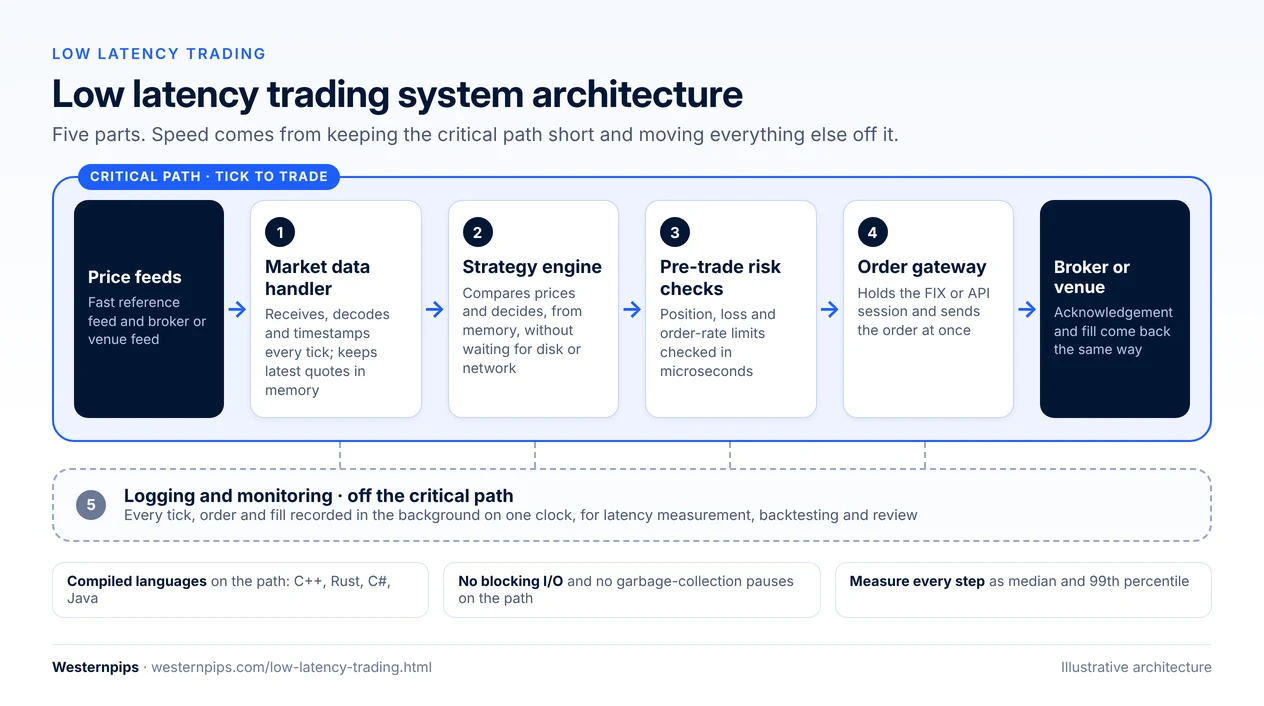
- Market data handler. Decodes feeds, timestamps each tick on arrival and keeps the latest quotes in memory.
- Strategy engine. Decides from memory, without waiting for disk or network calls.
- Pre-trade risk checks. Position, loss, order-rate and size limits run in microseconds, with a kill switch.
- Order gateway. Holds the FIX or API session and sends orders as soon as they are ready.
- Logging and monitoring. Records every tick, order and fill in the background, off the critical path.
Programming languages for low latency trading
| Language | Where it is used | Trade-off |
|---|---|---|
| C++ | The trading path at most exchange HFT firms | Fastest and most predictable, but slow to develop and easy to get wrong |
| Rust | Newer trading engines and infrastructure | Speed close to C++ with memory safety; fewer libraries and developers |
| C# and Java | Trading platforms, order gateways, many retail and broker systems | Fast to build; garbage-collection pauses must be controlled |
| Python | Research, backtesting, data analysis | Too slow and unpredictable for the trading path itself |
Design matters more than language: no blocking input and output on the critical path, lock-free queues between threads, no allocation or garbage-collection pauses inside it. Building such a system takes months; ready-made tools are compared in HFT software for retail traders.
Low Latency Trading Software: What to Look For
Low latency trading software connects to feeds and brokers directly, decides in native code and timestamps every tick and order on one clock. Software that runs as a plugin inside a retail terminal inherits the terminal’s delay, however fast your server is.
- Direct connections. FIX, API, ITCH or TCP connectors, not a chain of terminals and bridges. See FIX API trading.
- Several feeds compared tick by tick. A fast reference price against slower quotes, inside the software.
- Built-in latency measurement. Quote arrival, signal, order, acknowledgement and fill on one clock, shown as distributions.
- Backtesting on recorded ticks. Your own data with real delay, slippage and commission, not historical bars.
- Millisecond risk controls. Spread, drawdown, trade-duration and tick-rate filters, and a stop-all switch.
- Stable under load. Low delay during news, across several brokers and accounts at once; check the worst case, not only the median.
Westernpips Private 7 is built around these points: 10 built-in fast feeds, 37+ FIX, API, ITCH and TCP connectors, 10+ algorithms, tick recording and a Back Tester on recorded ticks, from US$777 for a lifetime licence. It is not a broker: you choose the broker, measure latency and test settings yourself. See Westernpips Private 7.
Low Latency Trading Infrastructure
Low latency trading infrastructure is a server close to the broker or venue, a direct connection, a fast reference feed and software that adds no delay of its own. For retail traders the biggest single gain usually comes from moving the server into the broker’s data centre.
- Server location. Most forex trade servers sit in Equinix LD4 (London), NY4 (New York) or TY3 (Tokyo); a server in the same building cuts the network step to a fraction of a millisecond. See forex VPS for arbitrage.
- VPS or dedicated server. A VPS shares hardware and can add jitter; a dedicated (bare-metal) server avoids it at a higher price.
- Connection and network. FIX or a broker API instead of a retail M4/M5 terminal; inside the data centre, a cross-connect (a direct cable to the broker’s equipment) beats any internet route.
- Reference feed. For arbitrage you need a price faster than the broker’s; see fast quote providers.
- Redundancy and cost. A second line with tested failover; typical monthly figures are in the HFT infrastructure cost guide.
How to Test a Low Latency Broker: Quote Lag, Fills and Last Look
Record the broker’s quotes next to a faster reference feed on the same server, measure how long they stay behind, then send small test orders and measure fill time, slippage and rejections. Advertised execution speed is not enough: what counts is the delay you measure on your own setup.
- Quote lag. How long the broker’s bid and ask stay behind the fast feed, on one clock.
- Order round trip. Order sent to acknowledgement and fill, as median and worst case.
- Fill quality. Slippage in both directions, requotes and rejections.
- Terms. Many brokers restrict very short trades or arbitrage in their client agreements; read them first.
A two-week test is described step by step in how to find a broker for arbitrage.
Last look and hold times in forex execution
Forex has no central exchange, and that changes what speed can buy. Liquidity providers may apply last look: a short window, the hold time, in which they check the order against their current price and fill or reject it. They use it to protect themselves from adverse selection, trading against someone who already knows the new price; Oomen (2017) analyses it as the main defence against stale quotes. The FX Global Code (Principle 17) says last look should be used only as a risk control, and the GFXC’s 2021 guidance asks providers to disclose how it works, including any added hold time and whether price checks are symmetric.
- Speed cannot shorten the hold time. It is set by the provider; a faster order still waits for the check.
- Stale-price orders are what last look rejects. A fast setup can show a high rejection rate rather than better fills.
- Asymmetric checks skew slippage. If moves against the provider are rejected but moves in your favour are filled at the old price, compare positive and negative slippage, not the average.
- Consistent winners get flagged. Brokers measure toxic flow, orders that keep trading on prices they have not yet updated, and answer with wider spreads, longer checks or restrictions; Foucault, Kozhan and Tham (2017) call this trading toxic arbitrage. See broker restrictions on arbitrage.
How to Measure Your Own Trading Latency
Measure each step on the server you trade from, keep all timestamps on one clock, and report the median and the 99th percentile rather than the average.
- Network round trip. Ping or connection time to the broker’s trade server; only the network part.
- Quote delay. When the broker’s quote arrives compared with the same move on a faster feed.
- Tick-to-trade. Time inside your software from the triggering tick to the order leaving the machine.
- Order to fill. Order leaving to acknowledgement and fill.
- Clock sync. If you must use two machines, synchronise them: NTP is accurate to about a millisecond, PTP and GPS-disciplined clocks to microseconds.
A checklist of data checks is in Alexander Vinsky’s seven ways a latency measurement can mislead you.
Low Latency Trading in 2026: What Is Changing
The main low latency trading trends in 2026 are exchanges moving their matching engines into private clouds, machine-learning models running on the critical path in microseconds, faster hollow-core fibre, longer trading hours, and stricter operational-resilience rules. For retail traders the basics do not change: server location, direct connections and measured delay still decide the result.
- Exchanges move into the cloud. CME Group is migrating CME Globex to a private Google Cloud region with ultra-low-latency networking; testing has been open since June 2026 and the first market moves in late 2027. Nasdaq took a different route, placing AWS hardware inside its own data centres and keeping the network to the matching engine under its control. Market makers’ main question is whether cloud matching stays deterministic, processing orders strictly in the order they arrive.
- AI on the critical path. Trading firms now run machine-learning models inside the tick-to-trade loop, not only in research. FPGA-based inference has been benchmarked by STAC at under 2 microseconds at the 99th percentile in 2026, fast enough to put a model between the tick and the order.
- Hollow-core fibre. In hollow-core cable light travels through air instead of glass, cutting delay by roughly 30% compared with standard fibre, which is why it is being laid on the most latency-sensitive routes.
- Longer trading hours. Crypto trades around the clock and equity venues are extending towards 24-hour sessions, so low latency systems must stay fast and stable with fewer maintenance windows.
- Operational resilience. In the EU, the Digital Operational Resilience Act (DORA), in force since January 2025, requires financial firms to manage and test the resilience of their technology, which pushes redundancy and failover up the agenda alongside speed.
- Rust for trading engines. Rust is increasingly considered as an alternative to C++ for new trading systems, for close-to-C++ speed with memory safety.
None of these changes the retail picture described above: broker quote windows are still measured in tens of milliseconds, and the gain still comes from measuring your own delay and removing the largest step first.
Low Latency Trading FAQ
What is low latency trading?
What is considered low latency in trading?
Is low latency trading the same as high-frequency trading?
What software is used for low latency trading?
Do retail traders need low latency?
Does a VPS make my trading low latency?
Is FIX API faster than M4/M5?
Is low latency trading regulated?
Is low latency trading good for markets?
This page is published by Westernpips, which develops and sells latency arbitrage software, including Westernpips Private 7. Leveraged trading can result in the loss of your capital, and brokers can restrict accounts under their client agreements. Worked examples use hypothetical prices. This is general information, not investment advice.
Sources
- Hasbrouck, J. and Saar, G. (2013). Low-latency trading. Journal of Financial Markets, 16(4), 646–679. www.sciencedirect.com/science/article/abs/pii/S1386418113000165
- Moallemi, C. C. and Sağlam, M. (2013). The Cost of Latency in High-Frequency Trading. Operations Research, 61(5), 1070–1086. doi.org/10.1287/opre.2013.1165
- Budish, E., Cramton, P. and Shim, J. (2015). The High-Frequency Trading Arms Race: Frequent Batch Auctions as a Market Design Response. Quarterly Journal of Economics, 130(4), 1547–1621. doi.org/10.1093/qje/qjv027
- Wikipedia (2026). Low latency (capital markets): the speed-of-light limit, co-location and the definition of ultra-low latency. en.wikipedia.org/wiki/Low_latency_(capital_markets)
- Vinsky, A. (2026). How Long Do Stale Quotes Last? Measuring Latency Arbitrage Windows on XAUUSD at Three Retail Brokers. Westernpips research paper (CC BY 4.0). doi.org/10.5281/zenodo.23364414
- Oomen, R. (2017). Last look. Quantitative Finance, 17(7), 1057–1070.
- Foucault, T., Kozhan, R. and Tham, W. W. (2017). Toxic arbitrage. The Review of Financial Studies, 30(4), 1053–1094.
- Global Foreign Exchange Committee (2021). Guidance paper on last look, published alongside the FX Global Code (Principle 17). www.globalfxc.org/docs/gfxc_report_last_look.pdf
- Commission Delegated Regulation (EU) 2017/574 (RTS 25) on the level of accuracy of business clocks under MiFID II: maximum divergence from UTC of 100 microseconds and timestamp granularity of 1 microsecond for high-frequency algorithmic trading techniques. eur-lex.europa.eu/eli/reg_del/2017/574/oj
- A10 Networks (2026). What Is Low-latency Trading? Glossary page with typical latency figures for network cards, kernel bypass and microwave links. www.a10networks.com/glossary/what-low-latency-trading/
- Commission Delegated Regulation (EU) 2017/589 (RTS 6) on organisational requirements for investment firms engaged in algorithmic trading under MiFID II: pre-trade controls, kill functionality, testing and monitoring of trading systems. eur-lex.europa.eu/eli/reg_del/2017/589/oj
- U.S. Securities and Exchange Commission (2010). Rule 15c3-5, Risk Management Controls for Brokers or Dealers with Market Access: pre-trade financial and regulatory risk controls for firms that give market access. www.sec.gov/rules-regulations/2011/06/risk-management-controls-brokers-or-dealers-market-access
- Khapko, M. and Zoican, M. (2019). Do speed bumps curb low-latency trading? Evidence from a laboratory market. Working paper, arXiv:1910.03068. arxiv.org/abs/1910.03068
- CME Group (2026). CME Group announces cloud migration milestones for CME Globex on Google Cloud. Press release, 12 October 2026. www.cmegroup.com/media-room/press-releases/2026/10/12/cme_group_announcescloudmigrationmilestones.html
- Markets Media Europe (2026). Cloud-based exchanges could change the value of a broker dealer: how Nasdaq and CME are moving market infrastructure toward the cloud. www.fi-desk.com/cloud-based-exchanges-could-change-the-value-of-a-broker-dealer/
- myrtle.ai (2026). VOLLO sets new STAC-ML records for gradient-boosted tree inference: sub-2 microsecond p99 latency in audited benchmarks. Press release, 6 October 2026. www.prnewswire.com/apac/news-releases/myrtleais-vollo-sets-new-stac-ml-records-for-gradient-boosted-tree-inference-302898730.html
- Regulation (EU) 2022/2554 on digital operational resilience for the financial sector (DORA), applicable from 17 January 2025. eur-lex.europa.eu/eli/reg/2022/2554/oj
- Westernpips (2026). Westernpips Private 7: HFT Trading Software for Latency Arbitrage. Product page. westernpips.com/wp7.html
- Financial Conduct Authority (2019). FCA confirms permanent restrictions on the sale of CFDs and CFD-like options to retail consumers (rules apply from 1 August 2019): leverage limits of 30:1 to 2:1, 50% margin close-out, negative balance protection and a standardised risk warning. www.fca.org.uk/news/press-releases/fca-confirms-permanent-restrictions-sale-cfds-and-cfd-options-retail-consumers
- European Securities and Markets Authority (2018). ESMA adopts final product intervention measures on CFDs and binary options: leverage limits from 30:1 (major currency pairs) to 2:1, 50% margin close-out, negative balance protection and a standardised risk warning; CFD measures applied from 1 August 2018. www.esma.europa.eu/press-news/esma-news/esma-adopts-final-product-intervention-measures-cfds-and-binary-options

Lead Developer and Chief Technical Specialist at Westernpips. He works on Westernpips Private 7 and its BackTester and measures how long price gaps between fast feeds and broker quotes really last. The latency figures in this guide come from his published XAUUSD study.
Numbers and examples reviewed by Sergey Berezhnov.
Read next
- XAUUSD latency studyHow long broker quotes stay behind a fast feed, measured on three brokers.
- High-frequency trading (HFT)The strategy that low latency makes possible: meaning, algorithms and costs.
- Forex VPS for arbitrageWhere to host your server and how close to the broker it should be.
- FIX API tradingDirect connections to liquidity providers and ECNs.