


 Broker guide · Updated 25 November 2026
A-Book vs B-Book Brokers: What It Means for Your Trades
An A-book broker passes your trades to liquidity providers and earns from spreads and commissions; a B-book broker keeps your trades on its own book and is the other side of them, so it gains when you lose. Most retail brokers run a hybrid model and decide account by account which book to use, which is why consistently profitable short-term traders often see their conditions change.
- A-book: risk goes to liquidity providers; the broker earns on volume.
- B-book: the broker is your counterparty; your profit is its loss.
- Hybrid is the norm: accounts are classified by how they trade, and can be moved.
- For arbitrage traders: B-book brokers restrict stale-quote trading directly; A-book providers can reject or re-price orders through last look.
A-Book and B-Book Defined
A-book and B-book describe where a broker puts the market risk of client trades. In the A-book the broker offsets each trade with a liquidity provider; in the B-book it keeps the trade and the risk on its own balance sheet.
The terms are industry slang, not legal categories. Brokers describe the same models as STP or agency execution (A-book) and market making or dealing desk (B-book). A broker can hold a B-book in one instrument and pass another through, or keep small clients in-house and route large or fast ones to providers.
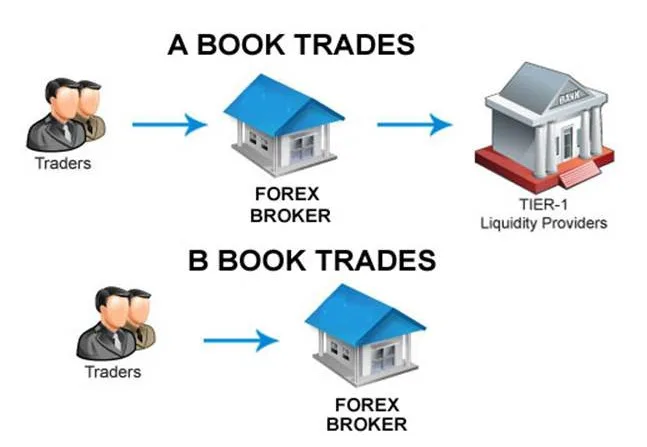
A-Book vs B-Book vs Hybrid: Comparison
The models differ in who takes the risk, how the broker earns and how it reacts to clients who win consistently.
| A-book (STP / agency) | B-book (market maker) | Hybrid | |
|---|---|---|---|
| Who takes the risk | Liquidity providers | The broker | Depends on the account |
| How the broker earns | Commission and spread mark-up | Spread plus client losses | Both |
| Conflict of interest | Lower: the broker wants volume | Higher: the broker gains when the client loses | Varies by account |
| Typical execution | Variable spreads, possible slippage, provider rejections | Often fixed or tight spreads, internal fills | Mixed |
| Reaction to consistent winners | Providers may widen prices or stop quoting | Restrictions, wider spreads, delays or account closure | Moving the account to the A-book, or restrictions |
How Brokers Decide Which Book a Client Goes To
Hybrid brokers classify accounts by how they trade. Small accounts that trade infrequently and lose on average tend to stay in the B-book; accounts that win consistently, trade large size or profit from very short holding times are routed to providers or restricted.
- Profitability over time, often measured by markouts: where the price goes in the seconds after each fill.
- Holding time: trades closed within seconds after a quote move are typical of stale-quote trading.
- Trade size and frequency.
- Links between accounts, such as the same IP address, device or opposite trades on two accounts.
Flow that consistently profits at the broker’s or provider’s expense is called “toxic flow”. We describe the detection methods in more detail in how brokers detect latency arbitrage.
Last Look and Liquidity Providers
Last look is a short window in which a liquidity provider can accept or reject an order at the quoted price. It is how A-book providers protect themselves from stale-quote trading, and the FX Global Code sets out how it should be used and disclosed.
Principle 17 of the FX Global Code says last look should be used as a risk control to check the validity and price of a trade, not to profit from the information in the client’s order, and that its use should be disclosed. For a trader, last look shows up as rejections or re-quotes that cluster around fast price moves.
What A-Book and B-Book Mean for Arbitrage Traders
A B-book broker loses directly when a client trades its stale quote, so it usually restricts latency arbitrage in its terms. An A-book broker passes the cost to its providers, which respond with last look, wider prices or by cutting off the broker. Either way, arbitrage depends on the broker’s rules, not only on speed.
- Read the client agreement for rules on holding times, “abusive” strategies and price errors before you deposit.
- Ask the broker directly whether fast or short-term strategies are allowed on your account type.
- Test at the minimum lot and record rejections and slippage, as described in our broker test.
- Strategies that hold positions for a set time, such as two-leg lock arbitrage, exist for brokers with holding-time rules; they still have to follow the broker’s terms.
How to Tell Whether a Broker Is A-Book or B-Book
No broker label tells you for sure, but its documents and behaviour do: the order execution policy, the conflicts-of-interest policy, how it describes its role as counterparty, and how its prices and fills behave around fast markets.
| Where to look | What to look for |
|---|---|
| Order execution policy | Whether the broker acts as principal (counterparty) or agent, and which venues it uses |
| Conflicts of interest policy | Statements that the broker may profit from client losses |
| Risk warning | EU and UK CFD providers must show the share of retail accounts that lose money (ESMA, 2018; FCA, 2019) |
| Spreads and commission | Raw spreads plus commission suggest pass-through; fixed spreads with no commission are common in market making |
| Fills around news | Rejections and re-quotes in fast markets point to last look at the provider or the broker |
For a full checklist, see how to find a broker for arbitrage.
Glossary
- A-book
- A broker model in which client trades are offset with liquidity providers, so the broker does not hold the market risk.
- B-book
- A broker model in which the broker keeps client trades on its own book and is the counterparty.
- Hybrid broker
- A broker that routes some accounts or trades to the A-book and keeps others in the B-book.
- Toxic flow
- Order flow that consistently profits at the expense of the party quoting the price, for example trades on stale quotes.
- Last look
- A short window in which a liquidity provider can accept or reject an order at the quoted price.
A-Book vs B-Book FAQ
What is the difference between an A-book and a B-book broker?
Is a B-book broker a scam?
Can a broker move my account from the B-book to the A-book?
What is toxic flow in forex?
Which broker model is better for latency arbitrage?
This page is published by Westernpips, which develops and sells latency arbitrage software, including Westernpips Private 7. Leveraged trading can result in the loss of your capital, and brokers can restrict accounts under their client agreements. Worked examples use hypothetical prices. This is general information, not investment advice.
Sources
- Global Foreign Exchange Committee. FX Global Code, including Principle 17 on last look. www.globalfxc.org/fx_global_code.htm
- European Securities and Markets Authority (2018). ESMA adopts final product intervention measures on CFDs and binary options: leverage limits from 30:1 (major currency pairs) to 2:1, margin close-out and negative balance protection for retail clients. www.esma.europa.eu/press-news/esma-news/esma-adopts-final-product-intervention-measures-cfds-and-binary-options
- Financial Conduct Authority (2019). FCA confirms permanent restrictions on the sale of CFDs and CFD-like options to retail consumers, including leverage limits and a standardised risk warning with the share of retail accounts that lose money. www.fca.org.uk/news/press-releases/fca-confirms-permanent-restrictions-sale-cfds-and-cfd-options-retail-consumers
- Westernpips (2026). How Brokers Detect Latency Arbitrage: Rules and Limits. westernpips.com/broker-arbitrage-restrictions.html

Trader and developer of software for latency arbitrage and HFT trading with more than 19 years of experience. He founded Westernpips in 2007 and leads the development of Westernpips Private 7, its FIX and API connectors and the tools used to record and analyse quotes and fills.
Read next
- How brokers detect latency arbitrage
Markouts, holding times, linked accounts and the usual broker rules.
- How to find a broker for arbitrage
ECN vs STP vs market maker and a two-week broker test.
- Latency arbitrage explained
How stale broker quotes are traded and how to test a broker.
- Statistical arbitrage
Pairs trading in forex and CFDs, and what breaks it.